Skytrak Space Requirements – A Must Read guide!
Posted in Launch Monitors, Room Setup
Every SkyTrak generation — original, SkyTrak+, and ST MAX — publishes the same space requirement: a 10ft × 10ft minimum of unobstructed room. In practice, plan around 12 feet of depth (15+ for comfort), 10 feet of width, and 9–10 feet of ceiling, and you’re set. That consistency is the quiet headline of this guide: SkyTrak’s space math never changed across three generations — the market around it did. And because the camera sits beside your ball instead of behind you, a SkyTrak fits rooms that radar units physically can’t.
This post may contain affiliate links, which means I may earn a small commission at no extra cost to you. This really helps out me and my site so thank you in advance! Thanks, Alex @ MyGolfSimulator
In this guide: How SkyTrak saves space · Depth · Width · Lefties & righties · Ceiling · Placement precision · The generations · The ideal room · FAQ
Quick Verdict
| Dimension | Manual minimum | Realistic minimum | Comfortable |
|---|---|---|---|
| Depth | 10ft unobstructed | 12ft | 15ft+ |
| Width | 10ft unobstructed | 10ft | 12–15ft (centered aim) |
| Ceiling | No fixed figure — “varies by golfer height and club length” | 9ft (8.5ft only for shorter, flatter swings) | 9.5–10ft |
| Unit placement | Beside the ball, level with the hitting surface, 11.5–12.5in away (OG-documented; presumed to carry over to +/MAX) | — | — |
👉 Bottom line: if a radar unit doesn’t fit your room, a SkyTrak probably still does — the constraint that actually bites is ceiling height, not floor space. (Ceiling section · placement · ideal room.)
How SkyTrak works — and why that saves you space
The whole space advantage in one line: SkyTrak reads impact, not flight — so your room only needs to fit your swing.
SkyTrak is a photometric unit: high-speed cameras photograph the ball through impact and the first stretch of flight from a position beside the tee. It never needs to watch the whole flight — which is exactly what radar units need, and why they demand so much more room.
A fresh July thread put the practical consequence perfectly, comparing a SkyTrak against a Garmin R10 for an 18ft garage: “you don’t need any more ball flight than you need for it to be comfortable to fully swing your club.” The same thread’s buying advice: “if you’re pinched for space then you need to go with the skytrak.” Owners hitting from just 6–9 feet of ball flight with camera units consistently report it working well — fourteen separate owners on record, several of whom find the shorter throw more immersive, not less. SkyTrak+ owners specifically praise the design for tight garages, sheds, and multi-use rooms.
The companion piece, covering what the radar math looks like when it doesn’t fit: Garmin R10 Space Requirements – Length, Width and Height.
Room length and depth
The manuals say 10ft × 10ft unobstructed, all three generations. Here’s what actually fills the depth:
- Ball to screen: 6–9ft — the camera-unit comfort band owners really use
- Behind the screen: ~1.5ft. A veteran European installer’s rule this summer — leave that much “to be a 100% safe” so the screen can deform and the wall survives; dozens of builders posting their dimensions in his thread corroborated the guidance
- Your stance and a step back — a few feet more
- Optional seating: 6.5ft behind the ball for anyone watching, per the same installer
Stack it honestly and 10ft is the manual’s floor, not a pleasant room. Updated for what the community actually builds: 12ft of depth is the workable minimum; 15ft and up is where the setup breathes. A fresh data point frames the ceiling of ambition nicely: one builder called his 15×15ft, 9’6″ room “tight” but fine, and reckoned 12×12 was the absolute floor “regardless of equipment.”
Room width and centered aim
Ten feet of width satisfies the manual. What width really buys you is aim: a centered hitting position with the screen dead ahead, rather than an offset stance aiming across the room. Offset setups work — sim software lets you shift the target line — but every degree of offset costs a little immersion, and it drags your projector mounting sideways with it.
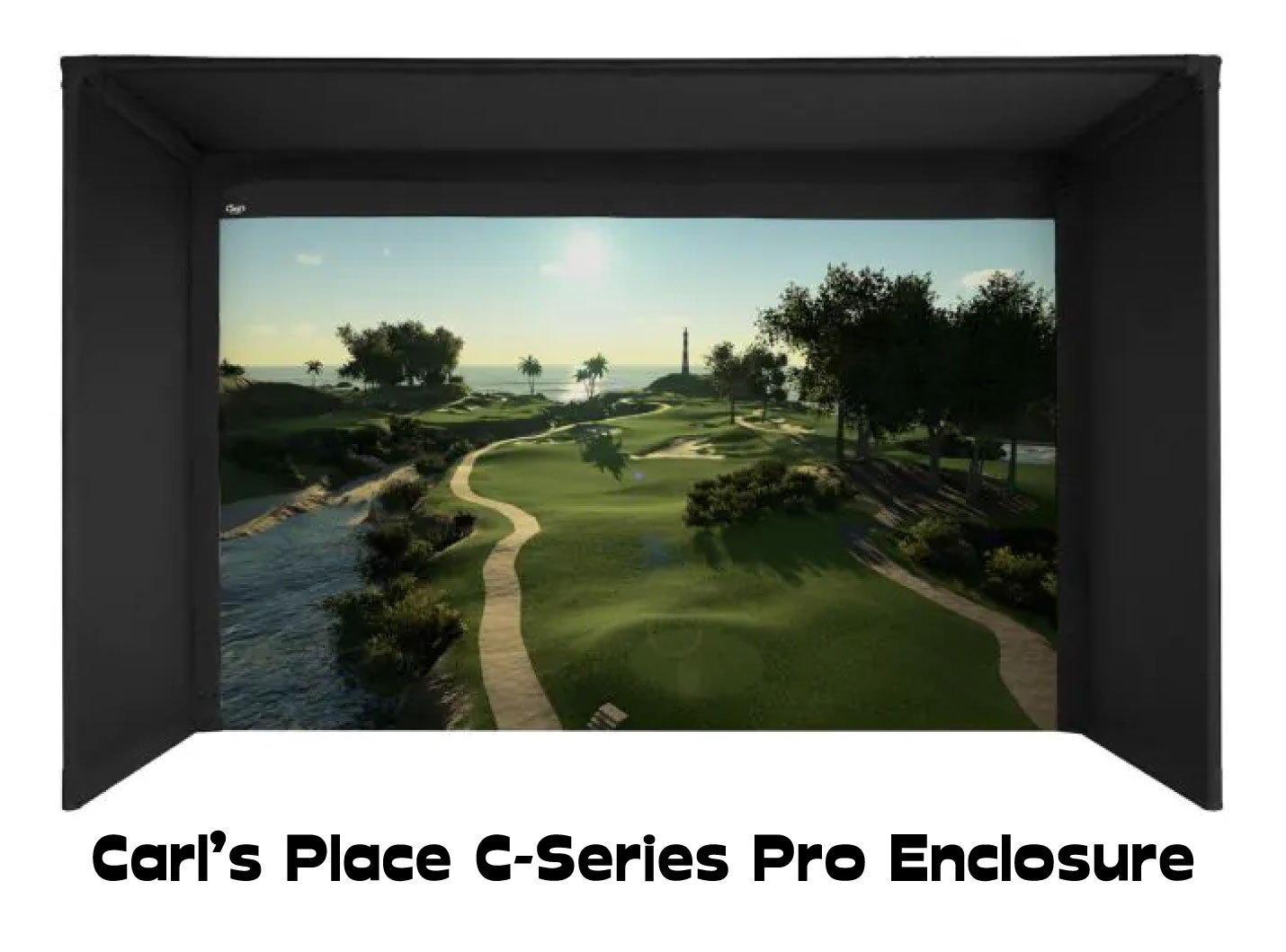
If you’re building an enclosure, there’s flexibility in the build itself. If you’re making it from metal conduit piping as I did then you have a bit more flexibility.
For reference, SkyTrak’s own studio packages come in four frame sizes — package frame sizes, note, not room minimums:
| Package | Width | Height | Depth |
|---|---|---|---|
| 8ft option | 8ft | 7’5″ | 4ft |
| 10ft option | 10ft | 8’6″ | 5’4″ |
| 12ft option | 12ft | 8’6″ | 5’4″ |
| 13ft-deep option | 13ft | 10ft | 10ft |
Left- and right-handed players: the repositioning tax
Here’s the trade that comes with a beside-the-ball camera: it sits on one side. The manual itself instructs a physical move — in multiplayer modes, you carry the unit to the opposite side of the mat for a left-handed player and keep it parallel to the target line. There’s no software re-aim for handedness on a floor camera.
Owners in mixed households describe this honestly from both directions. The friction is real — reported across all three generations, with original-unit owners putting it most bluntly: the pick-up, reposition, re-level routine “kills the flow” of alternating play. And the workaround is real too: “I set mine up per session and I move skytrak back and forth for my son and I… I have tape lines on the floor to set it up quickly,” one owner explained this July. One household’s trick, but a good one: tape lines turn a two-minute realignment into twenty seconds.
There is no software re-aim for handedness on a floor camera — the move is physical, every time. If your household splits handedness and that tax sounds miserable, the no-moving-parts alternatives are overhead-mounted units (or a fixed low-profile unit like Nova) — a different budget class of hardware entirely.
Ceiling height
The manuals’ answer is refreshingly honest: there is no fixed figure. All three generations state that ceiling height “varies by golfer height and club length” (the original’s manual says “physical height”). SkyTrak the company won’t give you a number because the number is you.
The community will, though — and it’s remarkably consistent:
| Ceiling | Owner consensus |
|---|---|
| 9–10ft | The safe minimum for a comfortable driver swing (14 reports, 11 owners) |
| 9–9.5ft | Enough for most golfers, including many over 6ft |
| Below ~9.5ft | Possible for shorter or flatter swings — but a dozen owners report scraping or denting ceilings at heights from 8’4″ up to 9’5″, almost always on the follow-through |
One more caveat while you’re here: SkyTrak’s smallest studio package lists a 7’5″ frame height — that’s an enclosure dimension, not a promise you can swing under it.
💡 Want to know your number instead of the internet’s? Measure your actual swing. I went to a bay next to the driving range wall with slats on the wall. I saw which slat related to my club by looking at the photo. Then I used a tape measure to see how high this was. You can do the same with width if you address the ball on the mat then use any floor markings to see how wide you go.
The full ceiling treatment — per-monitor requirements, low-ceiling workarounds, the structural fixes and their costs — lives in the dedicated guide: What’s the Minimum Golf Simulator Ceiling Height?.
Placement precision: small zone, big accuracy stakes
A SkyTrak asks for less room than a radar unit but more precision within it:
- Distance: the original’s manual specifies 11.5–12.5 inches from the unit’s laser to the ball. The same beside-ball geometry carries across SkyTrak+ and ST MAX, though the newer manuals don’t restate the inch figure — treat it as the family’s working number.
- Ball position: base of the tee on the red dot, or up to 3 inches behind it — a hitting zone of roughly 2 × 2 inches in practice.
- Level with the hitting surface: the unit sits raised to mat height, not on the slab beside a raised mat.
Owners describe the placement reputation both ways — plenty find it fussy, and a counter-camp insists the zone is “larger and less restrictive than reputation suggests.” Both camps agree on the fix: mark your positions once, then stop thinking about it.
One legacy note: the original SkyTrak famously needed the SkyPro accessory era for club-path data. That era is over — club data went native from SkyTrak+ onward, which is a big part of the generations story: Skytrak Plus Vs Skytrak – 7 Key Upgrades.
Three generations, one space story
The surprising part: across original → SkyTrak+ → ST MAX, the published space requirements are identical. Same 10×10 minimum, same no-fixed-ceiling honesty, same beside-the-ball placement — SkyTrak+ added radar hardware for club data and still kept the camera’s floor plan. Upgrading generations never bought you a smaller room; it bought you better data from the same one.
What did change:
- Connectivity: the ST MAX’s USB data cable is Windows-only — Mac, iOS and Android connect over Wi-Fi instead (iPad vs PC for Skytrak – Choose your Skytrak device covers the whole platform question)
- Lifecycle: the original is gone from SkyTrak’s store, the SkyTrak+ is discontinued at clearance pricing (about $1,995 on the manufacturer’s site as of late August, with retailer deals dipping lower — one August roundup listed the ST+ standalone at $1,195), and the ST MAX is the current flagship at $2,995 MSRP / $1,995 sale, both dated late-August checks
The ideal SkyTrak room — and what else fits in it
I believe the perfect golf simulator doubles up as a swing studio. Give yourself around 15ft of depth, 12–15ft of width, and 9.5–10ft of ceiling, and the room stops being a compromise: full swings with every club, a centered aim, space for a camera tripod and a screen you can actually watch from a chair.
My perfect golf simulator would also double up as a home theater for watching movies. It would be warm enough (not a drafty garage) and have some comfortable chairs that I could move into position when not using the simulator itself. That’s not indulgence — it’s the difference between a room you use twice a week and one you use twice a winter.
The buyer’s checklist, updated:
- Depth ≥ 12ft (15ft+ ideal), including screen clearance
- Width ≥ 10ft (12ft+ for centered aim, or two-mat lefty/righty setups)
- Ceiling that passes your test swing — not just the tape measure
- Room left over for the humans: 6.5ft behind the ball for seating
Not enough space? Cheaper and smaller routes
If the room genuinely won’t stretch:
- Net-only practice bay: SkyTrak into a net needs the least room of all — no projector geometry, no screen clearance beyond the net itself.
- Short-game corner: chipping and putting setups fit where full swings can’t.
- Take the launch monitor to the range. I use the Garmin Approach G80 at the driving range, but it could easily be used in a hitting bay at home. (The G80 is an older unit now — check current availability before shopping that specific model.)
- The garage compromise: door open, net outside, unit inside — the classic depth cheat: Garage Golf Simulator – 13 Key Challenges + Tips & Tricks.
For the full room-planning picture across every launch monitor type: How much space do you need for a Golf Simulator?.
How this changed (2020 → 2026)
- One generation became three — and the space spec never moved: 10×10 across all of them.
- The WGT/TGC software era ended; target-line offsets now live in golf-simulation software settings — GSPro and E6 Connect, the two packages that put actual courses on your screen. E6 Connect is officially supported on SkyTrak+ and ST MAX; GSPro connects only through an unofficial community bridge — different animals, worth knowing before you plan a room around either.
- The SkyPro accessory era ended; club data went native on SkyTrak+ and ST MAX.
- The original left the store, the ST+ was discontinued, the ST MAX took the flag.
- The community settled its numbers — 9–10ft ceilings and 6–9ft ball flight as the happy band — and one owner’s tape-line trick for fast lefty/righty switching deserves to spread.
SkyTrak space FAQ
Ceiling, lefty/righty, and screen-distance answers below come from owner threads; minimum-room, generation-parity, and laser-distance answers are pulled straight from the manuals.
What’s the absolute minimum room for a SkyTrak?
The manuals say 10ft × 10ft unobstructed. Treat that as the legal minimum; 12ft of depth is the livable one.
Does the ST MAX need more room than the original?
No — all three generations publish identical space requirements. Buy the generation for its data, not its footprint.
How high should my ceiling be?
SkyTrak deliberately gives no figure. The community’s safe zone is 9–10ft; test-swing your longest club in the actual space before spending anything.
Can lefties and righties share one SkyTrak?
Yes, with a physical move of the unit each switch. Floor tape lines make it quick.
How far from the ball does the unit sit?
11.5–12.5 inches, laser to ball, level with the hitting surface (documented in the original’s manual; the same beside-ball geometry carries across the newer units).
How close can my screen be?
Owners are happy from about 6ft of ball flight; leave roughly 1.5ft behind the screen for deformation.
Final Thoughts
SkyTrak has stayed the small-room default for a decade because the architecture earns it: cameras beside the ball ask so much less of a room than radar behind it. Clear 12 honest feet of depth, mind the ceiling, mark your placement lines once — and the smallest spare room in the house becomes a golf simulator.
Check the SkyTrak ST MAX here: ST MAX — Take a Look!
Building the bay: enclosures and screens · hitting mats

Mevo Gen 2 Space Requirements

Gray Impact Screens – Pros and Cons
ABOUT THE AUTHOR
Hello! My name is Alex and it is my mission to bring you all the information you need to build your own home golf simulator! I hope mygolfsimulator.com helps you on your journey to better golf at home!
LEGAL INFORMATION
On this site, you'll find articles on all aspects of building a golf simulator. I will also link to other sites where you can buy some of the simulator components. Some of these links may be affiliate links, which means if you click them I gain a small commission at no extra cost to you. This really helps out me and my site so thank you in advance! mygolfsimulator.com and all related social media accounts are property of Awonline LTD.