How to use Skytrak Outside (see our 11 Point Checklist)
Posted in Launch Monitors
Yes — SkyTrak works outdoors, and it can turn a garden net or a range bay into a proper practice session. But it works under three rules the manual hints at and owners have proven the hard way: keep direct sun off the lenses, hit off a mat rather than grass, and sort your power and connection before you leave the house. This guide covers all three, plus the range-day system that fills its second half — updated for the 2026 family, where the original SkyTrak is a used-market staple (and sold new again by SkyTrak), the SkyTrak+ is discontinued and sold only pre-owned, and the ST MAX carries the flag.
I will also link to other sites where you can buy some of the simulator components. Some of these links may be affiliate links, which means if you click them I gain a small commission at no extra cost to you . This really helps out me and my site so thank you in advance! Alex @ MyGolfSimulator
In a Nutshell
Yes, SkyTrak works outdoors if you keep direct sun off the lens, hit off a mat rather than grass, and sort power and connection before you leave the house. It has no weatherproof rating, so the unit comes inside after every session.
👉 SkyTrak outdoors is a shade game: the tracking survives outside, but direct sunlight into the optics causes misreads and no-reads, so hit from cover, off a mat, with the lens shaded. It is not weatherproof — the structure can live outside, the electronics never should.
| Rule | Why |
|---|---|
| Shade the unit | Direct sun into the lens breaks shot capture — the manual and owners agree |
| Hit off a mat | Grass and flying divot debris confuse the cameras |
| Plan power + connection | Up to 5 hours of unit battery; your iPad usually taps out first |
| Bring it in afterward | No weatherproof rating exists; rain, dew, and overnight damp are your problem |
Jargon, once: photometric = camera-based shot capture at impact (the whole SkyTrak family, with radar added on the Plus and MAX). Direct Mode = connecting your device straight to the unit’s own Wi-Fi network, no internet involved. Hotspot = sharing your phone’s mobile data as a Wi-Fi network.
How this has changed
- The family moved on: the original SkyTrak is gone from the lineup page but SkyTrak sells it new again ($695 on sale, list $1,995; used $400–1,000), the SkyTrak+ is discontinued and sold only certified pre-owned ($895), and the ST MAX ($2,995 list, $1,695 on sale) is the current unit — prices checked 21 October 2026.
- Direct Mode grew passwords. Older guidance said you wouldn’t need one — see the connection section for the current per-model details.
- The ST MAX changed the ports: dual USB-C, and its USB cable connection is Windows-only.
- The community’s outdoor protocol matured: gazebos and gales taught owners that enclosures stay out, launch monitors come in — and that in full sun, your display usually fails before the tracking does.
Can SkyTrak actually handle the outdoors?
The short answer: yes for sessions, no for weather. The manual’s own guidance is the foundation: avoid direct sunlight into the optics lens during use and hit from a covered area if one is available, because sun into the lens causes inconsistent shot capture. It also tells you to avoid extremes of temperature, keep the unit away from water, and not to drop it — and no SkyTrak carries a published weatherproof rating of any kind. Treat it like the camera equipment it is.
(The wider misread-and-accuracy story — indoors and out — lives at How Accurate is Skytrak? – 8 Easy Ways to Maximise Skytrak Accuracy.) Owner experience matches the manual with unusual precision. A six-year original-SkyTrak owner who still uses his unit several times a week gave outdoor hopefuls exactly two caveats this spring: shade — “it doesn’t like direct sunlight. You’ll probably want to put up some sort of shade or something” — and surface: “if you’re hitting off grass. Grass and dirt flying around after impact will also cause issues with it reading your shot.” The shade point is corroborated across several threads this summer; the grass point is his account, squarely backed by the manual’s mat recommendation. Camera-unit sun-sensitivity has become the community’s standing caution — in an August outdoor-gear thread, the old SkyTrak was the cautionary example cited by name.

One more outdoor reality owners keep re-learning: in full sun, screens fail before sensors. In a detailed patio test this June, tracking survived noon light but the displays didn’t — “the app is almost unreadable in full noon sunlight,” as a second tester put it the same week. Plan your iPad’s shade and brightness like you plan the unit’s.

The weather protocol, in one line: the structure can stay outside; the electronics never do. One UK owner has run a SkyTrak outdoors for a year under a storm-strapped gazebo; another SkyTrak owner in the same thread puts the rule plainly: “I bring my SkyTrak and tablet indoors between sessions and I deal with the rain by not practicing if it’s raining.” A Canadian owner running a different launch monitor overwinters their metal enclosure outside and follows the same rule for the electronics. Same protocol across the board.
Outdoor home setups that work
The proven pattern is cover over the hitting area plus containment for the ball. The year-round UK setup above is a 3m-tall gazebo — height enough for a full driver swing — held down with concrete anchors and storm straps. Wind deserves respect beyond the anchors: a June gust blew one tester’s net down, landing inches from their launch monitor — a different brand of unit, but the same wind risk applies to any outdoor rig. Side netting is also less trustworthy outdoors than it looks; owners report nets sagging and letting balls through, with neighboring property on the receiving end.


On the ground: a hitting mat is the manual’s recommendation indoors and out, and outdoors it does double duty — consistent capture and no divot debris. Space needs are the same as indoors, minus the ceiling anxiety; the full geometry lives at Skytrak Plus Space Requirements – Length, Width, Height + More.
Cold, heat, and your gear. The way I get round this is to do short, sharp, targeted practice sessions. I’ll have a warm up, work on one or maybe two drills, then come back inside. As I’ve said many times on this site though, any home golf simulator is better than no home golf simulator! Two facts to know: cold air genuinely shortens the carry your monitor reports — owners see smaller numbers in a cold bay with the same swing — and cold storage alone doesn’t kill electronics; the real risk is condensation when cold gear warms up fast. Let the unit acclimatize before a session, and mind the manual’s extreme-temperature caution. Heating a winter space properly is its own topic: Garage Golf Simulator – 13 Key Challenges + Tips & Tricks and Golf Simulator Sheds – Size, Cost, Options & Ideas carry it.
Taking SkyTrak to the driving range
A SkyTrak in a range bay is a legitimate, data-rich session — if you arrive charged and prepared. Some golfers feel self-conscious setting up a launch monitor at the range; the curiosity you attract is friendlier than you fear, and the data is worth far more than the glances. These are premium machines ($695 to $1,695 new across the family on 21 October 2026), so the protection section below matters doubly in public.
Charge discipline:

- The unit runs up to 5 hours on a full charge (give a new unit its full initial charge before first use — the manual specifies a minimum 6 hours).
- Your device is usually the limiter: expect roughly 1–2 hours of iPad battery during range play; course-play graphics may not render on lower-spec devices, but range and practice modes work fine regardless.
- 💡 The USB splitter trick: connected to a laptop, the unit can charge continuously while in use — the all-day option.
I have a dedicated charging station on top of a tool bench in my golf simulator room. This is also where I store my Skytrak if it is ever not in use.
Range balls. Driving range balls are usually of inferior quality to premium balls and, in general, don’t give accurate ball flight data — speed and spin read low compared to the ball you play on the course. Make sure the balls you hit are clean and ideally dry, and cull the truly dead ones (every basket has a few) for warm-up swings. Three modern additions from the owner record: patterned or logo-marked balls read noticeably better for spin, the ball’s marking should face the lens (the manual’s own tip), and the misread-cutting tricks from home carry outdoors — avoid white shafts and white tees, and keep the background behind the ball dark where you can.
And the practice structure that makes the trip worthwhile: the notebook that lives in my Skytrak case is full of challenges I’ve set myself and lots of sets of results. Set a challenge before you leave the house, log the result when you get back, and the range session joins the same improvement loop as your home bay.
Alignment outdoors
Getting alignment right away from your calibrated home bay is the difference between data and noise. The procedure:
- Place the unit on a platform completely level with the surface the ball sits on — ideally not on the mat itself, since club impact sends small vibrations through the mat that can affect readings. This would be quite a satisfying little DIY project I think, I plan to make my own soon.
- Keep the laser aperture at the family’s specified distance — 11.5 to 12.5 inches from the ball position.
- Ball on the red dot, or up to 3 inches behind it — never in front.
- Set your target line with alignment sticks or clubs laid parallel, exactly as the manual suggests, and mark it.

I use both a long-distance target and a target closer to me. I recommend buying a little laser that is capable of creating a line on the ground (rather than just a dot). If your alignment is off, the shots you hit in real life will diverge from what the screen shows you — and the data goes with it. A video demonstration of the full alignment routine, from the Professional Golf Instruction YouTube channel:
Protecting your SkyTrak
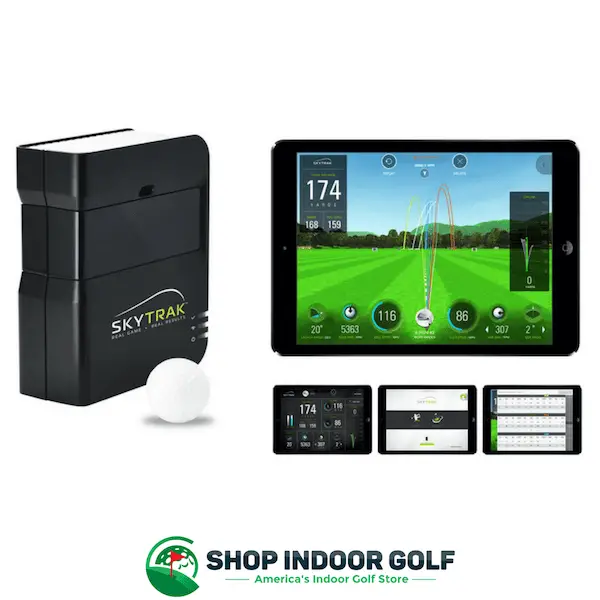
Protection is where outdoor use earns its checklist. In my opinion, the Skytrak metal case is absolutely essential when using Skytrak outside. To be honest I think its essential inside too. SkyTrak protective case at Shop Indoor Golf

I recommend purchasing a dedicated protective briefcase for transporting your Skytrak. Beyond the unit itself, the non-obvious things inside mine:

- Spare charging wire and plug, plus a portable power bank
- A notebook with Bag Mapping results and my practice challenges
This case will only ever be found at the driving range, in my home golf simulator or in my car. I make a point of not leaving it anywhere else. This gives me piece of mind that I wont misplace or lose any Skytrak gear.
Gadget insurance is the final layer — a policy that covers accidental damage away from home. I really recommend this step. One 2026 note that sharpens all of this: the family’s standard warranty runs 6 months or 25,000 shots, so most units in the wild are out of warranty — and the community’s warranty-service experiences make self-protection the better bet anyway (Skytrak Pros and Cons – 17 Key Points carries that story).
Staying connected away from home Wi-Fi
Direct Mode is your range-day friend. The unit broadcasts its own Wi-Fi network — join it from your device and you’re tracking shots with no internet at all. Current manuals print per-model defaults: the SkyTrak+ network appears as STPLUS_XXXXXX with password “skytrakplus”, the ST MAX as STMAX_XXXX with password “skytrakmax”. (Older SkyTrak guidance said no password was needed — that changed with this generation.)
The trade-off: in Direct Mode your device has no internet connection alongside the unit, so real-time syncing and online course play are out until you reconnect. For course play away from home, a phone hotspot fills the gap — share your phone’s data connection, join both devices to it, and you’re networked. A practical pattern from owners without reliable outdoor Wi-Fi: simulator software runs happily offline once courses and updates are downloaded, needing only an occasional online check-in — so the hotspot is for downloads and log-ins, not every shot.

If the connection misbehaves — and mid-session Wi-Fi drops are the family’s most persistent complaint — work the fix ladder:
- A dedicated hotspot or Wi-Fi network name (SSID — the network’s broadcast name) just for the unit
- Direct Mode over network mode
- The USB cable — Windows-only on the Plus and MAX
The deep troubleshooting lives at Skytrak Connection Problems – The Ultimate Guide, and the hotspot specifics at Skytrak Personal Hotspot – How to Use Skytrak Online Features Outside.


Which SkyTrak are you taking outside?
| Model | Status | Money (21 October 2026) | Outdoor notes |
|---|---|---|---|
| Original SkyTrak | Off the lineup page, but sold new again by SkyTrak | $695 new on sale (list $1,995); $495 certified pre-owned; used $400–1,000 | The most-documented outdoor unit — years of range and gazebo use on record |
| SkyTrak+ | Discontinued 2026 — no longer sold new | Sold out new (last $1,995 from $2,995); certified pre-owned $895 from SkyTrak; refurb listings roughly $1,300–2,000 | Same placement and battery; no owner posted an outdoor ST+ session this summer |
| SkyTrak ST MAX (see the last FAQ below before buying specifically for outdoor use) | Current | $2,995 list; $1,695 on sale | Dual USB-C; one early owner ran foam balls outdoors into a sheet and caught 9 of 10 swings — though whether foam-ball data is accurate is its own open question |
One honesty note: this summer’s outdoor accounts come from original-SkyTrak and ST MAX owners — no ST+ outdoor session surfaced June through August. The Plus is presumably identical in practice (same optics family, same battery), but that’s inference, not record. SkyTrak’s trade-in program toward a new ST MAX now takes every generation (US customers only: $500 credit for an ST+, $300 for an original on 21 October 2026; terms volatile — check current details).
Final thoughts — and the Using SkyTrak Outside checklist
The one habit that saves a unit: the moment the session ends, the electronics come inside. Everything else is optimization; that rule is survival.



The checklist:
- ☐ Unit charged (and device charged — it dies first)
- ☐ Protective case packed — will you use a case like me to transport Skytrak, or another method?
- ☐ Hitting mat, or a bay with one
- ☐ Clean, marked balls (logo toward the lens)
- ☐ Alignment sticks or line laser
- ☐ Shade plan for the unit — and for your screen
- ☐ Connection plan: Direct Mode for practice, hotspot for courses
- ☐ Bring-it-in rule: electronics never overnight outside
Using SkyTrak Outside FAQs
Can I use SkyTrak in the rain?
No. No SkyTrak carries a weatherproof rating, and the manual warns against water exposure. Covered, dry setups only — and bring it in after.
Does direct sunlight really matter that much?
Yes — it’s the single biggest outdoor factor. Sun into the lens causes misreads and no-reads; bright light on the ball is fine. Shade the unit, not necessarily the whole bay.
Will range balls give me accurate numbers?
Directionally useful, absolutely — but speed and spin read low versus premium balls, and battered balls read worst. Use the cleanest balls available and treat absolute numbers with a pinch of salt.
Does SkyTrak work without internet?
Yes — Direct Mode runs practice and range sessions fully offline. Courses and syncing need a connection; a phone hotspot covers downloads and check-ins.
How long does the battery last outside?
Up to 5 hours for the unit. Your tablet is usually the real limit — budget roughly 1–2 hours of iPad range play, or bring a power bank.
Should I buy a SkyTrak specifically for outdoor use?
If outdoor practice is the main mission, the current community steer points elsewhere: in an August outdoor-net buying thread, recommendations ran to radar and Bluetooth-connected units — Square’s Omni, Garmin’s R50 — and Uneekor, citing camera sun-sensitivity and Wi-Fi dependence. If you already own a SkyTrak, this guide’s rules make it work outside happily; if you’re buying new for a patio net, weigh those alternatives first.
Bushnell Launch Pro vs SkyTrak ST MAX (2026)
Golf Simulator Packages vs Building Your Own: Which Is Better Value?
ABOUT THE AUTHOR
Hello! My name is Alex and it is my mission to bring you all the information you need to build your own home golf simulator! I hope mygolfsimulator.com helps you on your journey to better golf at home!
LEGAL INFORMATION
On this site, you'll find articles on all aspects of building a golf simulator. I will also link to other sites where you can buy some of the simulator components. Some of these links may be affiliate links, which means if you click them I gain a small commission at no extra cost to you. This really helps out me and my site so thank you in advance! mygolfsimulator.com and all related social media accounts are property of Awonline LTD.