What Data does the Garmin R50 Measure? – Garmin R50 Data In-Depth
Posted in Launch Monitor Data
The Garmin Approach R50’s three cameras measure ball speed, launch angle, launch direction, spin rate and spin axis, and read four club numbers off a face sticker: head speed, face angle, path and angle of attack. Carry, total and deviation distance, apex height and smash factor are derived from those. The launch version of this guide drew the measured-versus-calculated line in the wrong places: Garmin says spin is directly measured, and its spec table lists no backswing or downswing timing.
In a Nutshell
The Garmin R50’s three cameras measure ball speed, launch angle, launch direction, spin rate and spin axis, and read club head speed, face angle, path and angle of attack off a face sticker; carry, total and deviation distance, apex height and smash factor are derived from those, 14 metrics in all.
👉 Bottom line: trust the ball data and the derived distances, within a few percent of premium units in published tests; expect stickers for club data, a short-game weak spot, and a PC for anything beyond Home Tee Hero.
In this guide: In a Nutshell · How this has changed · Measured or derived · The published tests · The setup · Ball data · Club data · Putting and what it does not measure · Screen, Home Tee Hero and software · Price and the competitive set · FAQ · Summary
- The count: 14 metrics on Garmin’s spec table, under a headline that says more than 15.
- Stickers: required for club data, not for the putter; 250 in the box.
- Price: $4,999.99 list (Garmin, 21 October 2026); owners report about $4,000 street and $3,000–3,750 used.
- Home Tee Hero: needs a Garmin Golf membership, $9.99 a month or $99.99 a year; the numbers show free on the unit’s screen, and the membership gates virtual rounds, the courses and the weekly tournament.
- Not measured: face impact location.
Jargon, once:
- Photometric — a launch monitor that photographs the ball and club.
- Spin axis — the ball’s spin tilt, which decides curve.
- Launch direction — the ball’s starting line, left or right of target.
- Deviation distance — how far left or right of the target line it finishes.
- Smash factor — ball speed divided by club head speed.
- Home Tee Hero — Garmin’s built-in simulator and courses.
- Fiducial sticker — the club-face marker the cameras track.

How This Has Changed Since January 2025
- September 2026: software 5.00 adds Bag Mapping, Match Play, Skins, Stableford, Forward Tees and 8-player rounds.
- Summer 2026: owners rank the Square Omni ahead on impact location; one gets about half the club readings without stickers.
- Summer 2026: used units sell at $3,000–3,750, in owners’ reports.
- March 2026: version 4.90 fixed the left-handed screen offset.
- January 2026: 42,000 courses; Garmin now says 43,000+.
- 2025–26: three published tests put it within a few percent of premium units.
- Confirmed: Garmin’s official GSPro connection guide; a PC still required.
- The competitive set: the Omni, the EYE MINI LITE and the GC3.
- Unchanged: $4,999.99 list (Garmin, 21 October 2026), 1.5 ft beside the tee, no PC for Home Tee Hero.
Measured or Derived: The Master Table
Garmin’s R50 page says the three cameras take “direct measurements of your ball speed and launch angle as well as spin rate, spin axis”, and its manual says the cameras record measurements. No Garmin page labels carry, total, deviation, apex or smash factor as calculated, and Garmin uses “measure” for those too. So the split in the table is the site’s, not Garmin’s, and follows how a three-camera unit works. The numbers read from images are the ball’s speed, launch angle, launch direction, spin rate and spin axis, plus the four club numbers tracked through the sticker. The derived numbers are carry, total, deviation distance, apex height and smash factor, the last a ratio of two measured speeds. Garmin’s headline promises more than 15 ball and club metrics over fourteen table rows, and a reviewer’s line is a reviewer’s claim, printed as such:
“It tracks an advanced amount of data with all of the vital data metrics being measured and not calculated.” (a reviewer, 2025-08-09)
How do Launch Monitors Work? – Radar vs Camera Systems
Launch Monitor Data – 33 Parameters Explained
| Metric | Garmin’s list | Read or derived (site’s classification) | Sticker | Note |
|---|---|---|---|---|
| Club head speed | Club | Read from the sticker | Yes | — |
| Club face angle | Club | Read from the sticker | Yes | The R10 can only estimate it |
| Club path angle | Club | Read from the sticker | Yes | — |
| Angle of attack | Club | Read from the sticker | Yes | The original listed it as calculated |
| Ball speed | Ball | Read from images | No | — |
| Launch angle | Ball | Read from images | No | — |
| Launch direction | Ball | Read from images | No | — |
| Spin axis | Ball | Read from images | No | The original called it calculated |
| Spin rate | Ball | Read from images | No | The original called it calculated |
| Apex height | Ball | Derived | No | — |
| Smash factor | Ball | Derived: ball speed ÷ club head speed | Yes, for the club speed | — |
| Carry distance | Ball | Derived | No | — |
| Total distance | Ball | Derived | No | — |
| Deviation distance | Ball | Derived | No | — |
What the Published Tests Found
Three published tests, conditions in the table, put the R50 within a few percent of premium references. Carl’s Place compared it with real-world measured carry. Owners’ benchmarks run the same way:
“I’ve put it to the test against Trackman, its IO launch monitor, and also the Trackman 4 launch monitor, and the Garmin has held its own in all aspects of the data that it provides” (an owner, 2025-08-09)
“I had the Bushnell Launch Pro (rebadged GC3) and the R50 is just as accurate IMO.” (an owner, 2025-09-09)

Trust in the ball numbers is the largest single thing owners say (20 reports from 14 owners and reviewers), against a smaller group who find carry inconsistent or short, especially with the driver, a live split. One owner running both Garmins finds the data much the same with RCT balls:
Garmin R10 Data – What Data does Garmin Approach R10 Measure?
| Test | Reference | Result | Shots |
|---|---|---|---|
| Carl’s Place, outdoors | Real-world measured carry | Average 3.72 % carry difference | 60 (20 each: driver, 6-iron, PW) |
| Carl’s Place vs Trackman 4 | Trackman 4 | 4.01 % driver, 3.14 % 6-iron, 1.65 % PW; Trackman slightly longer | Same article |
| PlayBetter hands-on | Foresight GC3 | “within a yard or two, a degree or two, and a hundred-or-so RPMs” | Not disclosed |
| MyGolfSpy 2024 launch monitor testing, indoors | Foresight GC4 | Ball speed within 1.5 % each time | Not disclosed |
| A review vs the R10 and SC4 Pro | Both units | More consistent than either, by that review | Not disclosed |
The Setup That Decides the Numbers
The R50 sits 1.5 ft (0.5 m) to the side of the tee, facing it, at about tee height, and compensates for uneven surfaces, so there is no leveling. Its club-data hitting zone is smaller than the ball-only zone, shown as a yellow line on screen with no published size, and the sticker on the top center of the face is what the club numbers depend on:
“Didnt have misreadings, had around %50 of club data readings without the stickers.” (u/LittleBitofaTurk, 2026-07-24) [sic]
The stickers are large next to a GC3’s, as one hands-on review put it, and direct sunlight on the unit or the sticker causes misreads. Even so, the R50 works off real grass at a driving range (4 reports from 4 owners and reviewers), which a radar on mats cannot claim. Setup is fast:
“Man it’s so easy to setup; literally 2 minutes from picking it up to start playing. Battery life is great, screen is nice and fast.” (u/LittleBitofaTurk, 2026-07-24)
“I’m hitting into the practice ranges on the r50 within 30sec of walking into my sim area.” (u/TheKingInTheNorth, 2026-07-22)
What are the Best Golf Simulator Mats for Left-Handers and Why?
| Rule | Manual figure |
|---|---|
| Placement | 1.5 ft (0.5 m) to the side of the tee, facing it |
| Height | About tee height |
| Leveling | Not required; the unit compensates for uneven surfaces |
| Target line | Parallel to the unit’s front by default; re-aim up to 10° left or right digitally in range sessions |
| Sticker | Top center of the face, not on the putter; replace when worn; 250 in the box |
| Club-data zone | Smaller than the ball-only zone; a yellow line on screen; no published size |
| Light | No direct sun on the unit or the face |
| Temperature | Operating −10 to 55 °C; charging 3 to 47 °C; shuts down above 55 °C |
| Handedness | A profile setting; the placement rule names no side |
Ball Data, Number by Number
Ball speed. Read from the images: the speed of the ball leaving the face, and the largest single input to every distance the unit prints. A 1.5 % ball-speed gap against a GC4 was MyGolfSpy’s indoor finding in its 2024 launch monitor testing.
Launch angle. The vertical angle of the ball’s start, read from the images. With speed and spin it decides how high and how far the ball flies.
Launch direction. The ball’s starting line left or right of the target, read from the images; the deviation figure grows from it and the spin axis.
Spin rate and spin axis. Measured, per Garmin, from the ball across frames, which is the point the original got wrong. The R10 calculates both, so on spin the R50 is a different class of instrument:
Garmin R10 Data – What Data does Garmin Approach R10 Measure?

Carry, total and deviation distance. Derived: the unit models the flight from the measured launch numbers, so the tests’ 1.65–4.01 % carry gaps are the model’s error plus the cameras’. Deviation is the finishing offset from the target line.
Apex height. Derived from the same model: the peak of the modeled flight.
Club Data, Number by Number
Club head speed. Read from the sticker’s movement across successive frames just before impact. Without the sticker, one owner got about half the club readings.
Club face angle. Where the face points at impact relative to the target line, from the sticker; a number the R10 can only estimate.
Club path angle. The head’s direction through impact relative to the target line, from the same frames.
Angle of attack. Whether the head is descending or ascending at impact, from the sticker; the original listed it as calculated.
Smash factor. Ball speed divided by club head speed, so a derived ratio that needs the sticker for its denominator; the smash factor guide covers the owner thread about a heel strike reading 1.15:
What is Smash Factor? – Launch Monitor Data 101
The sticker is the tax. Owners find it an annoyance next to rivals that need none (6 reports from 4 owners and reviewers). It must be replaced when worn and after cleaning club faces, and the club-data zone it works in is smaller than the ball zone.
Putting, the Short Game and What the R50 Does Not Measure
Real putting is supported, with a Putting toggle and no sticker on the putter, and disabled in the weekly tournaments, where approach proximity adds 0–3 strokes instead. The short game is the documented weak spot (10 reports from 9 owners and reviewers), against the launch reviewer who found the putting accurate in 2024.
Not measured: face impact location, tempo, face-to-path, dynamic loft and closure rate. The first is the one owners miss, because the Square Omni has it:
“The Omni also has face impact location and the r50 does not.” (u/el_lube, 2026-07-22)
The Screen, Home Tee Hero and Third-Party Software
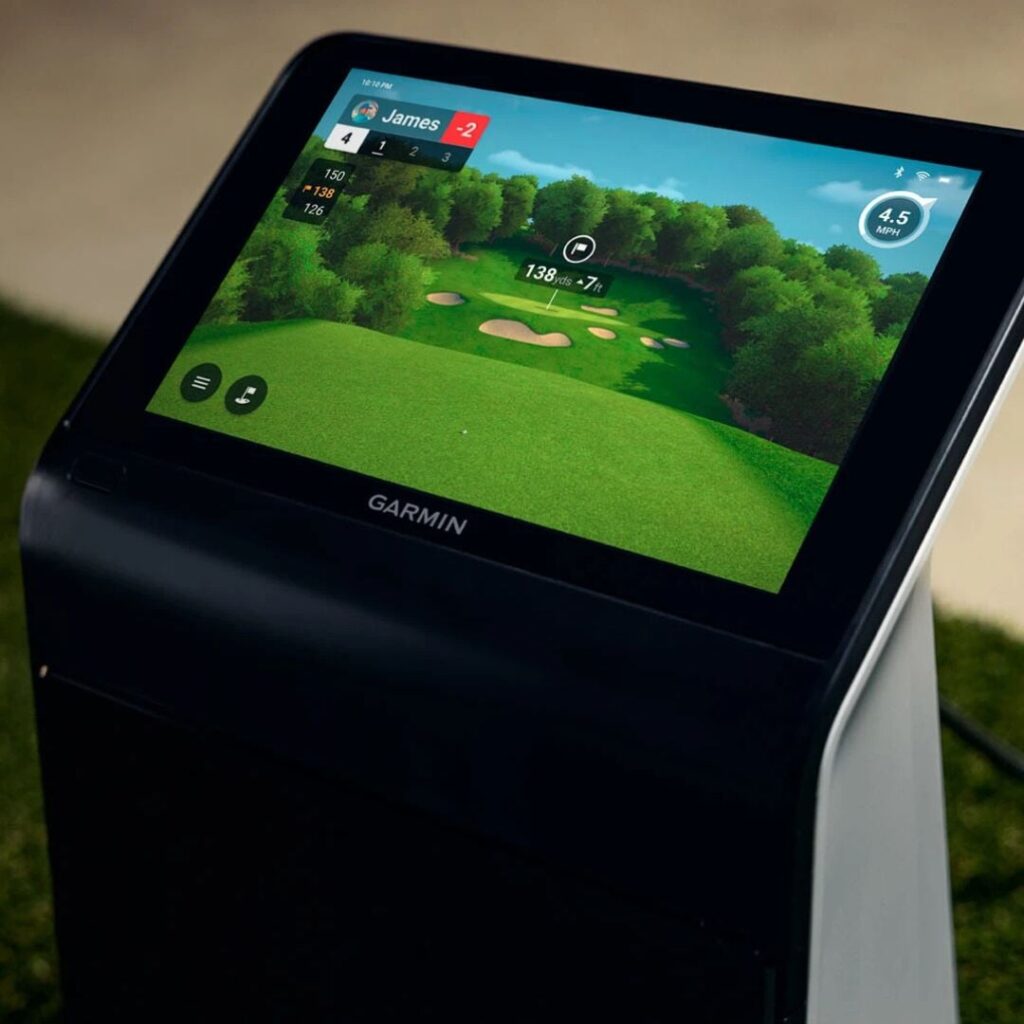
The 10 in touchscreen, 800 × 1280, is the reason the R50 exists. Home Tee Hero runs on the unit with no PC or phone (17 reports from 17 owners and reviewers), and the author’s view of the display has not changed:
I love the high-quality on-unit display.
GSPro, E6 Connect, E6 Apex, Awesome Golf and PinSeeker connect over Wi-Fi, each on a PC, and Garmin publishes an official GSPro connection guide. The PC requirement undercuts the no-PC pitch for owners who want GSPro (13 reports from 11 owners and reviewers):
“R50 owner here for 1 year now. I love it, but I want GSpro. Get the Omni/gaming pc” (u/jjwax, 2026-07-22)
That owner wanted online play; GSPro is supported, and the complaint is the PC and its cost. HDMI out tops at 1080p, so owners run wireless HDMI or long cables, and the ecosystem stays closed. Range mode has no changing green distance and no distance to the pin, in one owner’s report. Software 5.00 added the game modes owners asked for.
| Item | Detail |
|---|---|
| Screen | 10 in color touchscreen, 800 × 1280 |
| Video out | HDMI, 1080p maximum |
| Home Tee Hero | Runs on the unit; no PC or phone; needs a Garmin Golf membership |
| Garmin Golf membership | $9.99 a month or $99.99 a year (Garmin, 21 October 2026); required for virtual rounds, the weekly tournament and on-course practice; range sessions, shot history, stats and leaderboards are free |
| Courses | 43,000+ (42,000+ in January 2026) |
| Third-party software | GSPro, E6 Connect, E6 Apex, Awesome Golf, PinSeeker, over Wi-Fi on a PC; no Garmin subscription for third-party use |
| Software 5.00 (September 2026) | Bag Mapping, new club types, Forward Tees, Match Play, Skins and Stableford, 8-player rounds |
| Software 4.90 (March 2026) | Fixed the left-handed screen offset |
| Tournaments | Putting disabled; approach proximity adds 0–3 strokes |
| Bluetooth | Speaker and keyboard only |
| Updates and charging | USB-C via Garmin Express for updates; charging via the AC adapter only |
Price, Hardware and the 2026 Competitive Set
At $4,999.99 list the R50 is the premium tier, and owners call the price steep (15 reports from 15 owners and reviewers). Owners report street prices around $4,000 (Garmin, Carl’s Place and Shop Indoor Golf all listed $4,999.99 on 21 October 2026) and used units at $3,000–3,750, a market owners warn carries scam listings and wildly varying prices. The unit is 16.5 × 10.6 × 7.5 in and 9 lb, runs up to 4 h, is IPX3-rated and charges only from its AC adapter. Owners have moved to the Square Omni for its face impact location:
“As for Omni vs. R50, I would go with Omni because it’s much cheaper and provides precise impact location data, which I really like.” (u/Thin-Guard138, 2026-06-28)
“I think the R50 is the ultimate portable launch monitor because it doesn’t require a tablet.” (u/Thin-Guard138, 2026-06-28)
“It can be dark and grainy, and a too short in length. It’s not always easily obvious where you hit it.” (u/TantricCobra, 2026-06-27) [sic]
Reliability complaints are a minority. Against the GC3 the R50 trails in owners’ trust; against the EYE MINI LITE it wins on the screen and loses on price; the R10 is the upgrade path.
Garmin R10 Space Requirements – Length, Width and Height
Garmin R10 Data – What Data does Garmin Approach R10 Measure?
Uneekor Eye Mini Data -> Ball & Club Data + Measured & Calculated
Foresight GC3 Data – What Data does the GC3 Measure?
| Unit | Sensor | Screen | Price |
|---|---|---|---|
| Garmin Approach R50 | Three high-speed cameras | 10 in built in | $4,999.99 (Garmin, 21 October 2026); about $4,000 street and $3,000–3,750 used, owner reports |
| Garmin Approach R10 | Doppler radar | None; phone app | $499.99 (Garmin, 21 October 2026) |
| Uneekor EYE MINI LITE | Two high-speed cameras | None; PC by Ethernet | $1,999 sale, list $2,750 (Uneekor, 21 October 2026) |
| Square Golf Omni | Cameras, with face impact location | Built-in LCD; app or PC for club data | $1,599, sold out at Square (21 October 2026) |
| Foresight GC3 | Three high-speed cameras | Small built-in display | $3,999 sale, list $6,999 (Foresight, 21 October 2026) |

Garmin R50 Data FAQ
What data does the Garmin R50 measure?
Fourteen metrics: ball speed, launch angle, launch direction, spin rate, spin axis, apex, smash factor, carry, total and deviation, plus club head speed, face angle, path and angle of attack.
Does the Garmin R50 measure spin or calculate it?
Garmin says the cameras take direct measurements of spin rate and spin axis.
Are stickers needed on the clubs for the Garmin R50?
For club data, yes; the ball numbers work without them, and the putter needs none.
Does the Garmin R50 need a PC?
Not for Home Tee Hero. GSPro and the other third-party titles run on a PC over Wi-Fi.
Does the Garmin R50 work with GSPro?
Yes, through Garmin’s official connection guide, with a PC and Wi-Fi.
Is the Garmin R50 accurate?
Published tests put carry within about 1.65–4.01 % of premium references; owners trust the ball data and fault the short game.
What does the Garmin R50 cost to run?
Nothing for range use and third-party software; Home Tee Hero needs the $9.99 monthly or $99.99 yearly Garmin Golf membership.
Summary
Fourteen numbers, five measured off the ball and four off a sticker, the rest derived. Published tests within a few percent of premium units; a screen that runs Home Tee Hero without a PC and a GSPro path that needs one. No face impact location, a weak short game and a $4,999.99 list price are the trade.
Related guides: Garmin R10 Data – What Data does Garmin Approach R10 Measure? · Garmin R10 Space Requirements – Length, Width and Height · What is Smash Factor? – Launch Monitor Data 101 · How do Launch Monitors Work? – Radar vs Camera Systems · Launch Monitor Data – 33 Parameters Explained · Uneekor Eye Mini Data -> Ball & Club Data + Measured & Calculated · Foresight GC3 Data – What Data does the GC3 Measure? · What are the Best Golf Simulator Mats for Left-Handers and Why?

Check current prices: Garmin Approach R50
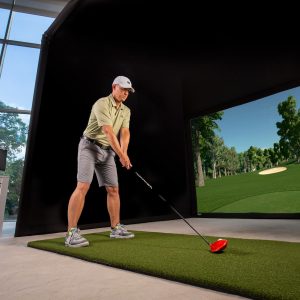
Carl’s Place Pro Golf Enclosure Review (2026): What’s in the Box, Real Cost and Owner Reports
Is SkyTrak Portable? Battery, Direct Mode and Range Days (2026)
ABOUT THE AUTHOR
Hello! My name is Alex and it is my mission to bring you all the information you need to build your own home golf simulator! I hope mygolfsimulator.com helps you on your journey to better golf at home!
LEGAL INFORMATION
On this site, you'll find articles on all aspects of building a golf simulator. I will also link to other sites where you can buy some of the simulator components. Some of these links may be affiliate links, which means if you click them I gain a small commission at no extra cost to you. This really helps out me and my site so thank you in advance! mygolfsimulator.com and all related social media accounts are property of Awonline LTD.