Impact Screen vs Net – Pros & Cons + Buying Guide
Posted in Enclosures, Golf Impact Screens, Room Setup
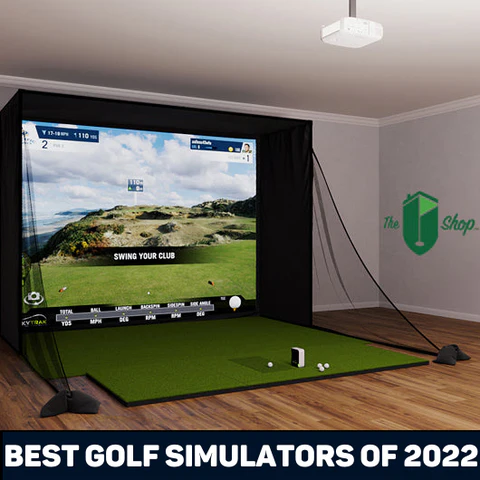
A net is the cheaper, quieter, smaller-room answer; an impact screen with a projector is the immersive one — and most first builds should start with the net. Nobody on Reddit frames this as “screen or net” any more; the choice shows up inside budget and product threads and resolves the same way every time: a net with a TV or phone beside it for anyone not chasing the full flight picture, and a projected screen for those who are, paid for three times over — in dollars, in decibels, and in light control.
In a Nutshell
A net is the cheaper, quieter, smaller-room choice and the right first purchase for most builds; an impact screen with a projector is the immersive one, if you can give it the space, a dark room and the budget.
👉 Choose the screen when you want the flight picture and can give it a dark room, 8–10 ft from tee to screen with a foot behind it, and a budget that covers screen, enclosure and projector. Choose the net when the room is bright, shallow or shared, or when the budget is the launch monitor — and put the picture on a TV or phone beside it.
- Owners who upgraded say the screen is far more immersive, and few go back.
- Screens are louder than nets. Owners describe the strike through a floor as a door slamming or a small gun going off (eight reports).
- A net is the sensible first step — owners and reviewers put the test build at about $50 before anything else.
- Either way, side containment decides whether the room survives. Gaps at the sides are what break windows and drywall (a rising complaint, eight reports from six owners).
Jargon, once: impact screen = the fabric you hit into when a projector throws the picture onto it. Enclosure = the frame and side panels around it. Bounceback = the ball coming back off the screen. No-fly zone = a net’s top panel that catches high shots. Side netting / baffles = the panels that catch the misses. Throw distance = how far the projector sits from the screen (What is the perfect golf simulator projector throw ratio?).

How this has changed since 2021
- 2026: net-plus-TV is the default advice in every in-window thread, five commenters in one thread alone; one daylight-garage owner runs a screen with a TV beside it.
- 2026: retractable screen systems widened the price spread: a METechs roller with a Spectrum screen at about $1,900, SportScreen’s Vanish 11 at $4,500, Gung Ho at about $3,500 (one buyer’s figures), and a DIY roller under $300 (one builder).
- 2025–2026: budget screens survive for years for some owners (six reports) and fray for others; three-layer versus single-layer is the dividing line.
- The Net Return line grew to eight models, with a no-fly zone and side barriers that owners credit with catching mishits (seven reports).
- Unchanged: noise and light are the two reasons people bail on projectors.
The trade, in one table
| Factor | Impact screen + projector | Net (+ TV or phone) |
|---|---|---|
| Immersion | The life-size flight picture; owners who upgraded call it far more engaging (nine reports) | A picture off to the side; owners value the convenience (five reports) |
| Noise | Louder; premium screens are quieter than budget ones (five reports from three reviewers) | Quieter — the net catches rather than stops |
| Bounceback | Managed with tension and a backer | Hung loosely, it returns the ball or drops it |
| Space | 8–10 ft tee to screen, a foot behind it, plus the enclosure | About 3–3.5 ft deep, plus the no-fly zone’s height |
| Room light | Washes out in daylight | A TV stays watchable with the lights on (five reports) |
| Storage and multi-use | Foldaway and hinged frames exist | Net Return sets up fast but is not built for constant teardown |
| Durability | Burn marks on the screen are normal wear (eight reports) | The Net Return is “very high quality” in owners’ words (seventeen reports from thirteen owners) |
| Cost | Screen, enclosure, projector and a PC | A net you may already own; the launch monitor is the spend |
Once the full build is done, the net-vs-screen regret cuts both ways. One owner who went from a net and a TV to a full build: “I really do love it but at times I am a bit surprised that I miss the simplicity of the old setup.” Another owner’s spouse asked why they had built a net instead of a screen and projector.
What a net build looks like in 2026
The launch monitor does the measuring; the display is a choice. Put the TV outside the ball’s path — behind the net or cage, with a polycarbonate shield if any risk remains; a consumer TV does not survive a ball strike. Owners run anything from a 43 in TV on the garage wall beside a 7.5 × 7.5 ft Costco GoSports return net to a 55 in Prime Day set; the sizing guidance and the phone-and-tablet device matrix are in Golf Simulator Without Projector – Setup Options & Tips.
“I’d just put a TV to the side” was the first answer to a question about hanging a screen behind a net, and an owner who tried exactly that found “the net was really distracting to the visual” and moved the TV to the side anyway. Daylight is the other driver: one garage owner “Tried several projectors up to $5k and none would work with the ambient light” and settled on a screen with a TV beside it for daytime.
However, I would so much rather have a home setup with a launch monitor, swing camera and quality golf net than no golf practice option at all.

Nets compared
| Net | Size (W × H × D) | Frame and netting | Ball return | Warranty | Price seen | Strengths | Watch-outs |
|---|---|---|---|---|---|---|---|
| The Net Return Pro | 8 × 7.5 × 3.5 ft, 28 lb | Aluminum frame; netting rated to 225 mph; tool-free assembly under 5 minutes | Yes, to your feet | 3 years | $795 (Pro) to $1,599 (Pro XL) at Shop Indoor Golf, 21 Oct 2026; $1,500–2,000+ with barriers and no-fly per reviewers | Durability praised (seventeen reports from thirteen owners); the premium is called worth it (fifteen reports) | Small models let skied balls over (nine reports); needs anchoring in wind (five reports, rising); not for frequent teardown (nine reports) |
| Rukket SPDR | 10 × 7 ft panel | Steel and fiberglass; rubber base | Yes, off the rubber base | 30 days full, 6 months netting, lifetime frame | $319.99 at one retailer, out of stock there on 2026-08-25; Rukket’s US web store was offline on 21 October 2026 | Side wings and a tri-turf mat included | No owner discussion on file this summer |
| Cimarron Swing Master | 11 × 7 × 3.5 ft, 43 lb | 1.5 in steel; replaceable 4 × 5 ft baffle | No | 1 year | $229 on sale (struck $289), 21 Oct 2026 | Wide panel for the money | No owner discussion on file this summer |
| Callaway Rapid Range | 8 × 8 ft | — | No | — | $279.99 on Callaway’s page | Known brand | No owner record here |
| Spornia, GoSports, PGM | ? | ? (PGM’s frame is steel per one owner) | Spornia and GoSports: yes | ? | ? | Owners weigh Spornia for portability against Net Return for permanence (fourteen reports) | No spec rows on file |
Two things owners flag about the Net Return that the spec table hides. The no-fly zone is not free height: “The no fly ads another foot and a half to the height” [sic], and the base cannot be made shallower because it is structural. One Home-model owner stands about 9 ft back from the net and 11 ft from the wall. And the frame material is the reason for the price gap over the clones: “NetReturn pro series has an aluminum frame”.
I recommend either going for a cube-style enclosure with netting on each side (like those found at many golf courses) or a premium golf net such as Net Return Pro which will return the ball to your feet on every shot. The Net Return Pro golf nets are amongst the best in the golf simulator market, the way they return the ball to your feet is just class.


with thanks to Cimarron Sports

The Net Return Pro Series · Cimarron Swing Master

What a screen build looks like
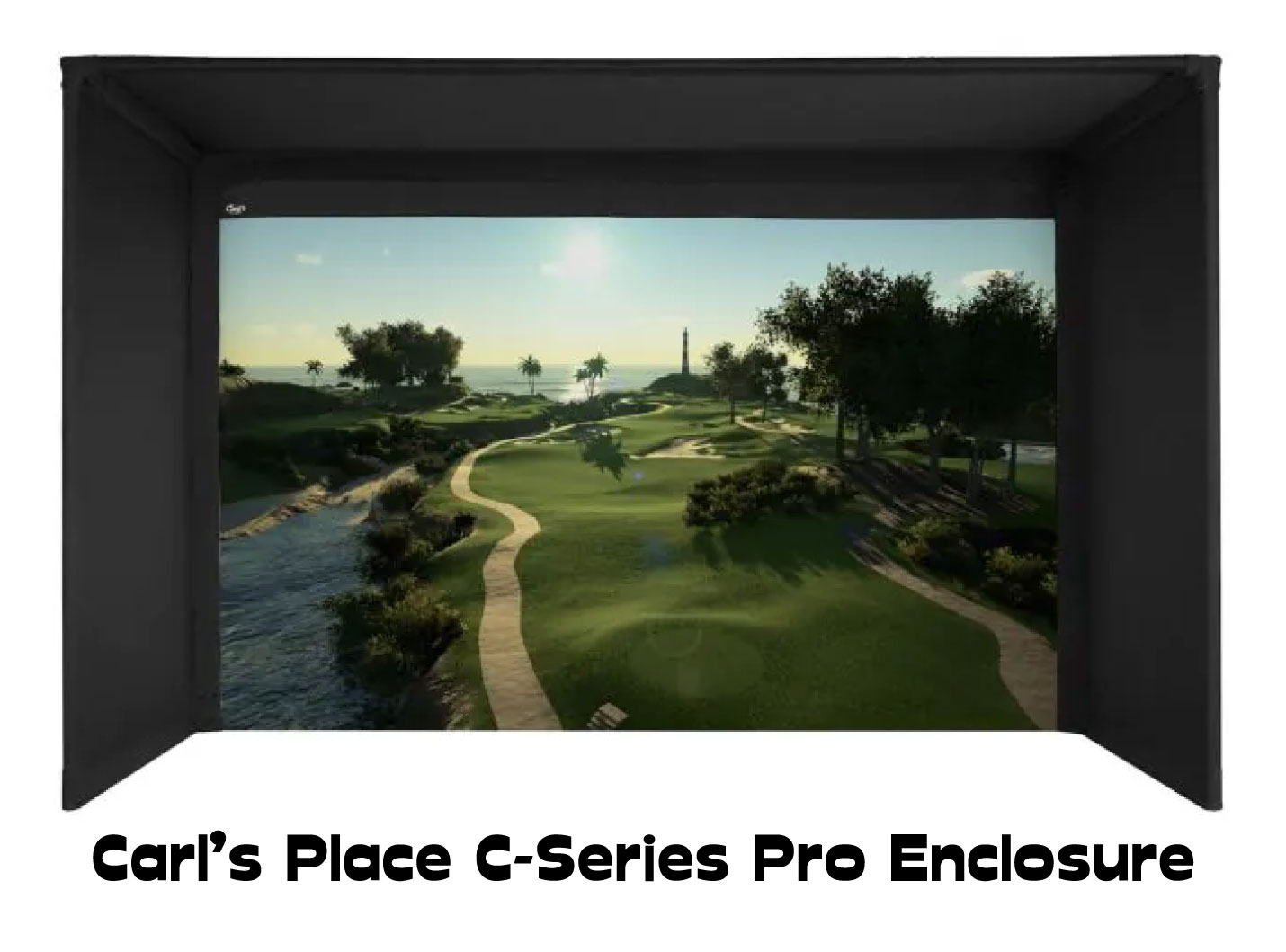
Screen, enclosure, projector. Carl’s Place’s Premium screen starts at $439.95 and its Gray at $449.95 — the darker material reviewers prefer once the room runs under about 4,000 lumens or the lights stay on; rival brand SIGPRO says its Premium is tested to ball speeds up to 250 mph. I recommend the Premium Impact Screen from Carl’s Place, which is a top-quality three-layer screen. If your budget is tight, I recommend checking out the Preferred Screen from Carl’s Place. The site’s roundup closes with the same line: a three-layer screen is a fair bet at any price, a single-layer mesh is not — Best Golf Impact Screen – 7 Key Features & Buying Guide, Best Impact Screen Materials for Picture Quality.


Sizing is where buyers get lost: screens are sold by aspect ratio and width, not diagonal. My mission is to make all this seem simple and easy for you though. I particularly like the way the website at Carl’s Place shows you impact screen sizes which are categorised by aspect ratio. One review source’s 16:9 minimum is about 10 ft wide by 5.63 ft tall; the sizing guide is at The Vital Link between Aspect ratio and Impact Screen Size and Best Golf Impact Screen – 11 Step Checklist & Buying Guide.


The projector is a short-throw over the tee (Where to Mount your Golf Simulator Projector – Pitfalls + Example Placements) with a brightness floor of 3,500–4,000 lumens for a lit room (Lighting in a Golf Simulator – Optimize Accuracy, Practice and Aesthetics); the enclosure needs about 6 in of clearance each side and 12 in up top (How to Build a DIY Golf Simulator Enclosure – Steps, Tools, Costs + Materials). Carl’s Place Premium Impact Screen · Carl’s Place Preferred Impact Screen


Space: the math for each
| Dimension | Screen build | Net build |
|---|---|---|
| Depth | 8–10 ft tee to screen, 1 ft behind the screen, plus the enclosure’s depth | About 3–3.5 ft for the net itself, plus the no-fly zone’s overhang |
| Width | 10 ft minimum with an offset aim; 15 ft for a centered aim | The same |
| Ceiling | 9 ft realistic minimum; 8.5 ft only for shorter, flatter swings; 10 ft recommended | The same — and the Net Return Pro’s 7 ft 6 in height clipped one buyer’s garage-door rail |
| What the net saves | — | No throw distance to find, and no projector in the swing path |
The room math for both is at How much space do you need for a Golf Simulator? and the ceiling ladder at What’s the Minimum Golf Simulator Ceiling Height?.
Side netting and containment
Gaps do the damage, not the screen. A single net without side protection is a real risk: the misses go past it into windows, doors, drywall and cars (a rising complaint). DIY containment works when the netting has slack and a few inches of space behind it to absorb the ball (fifteen reports from fourteen owners, rising); a curtain alone is enough only with that space behind it, which is the answer to a question new builders keep asking. The Net Return’s side barriers and no-fly zone do the same job for that net. The room-protection guide is at Protect Your Golf Simulator Walls and Ceiling – 12 Simulator Safety Tips.


Bounceback and noise, both ways
Screen bounceback, in the order owners fix it:
- Tension first. Loosen the screen — stretch cords, not zip ties (eight reports).
- A freely hung heavy backer an inch or more behind the screen (thirteen reports from eleven owners).
- The bottom crossbar is the usual ricochet culprit (six reports). The rest of the ladder, and the injuries it prevents, are at Protect Your Golf Simulator Walls and Ceiling – 12 Simulator Safety Tips.
Net bounceback is simpler: hang it loosely and it drops the ball. One owner took a shot back off the front bar, wrapped it in foam pipe insulation and has been fine since; another glued foam wedges to the ceiling to deflect high wedge shots down. One DIY screen owner gets the same effect from slack and a 2×4 along the bottom edge that hops when a driver hits.
Noise is the screen’s cost that nobody prices. Through a basement ceiling, owners say the strike “almost sounds like a low caliber gun going off” and “Sounds like someone is slamming a door downstairs every time it hits the screen.” Premium screens are quieter than budget ones, but not quiet. The fix one owner recommends is room choice, not hardware: “take the smaller room under the office”.
Cost, attributed
| Item | Figure | Source |
|---|---|---|
| A net to start | About $50 | Owners’ and reviewers’ test-build figure (nine reports from seven owners and reviewers) |
| The Net Return Pro | $795 (Pro) to $1,599 (Pro XL), 21 Oct 2026; $1,500–2,000+ loaded | Shop Indoor Golf, 21 Oct (base); reviewers (loaded); owners note the price rising |
| Rukket SPDR | $319.99 | One retailer, August 2026; Rukket’s US web store offline on 21 October 2026 |
| Cimarron Swing Master | $229 | Shop Indoor Golf sale (struck $289), 21 October 2026 |
| Callaway Rapid Range | $279.99 | Callaway’s page |
| Carl’s Place Premium / Gray screen | $439.95 / $449.95 | Carl’s Place, 21 October 2026 |
| DIY frame and marketplace screen | About $115 of EMT (electrical conduit) plus a $75 screen | One owner |
| Screen-and-projector combo | “less than $250 out the door” | One commenter |
| Retractable systems | $1,900 / about $3,500 / $4,500 | One buyer, September 2026 |
| Full builds | $700–$2,400 | Three owners; scopes vary |
The false economy, in one owner’s words: “I wouldn’t buy a cheap projector and also a cheap screen”. Buying twice is the regret owners cite most.
Upgrading later, and the off-season
Net first, screen later is a well-worn path. One owner ran Net Return’s own screen accessory, then left for a bigger screen: “Only reason I got rid of it was for a bigger impact screen.” Whether the ball-return function survives a screen hung on the net is a question that went unanswered on Reddit this summer, so treat it as unknown.
For the off-season:
- Foldaway and hinged frames are the common answer (eight reports).
- Steam the creases out of a screen before you roll it — owners say so more often than not.
- The Net Return is quick to set up but not built for constant teardown (nine reports).
Retractable options are at Retractable Golf Simulators – Ultimate Guide.
Impact screen vs net FAQ
Do you need an impact screen for a golf simulator?
No. The launch monitor measures the shot; a net catches the ball and a TV or phone shows the picture. The screen is for the flight picture.
Can you play courses with just a net?
Yes — the software runs on the PC, tablet or phone regardless of what you hit into.
Which is quieter?
The net. Screens are loud enough to hear through a floor.
Which needs less space?
The net: about 3–3.5 ft deep plus the no-fly zone, against 8–10 ft to the screen plus a foot behind it.
Is a Net Return worth the price over a cheap net?
Owners who own one say yes for permanence and outdoor use — aluminum frame, heavy netting, the ball back at your feet. For portability they pick Spornia.
Can you put an impact screen on a net frame?
Net Return sells one. Whether the return function still works with it is unanswered.
How do you stop bounceback?
Loosen the screen, hang a heavy backer behind it, and check the bottom crossbar. For a net, hang it loosely.
What TV size beside a net?
Owners run 43–55 in; the sizing guidance is in the no-projector guide.
Who should choose which
Golfers should choose a full golf simulator setup including impact screen, enclosure and projector whenever they have enough space and can afford it. You really can’t beat the ability to immersive yourself in simulated famous courses like Pebble Beach and Augusta, whilst practicing your golf game in your home driving range. I recommend the Premium (best) and Preferred (best on a budget) Impact Screens from Carl’s Place for their top quality picture quality, bounceback profile and durability. For everyone else, the net is the right first purchase.



Bushnell Launch Pro vs SkyTrak ST MAX (2026)
Golf Simulator Packages vs Building Your Own: Which Is Better Value?
ABOUT THE AUTHOR
Hello! My name is Alex and it is my mission to bring you all the information you need to build your own home golf simulator! I hope mygolfsimulator.com helps you on your journey to better golf at home!
LEGAL INFORMATION
On this site, you'll find articles on all aspects of building a golf simulator. I will also link to other sites where you can buy some of the simulator components. Some of these links may be affiliate links, which means if you click them I gain a small commission at no extra cost to you. This really helps out me and my site so thank you in advance! mygolfsimulator.com and all related social media accounts are property of Awonline LTD.