Skytrak Connection Problems – The Ultimate Guide
Posted in Launch Monitors
Most SkyTrak connection failures are one of five findable causes — signal, credentials, network type, cable/power, or a mode mixup — and the table below routes you straight to yours. When I bought my SkyTrak I was super excited. I had it all charged and ready to go and then when it came to setting it up, I couldn’t get it to connect. This was so frustrating! What’s changed since I first wrote this guide is that “SkyTrak” now means three different units — the Original, the SkyTrak+, and the ST MAX — with three different cable systems and some genuinely different rules, so identify your generation first, then fix.
In a Nutshell — Symptom → Most Likely Fix
Most SkyTrak connection failures come down to one of five causes: weak signal, wrong Wi-Fi credentials, the wrong network type, a cable or power fault, or a Direct/Network Mode mix-up. Identify your generation (Original, SkyTrak+ or ST MAX), read the lights, then use the table below.
👉 Still stuck after the table? The hard-reset sequence and when to call SkyTrak support are in the last section.
Jump to: Symptom table · Know your generation · LED decoder · Direct Mode · Network Mode · The mesh problem · Router fixes · USB by generation · Drops & missed shots · When it’s not you · How this guide changed · FAQ
Jargon, once: Direct Mode = the unit broadcasts its own Wi-Fi and your device joins it (no internet passthrough); Network Mode = unit and device both join your home Wi-Fi (recommended, keeps internet); a guest network is a router mode that isolates devices from each other — which breaks SkyTrak; QoS (Quality of Service) is a router setting that limits or prioritizes bandwidth per device.
These fixes come from SkyTrak’s own manuals across all three generations; SkyTrak+ and ST MAX share a manual, so every row applies to both unless it says otherwise.
| Symptom | Most likely cause → fix | Detail |
|---|---|---|
| Unit doesn’t appear in your Wi-Fi list | Normal — it’s in Network Mode. Switch back to Direct Mode from the app’s device connections window (ST MAX: or reset via Network > Device > Reset) | §4 |
| Middle light stays red / flashing red | Credentials: case-sensitive, no special characters — and a router gateway of 10.0.0.1 is incompatible | §5 |
| Middle light solid yellow | Guest network blocking device-to-device traffic, or your device is on a different network than the unit | §5 |
| ST MAX only: purple light during network setup | Normal — the wizard is working. Purple → yellow = success, red = failed. Wait up to 45 seconds; don’t reset mid-wizard | §3 |
| Connects, then drops mid-session | Weak signal, a router bandwidth/QoS cap, or mesh Wi-Fi | §6/§7 |
| Missed shots in Network Mode | Wireless signal strength — the manual’s own advice is a repeater | §9 |
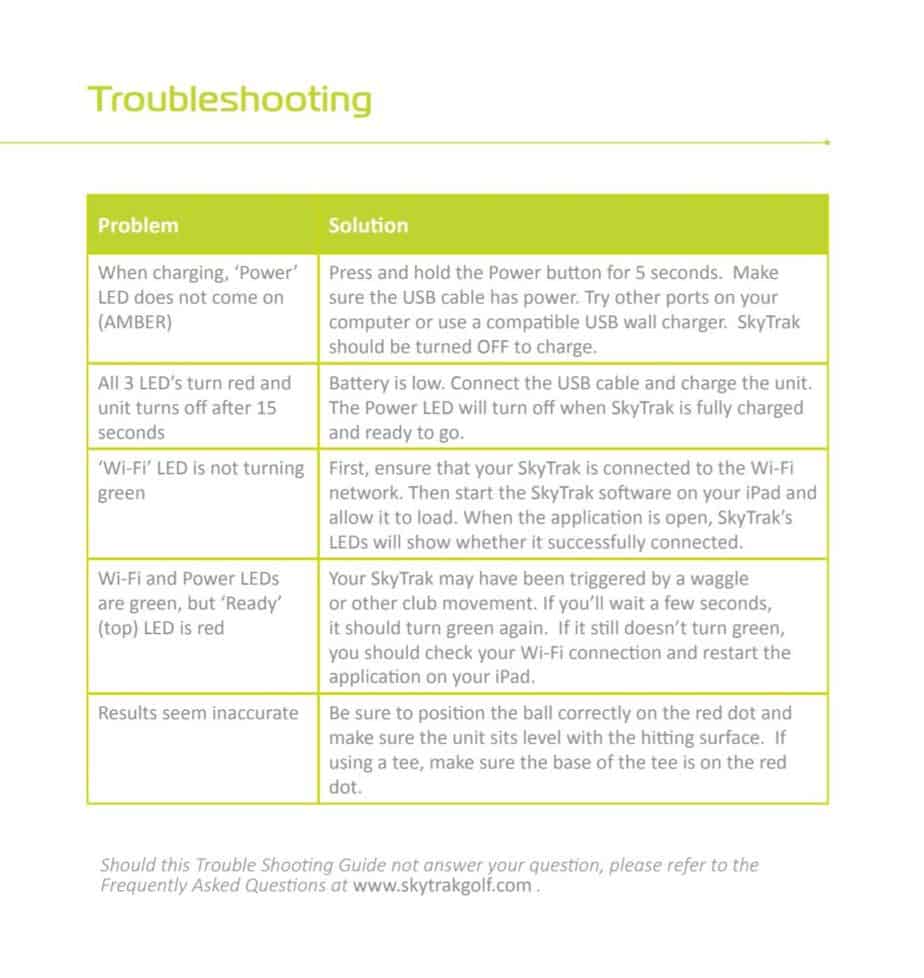
| Wi-Fi light green but Ready light stays red | The unit is tilted — level it | §9 |
| Nothing works | Hard reset (clears learned Wi-Fi), router reset, firmware update, then support | §10 |
👉 Bottom line: check your generation, read your lights, then fix the one thing your symptom points at. Random rebooting is the slowest possible path.
Know Your Generation
| Original SkyTrak | SkyTrak+ | ST MAX | |
|---|---|---|---|
| Connection modes | Direct Wi-Fi · Network Wi-Fi · USB (PC) | Direct · Network (recommended) · USB | Direct · Network (recommended) · USB-C |
| Cable | Full-USB to micro-USB (also charges) | USB-C with a splitter cable for PC data + constant charge | 2× USB-C: one wall-power, one PC data (right-side port) |
| USB data works on | PC (Mac not specified in current manuals) | PC (Mac not specified in current manuals) | Windows only — no Mac/iOS/Android data cable; those platforms use SkyTrak’s online setup guide |
| Direct-mode network name | SkyTrak network (see app) | STPLUS_XXXXXX | STMAX_xxxx |
| Direct-mode password | Not documented in current manuals — contact SkyTrak support for this one | “skytrakplus” | “skytrakmax” |
| App platforms | iOS/Android/PC (the same SKYTRAK app as the newer units; v6.2 as of October 2026) | iOS/Android/PC | iOS, Android, Windows, Mac |
One community warning worth its own line: some SkyTrak+ owners report the Wi-Fi password printed in their manual is simply wrong for their unit (part of a 7-report, 6-owner fix cluster) — if the default fails, check the app’s connection screen rather than assuming you mistyped.
The LED Decoder
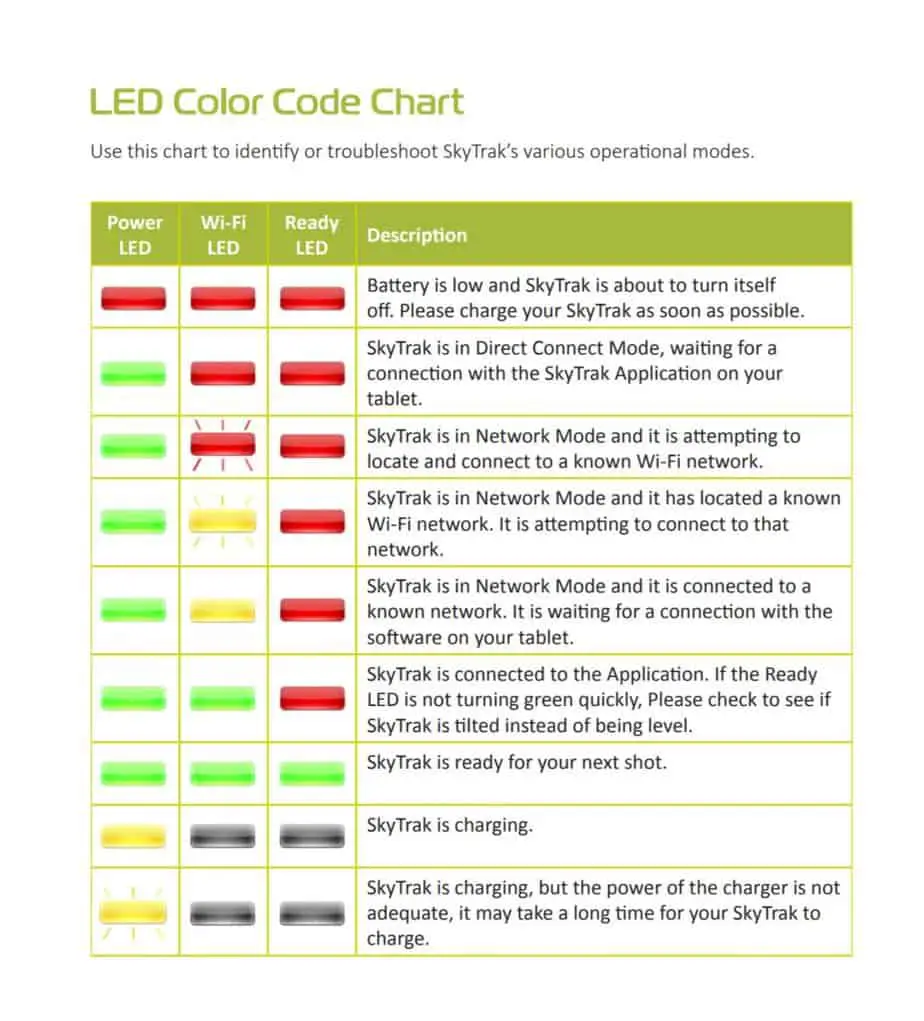
This is the chart of LED light configurations, rebuilt per generation from the current manuals. When I first looked at this table of light configurations I struggled to understand what the modes meant — I hope the plain-English column fixes that for you.
to download digital versions of all the Skytrak documentation, including
user manuals and further troubleshooting guides
to download digital versions of all the Skytrak documentation, including
user manuals and further troubleshooting guides
Original SkyTrak (lights: Power · Wi-Fi · Ready)
| Lights | Meaning |
|---|---|
| Green · RED blinking · Red | Network Mode — searching for a known Wi-Fi network |
| Green · YELLOW blinking · Red | Found a known network, connecting to it |
| Green · YELLOW solid · Red | Connected to the network, waiting for the app |
| Green · Green · Red | Connected to the app — if Ready won’t go green, check the unit isn’t tilted |
| All green + red laser dot on the mat | Fully connected, armed, ready to hit |
SkyTrak+ (lights: Power · Wi-Fi · Ready)
| Lights | Meaning |
|---|---|
| Green · YELLOW blinking · Red | Searching for a Wi-Fi network |
| Green · YELLOW solid · Red | Found a known network, attempting to connect |
| Green · Green · Red | On Wi-Fi and the app, not yet armed |
| All green + laser dot | Connected and ready |
Note the trap: the same “searching” state is a blinking RED Wi-Fi light on the Original but blinking YELLOW on the SkyTrak+. If you’ve upgraded generations, your old light-reading instincts will mislead you.
ST MAX (lights: Power · Wi-Fi · Ready)
| Lights | Meaning |
|---|---|
| Green · Red · Red | Application ready (direct-mode waiting state) |
| Green · Yellow/amber · Red | Wi-Fi connection in progress |
| Green · Green · Red | Wi-Fi connected |
| During the in-app Network Wizard: flashing → purple → yellow | Purple = working; yellow = connected. Red = failed. Allow up to 45 seconds |
| Stuck solid yellow after the wizard | Check your device’s Wi-Fi settings; power-cycle the ST MAX and/or the app |
| All green + laser dot | Connected and ready |
Direct Mode
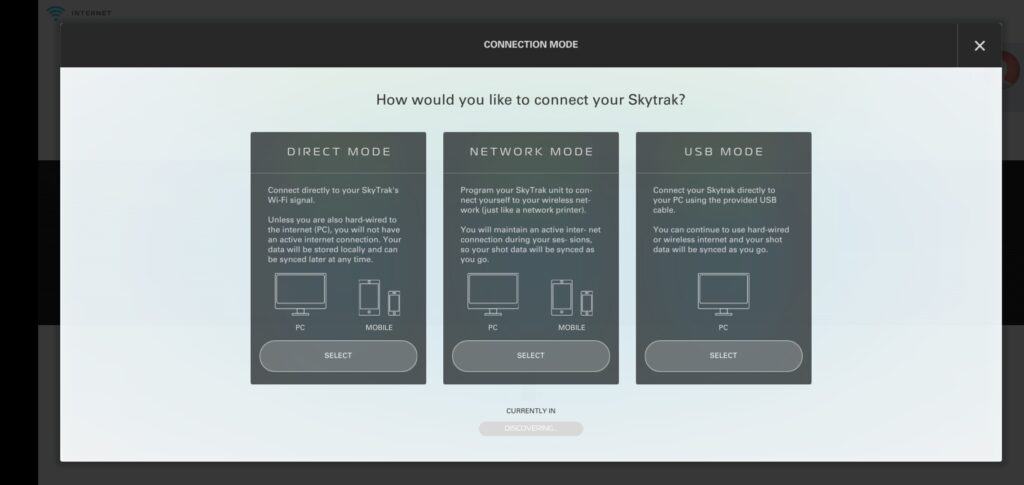
Direct Mode is the unit hosting its own Wi-Fi — best for the range, outdoors, or a home with unreliable internet. The catch: your device gets no internet passthrough while connected, so shots sync later and online features wait until you’re home.
- Power on the unit and your device; open the app’s connections menu.
- Join the unit’s own Wi-Fi network in your device’s Wi-Fi settings (names and default passwords in the generation table above).
- Return to the app; it should find the unit. All set — hit balls.
One trap I can vouch for personally: the connection wouldn’t work for me as I was using my phone’s VPN software. I turned this off and the connection worked straight away. A second trap comes straight from the documentation and ruins more range trips than any other: the very first time you log into the app on a device, it needs an internet connection — do that at home before you leave. A phone hotspot can also stand in for home Wi-Fi via Network Mode if you need online features away from home, though owners have always found that setup temperamental.
Network Mode — and the Rules That Still Break It
Network Mode puts the unit and your device on your home Wi-Fi together — the recommended mode, and the one that keeps your internet. Connect via the app’s network wizard (you’ll typically connect in Direct Mode first so the unit can learn your network credentials). Then the rules, straight from the manuals — nearly every “won’t connect” case lands on one of these:
- 2.4GHz only. SkyTrak’s Network Mode requires a 2.4GHz network — the older, longer-range Wi-Fi band that most routers broadcast alongside faster 5GHz, sometimes under one combined name. A 5GHz-only network won’t work.
- Credentials are case-sensitive, and special characters (?!@) break recognition — in the network name and the password.
- Guest networks block it. Guest modes isolate devices from each other; SkyTrak needs device-to-device traffic. (Manual-confirmed for every generation.)
- A router gateway of 10.0.0.1 is incompatible — an obscure one, straight from the troubleshooting docs, and worth checking if everything else looks right.
- Same-network check: your phone auto-joining a neighbor’s open network or your 5GHz band while the unit sits on 2.4GHz looks exactly like a broken SkyTrak.
- Legacy tip from the original guide, kept because it costs nothing: keep the network name short (under ~11 characters was the old community rule).
The Mesh-Router Problem — 2026’s Headline
The biggest change since this guide was first written isn’t SkyTrak’s — it’s your house’s. Mesh Wi-Fi systems became the default home setup, and one detailed owner report from this summer says the quiet part out loud. After a year of constant wireless disconnects, and after building a dedicated 2.4GHz network exclusively for the SkyTrak that still didn’t fix it, the owner called support: “Customer service said they don’t work well with Mesh systems. Like wtf? Just about everyone uses a mesh network in their homes. I said ‘do you explicitly state that somewhere on your site?’ Nope.”
That’s one owner’s account of an informal support admission — it isn’t published policy and can’t be verified beyond the report (the same account appears in the evidence behind the SkyTrak comparison guide). But it matches the broader pattern: connection complaints that survive every standard fix (a second commenter in the same thread: “These things have constant connectivity issues that they have not resolved”). If you run mesh Wi-Fi, the honest playbook — none of it guaranteed:
- Prefer wired. USB (per your generation’s rules below) takes the network out of the equation entirely.
- Try a non-mesh access point for the sim room — a cheap dedicated 2.4GHz AP on ethernet backhaul, not a mesh node, so the SkyTrak talks to one radio that never hands it off.
- Direct Mode as the fallback — no router involved at all, at the cost of online features.
Router-Side Fixes
The confirmed fix of the summer: check your router for per-device bandwidth caps or QoS rules and exempt the SkyTrak. One SkyTrak+ owner traced five mystery disconnects to exactly this — a QoS/limiter rule throttling the unit on his Wi-Fi. One report, but specific and actionable.
Weak signal is still the boring, common cause. Garages and basements sit at the far edge of home Wi-Fi; two SkyTrak+ owners in one thread independently traced early disconnects to weak garage signal. The fixes haven’t changed: a Wi-Fi extender or powerline kit for the sim room, an ethernet run for outbuildings, and the community’s most-corroborated stability recipe — a dedicated network name for the unit, direct mode when in doubt, USB as the wired fallback (7 reports, 6 owners).
USB, by Generation
The wired route dodges every Wi-Fi problem above — with generation-specific rules.
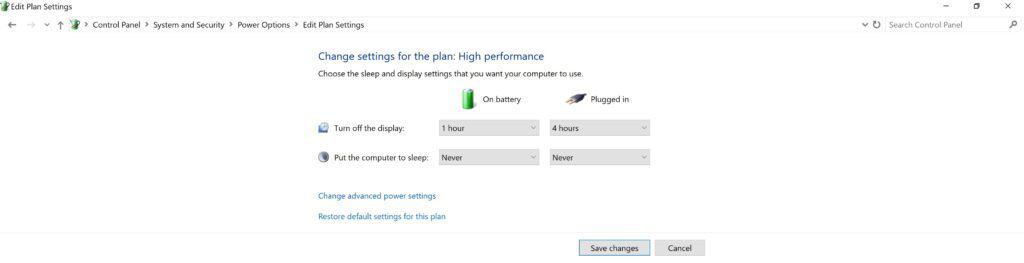
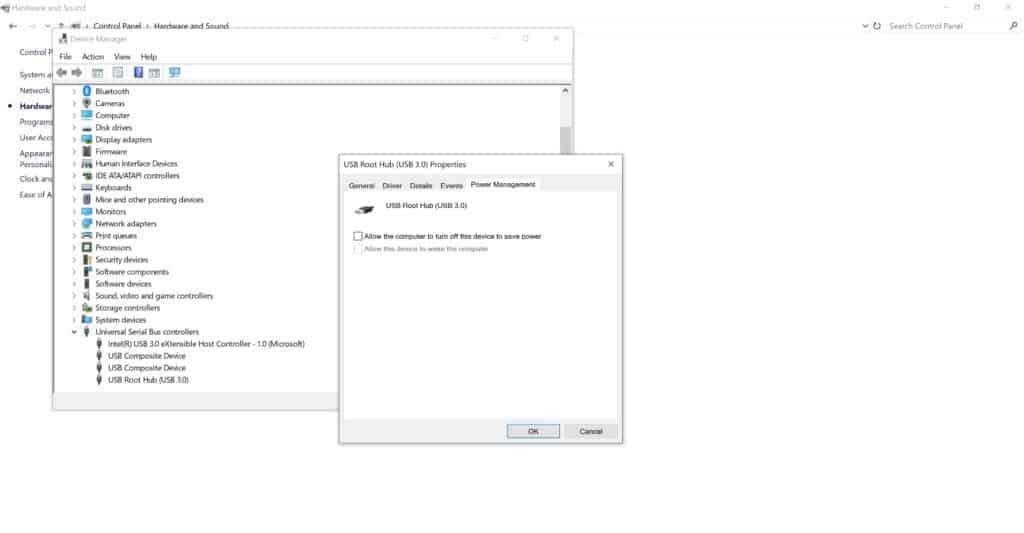
Original: full-USB to micro-USB (the cable also charges the unit). The connection order matters: cable in first, then power on the unit, then let the app search. The Windows power-management recipe from the original guide has helped owners for years — settings names may vary on Windows 11:
- Set the power plan to High Performance.
- Disable “USB selective suspend” in advanced power settings.
- Untick “allow the computer to turn off this device to save power” on the USB root hub in Device Manager.
A hard reset before starting also clears learned Wi-Fi credentials that sometimes interfere with USB.
SkyTrak+: USB-C, via the supplied splitter cable so the unit gets PC data and constant charge together.
ST MAX: two USB-C cables in the box — one is wall power, one is the PC data cable (right-side port). The data connection is Windows-only; Mac, iOS, and Android users follow SkyTrak’s online setup guide instead. Worth repeating, because it surprises people: there is no Mac USB data mode on the ST MAX.
And the cable itself matters: buy a solid cable that carries both power and data. I recommend Anker cables — I was having problems with my Oculus Quest connecting to my PC and these cables sorted me out. Cheap cables are the classic invisible culprit. One more original-guide note that survives: a clean electrical setup (decent power adapter, no cheap multi-way adapters daisy-chained around the unit) has fixed more than one “faulty” SkyTrak.
Missed Shots and Mid-Session Drops
- Missed shots in Network Mode: the manual’s own answer is signal strength — move the unit-router relationship closer or add a repeater. (For missed reads — shots that register wrong rather than not at all — that’s a different problem with its own fix recipe: laser-dot ball placement, patterned balls, light control, covered in the SkyTrak comparison.)
- The tilt check: if the Wi-Fi light is green but Ready stays red, the classic cause is a tilted unit — level it against the hitting surface.
- Drops that only happen with GSPro: a real pattern (7 reports, 6 owners; plus an earlier 4/4 cluster) — the community’s partial fix is USB, and the full fix is often the router work above.
- USB power cutoffs: a PC quietly powering down the USB port mid-session looks exactly like a flaky unit — that’s what the power-management recipe in §8 prevents. And the original guide’s wry observation stands: the missed shots always seem to be your best strikes.
When It’s Not You
An honest section this topic has earned. Connection complaints against the SkyTrak family are chronic, not occasional — but so are happy, trouble-free owners. Both halves are true at once:
| Generation | Complaints | Praise |
|---|---|---|
| Original | No-reads and interruptions, a rising 14/14 cluster | 5–8 years of reliable hardware from long-term owners (11 reports, 8 owners) |
| SkyTrak+ | Mid-session wireless drops across all supported connection methods (9-report, 6-owner cluster); this summer: “lots of issues with the product connecting since purchase” | “I’ve been pleased with my ST and connecting it to GSPro was easy” |
| ST MAX | One commenter’s theory that it’s “the same exact og tech with better wifi/bluetooth” — in his own words, a hunch, no teardown evidence either way | Dual-USB-C wired route credited with noticeably more stable, lower-lag sessions (4 reports, 3 owners) |
One more data point: an early SkyTrak+ owner called the experience “an absolute POS” — proof a bad setup week can happen to anyone.
If you’ve run this whole guide, work through this last-resort list:
- Reset the router.
- Hard-reset the unit.
- Confirm firmware is current.
- Try the old “Preamble Type: long” access-point trick from the original guide.
- Contact SkyTrak support — with your generation, your LED states, and what you’ve tried, which shortens the loop considerably.
Warranty context and the family’s wider risk picture: Skytrak vs Garmin R10 – Complete Guide (19 Key Comparisons)
How This Guide Changed (2020 → 2026)
- One generation became three, with three cable systems (micro-USB → USB-C + splitter → dual USB-C).
- Windows 7-era PC requirements and the old “Microsoft Visual” advice retired.
- Mesh Wi-Fi became the default home network and the new prime suspect.
- The app grew a proper network wizard (the v5.8 software release streamlined the ST MAX’s connection screens, and v6.2 in September 2026 added a connection-stability firmware update for SkyTrak+ and ST MAX).
- The community’s fix knowledge sharpened from “reboot everything” into named causes: bandwidth caps, gateway incompatibility, guest-network isolation, and the mesh question.
FAQ
(These answers are drawn from SkyTrak’s manuals and the fix patterns above rather than from a bank of commonly-asked questions — the community asks these in fragments, mid-panic, which is rather the point of this page.)
Why won’t my SkyTrak show up in my Wi-Fi list?
It’s in Network Mode — that’s normal. Switch it back to Direct Mode from the app, or reset it (ST MAX: Network > Device > Reset beside the serial number).
Direct Mode or Network Mode?
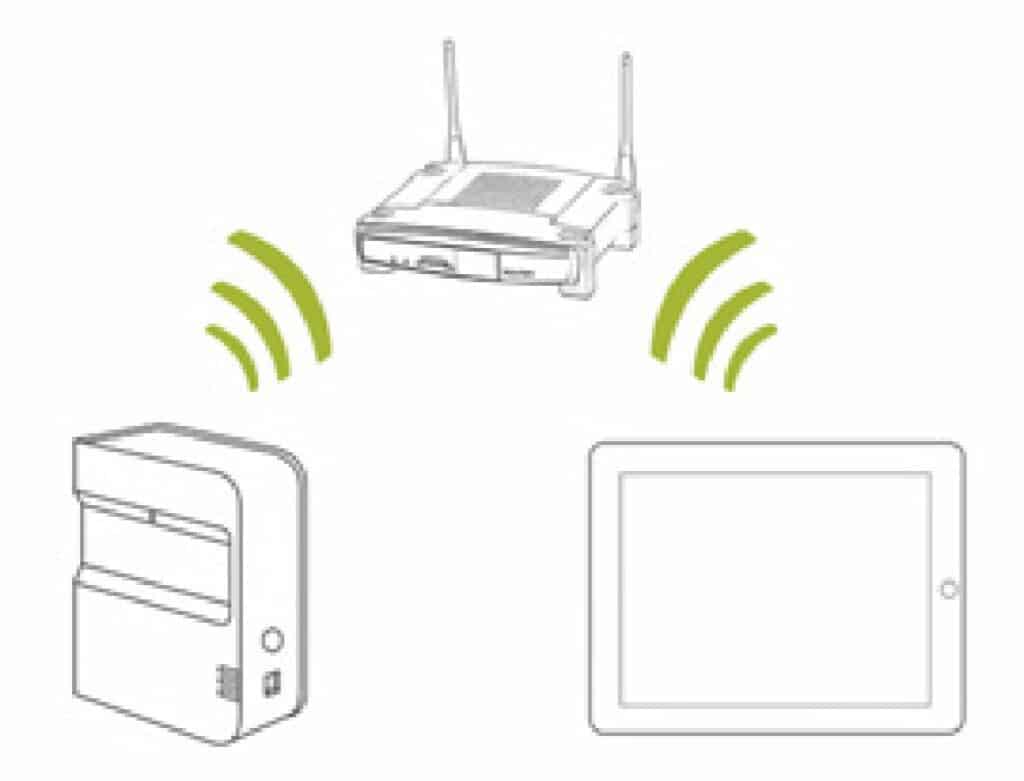
Network Mode for home (keeps your internet, syncs live); Direct Mode for the range, outdoors, or when the router is the problem.
Does SkyTrak work on 5GHz Wi-Fi?
Network Mode requires 2.4GHz. If your router merges bands under one name, force the unit onto 2.4.
Does SkyTrak work with mesh Wi-Fi?
Officially, nothing is published. One detailed owner report says support privately admits they “don’t work well with Mesh systems,” and a dedicated 2.4GHz network didn’t fully fix that household. Wired connections and a non-mesh access point are the reliable paths.
Why does it disconnect mid-round?
In order of likelihood: weak signal in the sim room, a router bandwidth/QoS cap, mesh handoffs, or (wired) USB power-saving cutoffs.
Can I use USB on a Mac?
Original and SkyTrak+ USB data is PC territory; the ST MAX’s data cable is explicitly Windows-only — Mac/iOS/Android users follow SkyTrak’s online setup guide over Wi-Fi.
Do I need internet at the driving range?
Not to hit — Direct Mode works offline. But log into the app at home first: the first login on any device requires internet.
What are the direct-mode passwords?
Original: not documented in current manuals — contact SkyTrak support for this one. SkyTrak+: “skytrakplus” (network STPLUS_XXXXXX). ST MAX: “skytrakmax” (network STMAX_xxxx). If a printed password fails, check the app — some units ship with the manual’s password simply wrong (owner-reported).
Final Thoughts
A SkyTrak launch monitor that doesn’t connect is worse than walking around Pebble Beach without your golf clubs. It’s the most frustrating thing ever, especially considering how much coin you have thrown at the whole golf simulator idea. But the fix list is finite: generation, lights, network rules, router, cable. Work it in order and you’ll be hitting balls again tonight in most cases.

And despite everything in the honesty section — if you’re still weighing a SkyTrak, I really recommend the experience it unlocks: so much more practice time than you’d ever get from an occasional hour at the range. If you’re still deciding which generation (or whether a rival suits your room better), start here: Skytrak vs Garmin R10 – Complete Guide (19 Key Comparisons) · Skytrak vs Mevo Plus – 27 Points Compared · SkyTrak ST MAX at Carl’s Place
Bushnell Launch Pro vs SkyTrak ST MAX (2026)
Golf Simulator Packages vs Building Your Own: Which Is Better Value?
ABOUT THE AUTHOR

Hello! My name is Alex and it is my mission to bring you all the information you need to build your own home golf simulator! I hope mygolfsimulator.com helps you on your journey to better golf at home!
LEGAL INFORMATION
On this site, you'll find articles on all aspects of building a golf simulator. I will also link to other sites where you can buy some of the simulator components. Some of these links may be affiliate links, which means if you click them I gain a small commission at no extra cost to you. This really helps out me and my site so thank you in advance! mygolfsimulator.com and all related social media accounts are property of Awonline LTD.