Trackman Space Requirements – Indoor and Outdoor
Posted in Launch Monitors, Room Setup
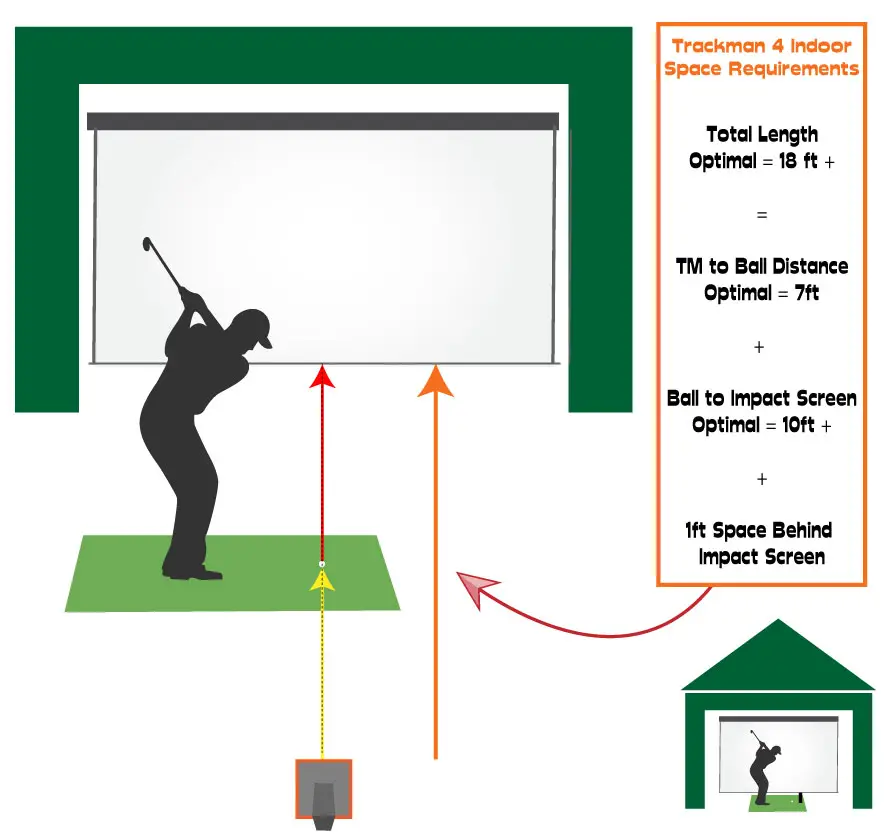
How much space does a Trackman need? For the behind-the-ball Trackman 4: roughly 7 ft from unit to ball, 10–12 ft of ball flight to the screen, a 9 ft ceiling, and 10–15 ft of width — 17 ft of room depth at absolute minimum, with the optimal chain landing around 19–21 ft. For the ceiling-mounted Trackman iO: a 270 cm (8’10”) minimum ceiling and 250 cm (8’2″) from tee to screen, 300 cm+ recommended — numbers the iO’s installation manual now publishes in centimeter precision. Which geometry fits your room decides which Trackman you’re shopping — the Quick Verdict below breaks down both.
In a Nutshell
The behind-the-ball Trackman 4 needs depth: 17 ft minimum and about 19–21 ft for the optimal chain, under a ceiling just over 9 ft. The ceiling-mounted Trackman iO needs height instead, from 270 cm (8’10”) with direct mounting up to 320 cm (10’6″), and gives the floor back, so under about 17 ft of depth the iO is the Trackman that fits.
👉 The behind-the-ball TM4 wants depth: 17 ft minimum, ~19–21 ft for the optimal chain. The overhead iO wants ceiling — 270 cm floor, direct mounting to 320 cm, pole mount above that — and gives the floor space back. Under ~17 ft of depth, the iO is the Trackman that fits. Over ~135 mph of swing speed, a live community debate says think twice about overhead capture.
| Dimension | Trackman 4 | Trackman iO |
|---|---|---|
| Ceiling | 2.8 m / just over 9 ft minimum; 10 ft+ comfortable | 270 cm (8’10”) absolute floor; direct mount to 320 cm (10’6″), pole mount above |
| Depth | 17 ft minimum; ~19–21 ft optimal | 250 cm (8’2″) tee-to-screen minimum; 300 cm+ (10 ft+) recommended |
| Width | 10–15 ft stated by Trackman; 15 ft the comfortable end | ~14 ft the community norm for centered overhead hitting |
| Placement | on the floor behind you, watching the whole flight | overhead, watching impact — floor stays clear |
One 2026 wrinkle worth knowing before the detail: Trackman’s own marketing page says the iO has no minimum space requirements, while Trackman’s own installation manual publishes minimum footprints and mounting bands. Both get quoted below — believe the manual.
Jargon, once: Doppler radar = tracking the ball by bouncing microwave signals off it. Tee-to-screen = the distance from where the ball sits to the impact screen. VESA / drop-pole mount = a standard bracket on an adjustable pole for ceilings too tall for a direct mount. Shadowing = the manual’s term for what goes wrong when the tee sits too close to the screen.
How this has changed
- The iO is now documented in centimeters. Its installation manual is the first ceiling-mount Trackman geometry this guide has ever been able to cite — three mounting bands, footprints, even dual-bay configurations. The full numbers are in the iO section below.
- Trackman contradicts itself on iO space — marketing versus manual, quoted both ways in the iO section below.
- iO club data is tier-gated. The base “Home” tier reports club speed only; the 9-parameter club suite needs Home Complete or Commercial. Nobody prints that beside the space specs, so it’s printed here.
- A fresh mechanism debate emerged: overhead cameras hold the club in view for fewer frames as swing speed rises — covered in the which-Trackman section.
- Pricing corroborated properly: the owner record now supports a much firmer cost picture than a lone data point — see the cost table.
Trackman 4: the behind-the-ball numbers
The TM4’s dual radar sits on the floor behind you and watches the entire flight, which is why depth is its appetite:
| Trackman 4 dimension | Figure |
|---|---|
| Ceiling | 2.8 m (just over 9 ft) minimum; 10 ft+ recommended for comfort |
| Unit to ball | 6–9.5 ft band, 7 ft the working optimal |
| Ball to screen | 10 ft minimum; 12 ft+ optimal |
| Total depth | 17 ft minimum (7 + 10); ~19–21 ft optimal |
| Width | Trackman states a 10–15 ft range; 15 ft is the comfortable end for a driver swing |
| Hitting area | strike from a width matching the unit itself (30 cm), aligned down the target line |
| Level | unit within 2 in (5 cm) above or below the hitting surface |
| Tracking arc | 26° — accuracy improves toward the center of it |
| Outdoors | tripod, no minimum: 6–10 ft behind the ball, 7 ft optimal |
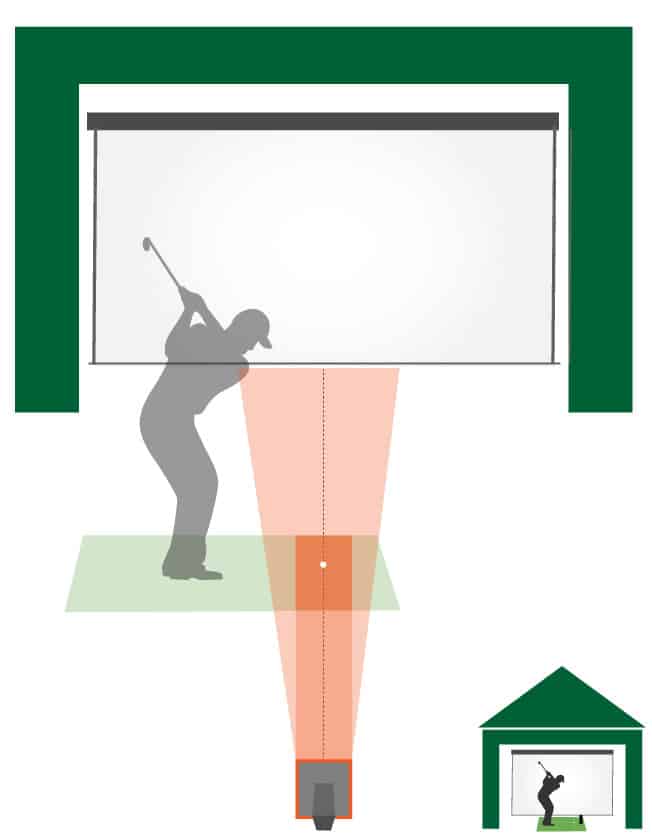
A note on how the optimal depth sums, because two setback figures exist: with the unit at the 7 ft working setback plus 12 ft of flight, the chain is ~19 ft; the original guidance placed the unit at 9 ft, which is where the familiar 21 ft figure comes from. Treat 19–21 ft as the optimal range — and 17 ft as the honest floor. Higher swing speeds and low-spin flights want the deep end of everything: more ball flight means more data for the radar. That lands the TM4 at the deep end of the radar band used across this site — 16–21 ft, a refinement of the older 15–20 ft figure in the master space guide.
Two practical carry-overs:
- The unit needs a clear line of sight to the ball — if it keeps losing sight at address, shifting it very slightly to the right (for a right-handed golfer, left for left-handed) preserves the view without hurting tracking.
- If your swing speed is at the top of the range, it’s worth a conversation with a Trackman representative before committing to a minimum-depth room.
Trackman iO: the ceiling-mount numbers
The iO hangs from the ceiling, watches impact from above with a 24 GHz radar plus dual cameras — spin is attributed to the cameras — and frees the floor entirely. Its installation manual publishes the geometry in three bands, chosen by your ceiling height:
| Mounting band | Ceiling height | Recommended mount height | Tee center to bracket center |
|---|---|---|---|
| Low | 270–290 cm (8’10″–9’6″) | 280 cm (9’2″) | 92–100 cm (3’0″–3’3″) |
| Mid | 285–305 cm (9’4″–10’0″) | 295 cm (9’8″) | 98.5–105 cm (3’3″–3’5″) |
| High | 300–320 cm (9’10″–10’6″) | 310 cm (10’2″) | 103–110 cm (3’5″–3’7″) |
| Pole mount | Above 320 cm (10’6″) — VESA drop-pole required | set to band height on the pole | per the installation table |
The bands overlap by design — a 290 cm ceiling sits inside both Low and Mid — so either row’s recommended mount height works; pick the one that suits your install.
The rest of the iO’s space contract:
- Tee-to-screen: 250 cm (8’2″) minimum — below it the manual warns of shadowing — with 300 cm+ (10 ft+) recommended.
- Footprint: a 150×180 cm minimum hitting surface with a 60×40 cm tee area centered in it. The manual maps five named zones (hitting surface, floor surface, hitting screen, ceiling surface, tee area).
- Two setup types, both supported by both mounts: projector-plus-impact-screen, or PC-monitor-plus-net.
- Duo dual-bay installs exist, with their own width tables — 290–427 cm between units depending on install type, and the tee-to-screen minimum rises to 260 cm. The manual owns the detail.
💡 Measure the ceiling before you order, to the inch. The bands aren’t cosmetic: units ship calibrated for a mounting tier, and owners report being right at a tolerance edge — or receiving a unit calibrated for the wrong ceiling height and waiting on a replacement (7 owners and reviewers, and climbing). The distance between “fits” and “return it” can come down to a single inch of drywall.
Now the contradiction, quoted both ways. Trackman’s marketing page (trackman.com, 21 October 2026): “All you need is enough room to swing a club — there are no minimum distance requirements in front of or behind the ball.” Trackman’s installation PDF: a 150×180 cm minimum hitting surface and 270–320 cm mounting bands. Those don’t reconcile, and this guide isn’t going to pretend they do. The manual’s figures govern every table on this page — marketing copy doesn’t hold a ladder while you drill the ceiling.
iO or TM4 for your room — and your swing speed?
The two placement philosophies trade differently. Behind-ball dual radar needs the deep chain but watches the whole flight; the overhead camera-radar combination frees the floor but captures impact in a shorter viewing period. That second half is the subject of a live community debate this summer — one thread, mechanism-level, unsettled:
- A TM4 owner reports their unit “has been able to easily handle 135-140mph swing speed and 210 ball speed,” while in-store iOs “will fluctuate with swing speed and ball speed.”
- The mechanism reply: “the overheads will have the club in their reading zone for a shorter period of time than the behind the ball units. Less frames to interpolate the data.”
- The arithmetic reply (CHS = club head speed): “Even at 116 CHS the IO camera only records about 15-20 frames around impact. At 140 MPH that’s probably not enough.”
- And its extension: “With 140mph ball speed at 4600 fps, thats 22 frames per foot. Id be surprised if their algorithm uses more than half of those frames.”
Every voice above is a single report from the same thread — worth knowing about, not a settled verdict. If you swing 135 mph+, weigh it; at ordinary speeds the iO’s owner record is emphatically strong — its ball and club data are described as rock-solid and near-instant (12 owners and reviewers, and counting).
Width for overhead hitting has a community norm the manual doesn’t print: ~14 ft for centered hitting, corroborated by two independent posters two months apart.
- One corroborating poster is a self-identified installer/wholesaler who recommends a slider system below about 14 ft of width.
- One owner is planning an iO into a basement area listed as 13 by 16 by 11 ft — posted with inch marks, but the context makes these feet.
- A completed commercial iO build runs a protective barrier about 5 ft in front of the hitting strip — the builder’s own open question is whether the barrier could interfere with the Doppler radar.
One more decision signal from the commercial side: simulator-lounge operators consistently favor the iO for reliability and low support burden — several describe it as the obvious call for a pay-to-play business (10 reports from 7 operators). Home buyers benefit from the same trait: the thing mounted to your ceiling rarely needs touching.
If your room forces a compromise below these numbers, read the site’s guide to what undersized rooms do to swings before you spend: Indoor Swing Syndrome – 11 Tips for Better Indoor Golf
What they cost (owner-corroborated, 2026):
| Hardware | Ongoing | |
|---|---|---|
| Trackman iO | ~$13,995–14,000 (Home) to ~$22,500–23,495 (Complete/Commercial) — reports from 12 owners and reviewers converge | subscription ~$1,100–1,200/yr |
| Trackman 4 | ~$20,000–25,000 new; used units trade at $6,000–14,000 | same subscription structure |
| Full bay build-out | commonly $50,000–60,000 all-in | — |
Verify at purchase time: on 21 October 2026 Trackman listed the iO Home at USD 13,995 plus $700 a year for software, and Shop Indoor Golf listed the iO Complete and Commercial editions at $23,995 (Complete software $1,100 a year after the first year) and the Trackman 4 at $25,995. The subscription is the figure long-term owners resent most — several describe it as renting the launch monitor rather than owning it.
Trackman 3e: the legacy numbers
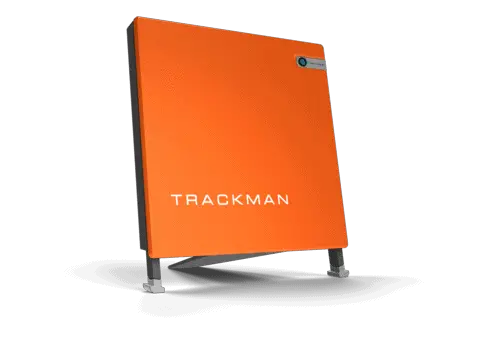
The 3e was an outdoor design adapted indoors, and its deeper appetite is exactly why the TM4 superseded it for home bays. For used-market shoppers, the historical reference:
| Trackman 3e dimension | Min | Optimal / Recommended |
|---|---|---|
| Room (overall) | — | 24 ft long × 15 ft wide × 10 ft high |
| Ceiling | 9.5 ft | 10 ft+ |
| Unit to ball | 7 ft | 9 ft optimal (12–13 ft max) |
| Ball to screen | 10 ft | 12 ft recommended; 15 ft optimal |
| Fine print | 30 cm strike width; back leg level with the mat within 1 in; unit tilted 7° | — |
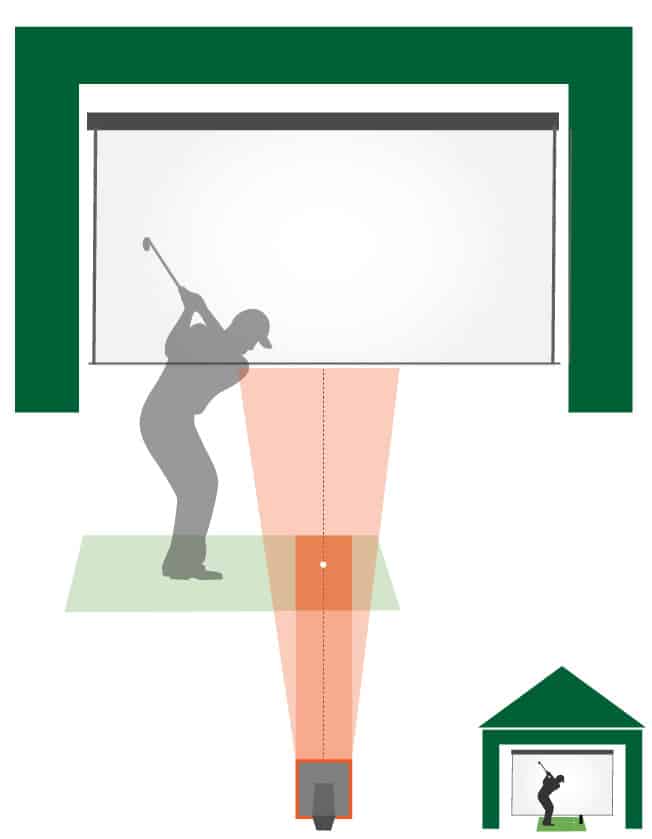
Outdoors, the 3e wants roughly 9 ft behind the golfer on the target line.
Width and the centered-aim question
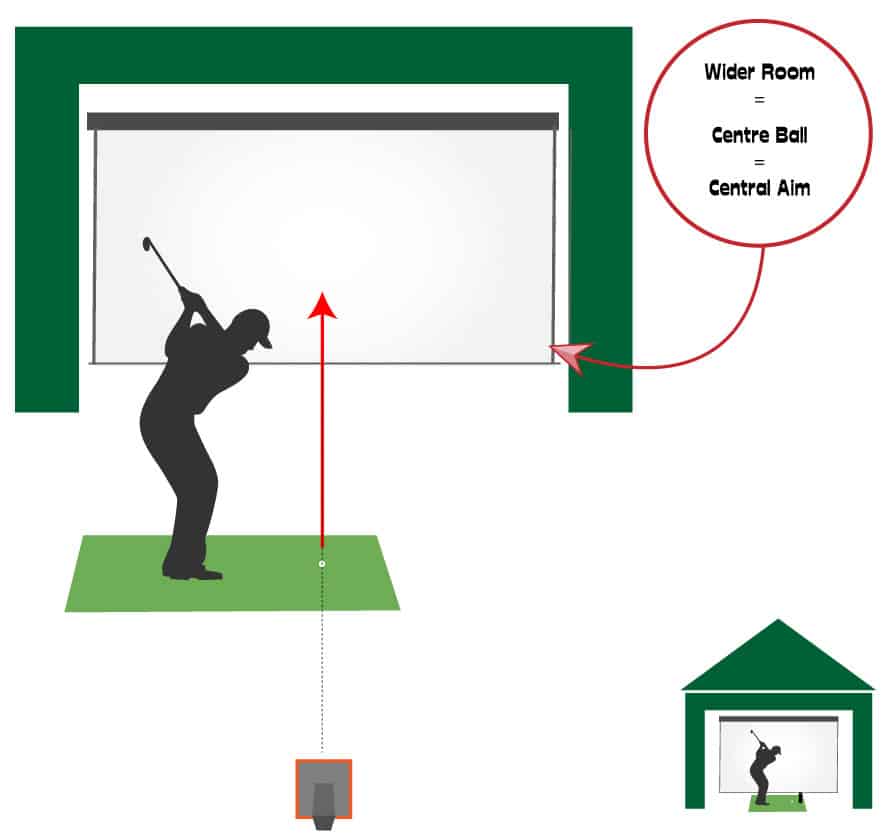
Fifteen feet is the working width recommendation for any Trackman bay — Trackman’s own stated range tops out there, and it’s the number that lets a driver swing breathe. A central aim is really important for immersion in the golf simulator and being able to correctly aim your shots. Adjusting the offset accommodates well for those with narrow rooms but I’ve always found it isn’t quite the same. The overhead ~14 ft centered-hitting norm points the same direction: narrow rooms work, offset aim works — centered is what you’re saving for.
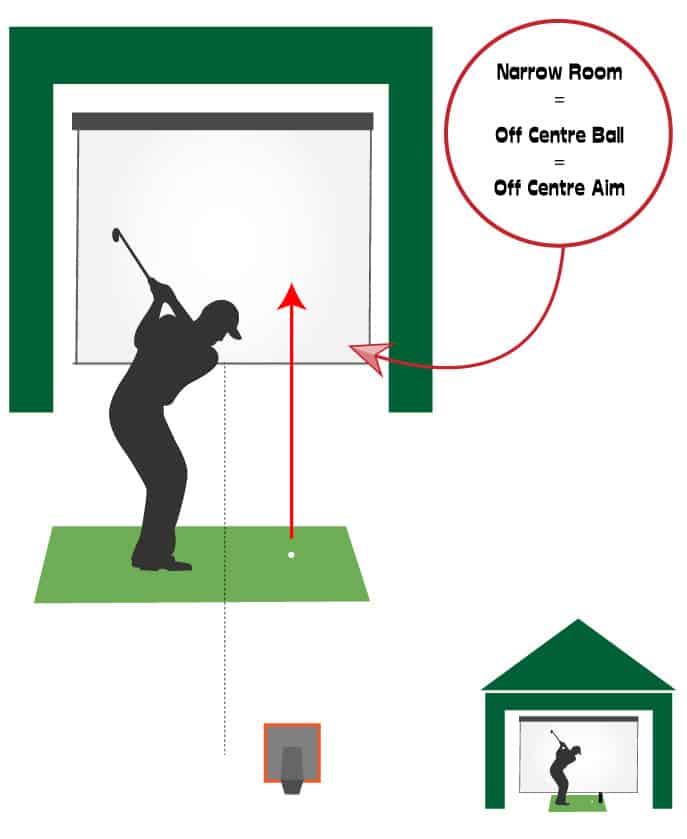
Where does the width actually go? Owners describe the practical constraint well: the clearance you need to the side wall roughly matches the vertical clearance at a 45-degree swing plane — get it wrong and the driver head finds the wall on the backswing (6 reports from 4 owners and reviewers). Width isn’t about the ball’s flight; it’s about the club’s.
The general space principles
Check out our dedicated post all about the room size and space principles to consider when building a golf simulator in general. How much space do you need for a Golf Simulator?

Two figures from a veteran European installer, consistent with the numbers this site has corroborated across several guides:
| Clearance | Figure | Installer’s words |
|---|---|---|
| Behind any screen | ~1.5 ft (45 cm) | “you need at least 45 cm 1,5 feet of security behind any screen, to be a 100% safe” |
| Behind the ball, for a free swing | ~6.5 ft (200 cm) | “you need a least from the ball 200 cm or 6,5 feet for it, to swing freely” |
Budget the behind-screen margin and the behind-golfer margin together — the tee-to-screen number alone doesn’t describe a room.
Trackman space FAQ
What’s the minimum ceiling for the Trackman iO?
270 cm (8’10”) is the hard floor. Direct ceiling mounting runs in bands up to 320 cm (10’6″); above that, the VESA drop-pole mount is required, not optional.
Can a Trackman 4 work in a 15 ft-deep room?
Honestly, no — not for full ball flight. The chain needs 17 ft minimum and runs best at 19–21 ft. A 15 ft room is exactly the situation the ceiling-mounted iO exists for.
What is “shadowing”?
The manual’s own warning term: put the tee closer than 250 cm (8’2″) to the screen and the install carries a “risk of shadowing” — the manual states the risk without spelling out the mechanism, which is exactly why the tee-to-screen minimum is worth treating as a real minimum.
Does the iO really have “no minimum space requirements”?
That’s what the marketing page says. The installation manual specifies a 150×180 cm hitting surface, 270–320 cm mounting bands, and a 250 cm tee-to-screen minimum. Both are quoted in the iO section — plan your room from the manual.
Is club data included with the iO?
Tier-gated: the Home tier reports club speed only. Home Complete and Commercial unlock the 9-parameter club suite (path, face angle, attack angle and the rest). The 14 ball-flight parameters aren’t tier-gated.
Will a Trackman fit a modest spare room with a ~9 ft ceiling?
This is one of the questions buyers ask most, and the honest synthesis: a 9 ft (274 cm) ceiling sits inside the iO’s Low mounting band, so the iO fits vertically with room to spare — check width next (14 ft for centered hitting, less with offset aim). The TM4 clears a 9 ft ceiling too, but depth is its gatekeeper: 17 ft minimum before it’s worth doing. The broader community consensus backs 9–10 ft as the safe ceiling for comfortably swinging a driver (14 reports from 11 owners and reviewers) — though owners with ceilings as low as 8’7″–8’8″ report swinging drivers without issue, so a marginal ceiling deserves a tape measure and a slow practice swing before it disqualifies the room. Compact rooms can work; the unit choice is what makes them work.
The numbers, side by side
| Trackman 4 | Trackman iO | Trackman 3e | |
|---|---|---|---|
| Ceiling | 9 ft+ min, 10 ft comfortable | 270 cm (8’10”) floor, bands to 320 cm (10’6″), then pole | 9.5 ft min, 10 ft+ recommended |
| Depth | 17 ft min, 19–21 ft optimal | 250 cm (8’2″) tee-to-screen min, 300 cm+ (10 ft+) recommended | 10–15 ft ball-to-screen plus 7–13 ft setback |
| Width | 10–15 ft stated | ~14 ft community norm, centered | 15 ft recommended |
| Placement | floor, behind the ball | ceiling-mounted overhead | floor, behind the ball, tilted 7° |
Measure the room first, then pick the Trackman that was designed for it — the other order is how expensive mistakes get made.
Bushnell Launch Pro vs SkyTrak ST MAX (2026)
Golf Simulator Packages vs Building Your Own: Which Is Better Value?
ABOUT THE AUTHOR
Hello! My name is Alex and it is my mission to bring you all the information you need to build your own home golf simulator! I hope mygolfsimulator.com helps you on your journey to better golf at home!
LEGAL INFORMATION
On this site, you'll find articles on all aspects of building a golf simulator. I will also link to other sites where you can buy some of the simulator components. Some of these links may be affiliate links, which means if you click them I gain a small commission at no extra cost to you. This really helps out me and my site so thank you in advance! mygolfsimulator.com and all related social media accounts are property of Awonline LTD.