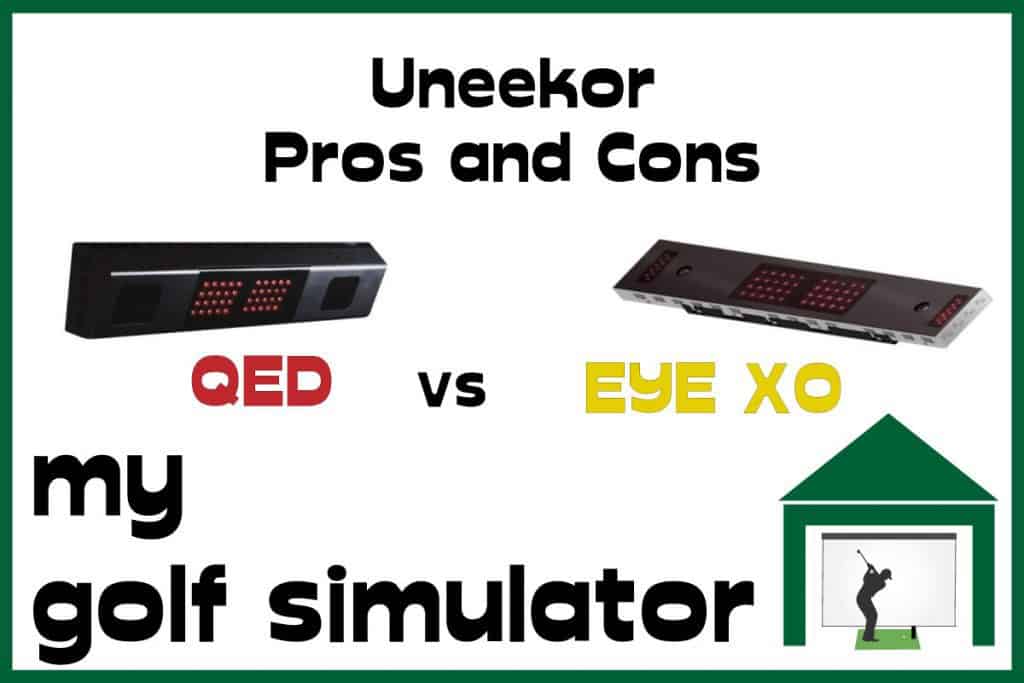
Uneekor QED vs EYE XO – Pros and Cons
Posted in Launch Monitors
The classic answer first: the EYE XO still beats the QED on data — more club parameters, and it reads any golf ball without the special marking the QED requires — and that hasn’t changed. What has changed is everything around it: the QED is discontinued and reaches official end-of-life on December 31, 2026, with an active trade-in program, and the EYE XO now carries a “Limited Availability” badge, currently sold as a $6,499 AI Studio bundle against a $7,999 list price. Neither is a simple buy in 2026. The comparison people actually face runs three ways — legacy value on the closeout pair, the current line (EYE MINI LITE → MINI → XR → XO → XO2), or the competitors owners increasingly defect to over subscription fatigue.
In a Nutshell
Bottom line: the QED-vs-XO question is now a lifecycle question first and a data question second. Both remain excellent at what made them famous — and both demand you check the calendar, the software fees, and the successor ladder before paying 2020 prices for 2020 hardware.
👉 The EYE XO still wins on data and reads any ball unmarked; the QED’s only remaining case is price, with a hard end-of-life date attached.
In this guide: In a nutshell · The durable part · Data, side by side · The QED in 2026 · The EYE XO in 2026 · The successors · Software in 2026 · Space & mounting · How this changed · FAQ
Jargon, once: overhead-mounted = fixed to the ceiling, watching the hitting zone from above; GSPro = the sim golf software most owners connect their launch monitor to; Club Optix = Uneekor’s real-time video of club meeting ball; Swing Optix = Uneekor’s separate camera system for full-swing video; marked balls = balls printed with black dots the QED needs to read spin.
| You are… | The 2026 answer |
|---|---|
| Hunting used/trade-in QED value | The cheapest real club-data entry in the overhead world — with eyes open: marked balls forever, support ends Dec 31, 2026, and used transfers have real friction (details below) |
| Want the XO specifically | $6,499 AI Studio bundle (launch monitor + Swing Optix cameras + a year of AI Trainer); carries the Limited Availability badge; non-marking, the fuller data suite |
| Want current Uneekor | The ladder: EYE MINI LITE ~$2,000 → EYE MINI $3,000 → EYE XR → EYE XO $6,499 → EYE XO2 (flagship). Note the platform fork: MINI runs PC-free, MINI LITE requires a Windows PC (Golf Simulator System Requirements in 2025 – Updated Reference Guide) |
| Subscription-fatigued | You’re not alone — owners exiting to ProTee VX/VTrack say so loudly (quotes below). Price the software stack before the hardware |
What Made This Comparison Matter — the Durable Part
Three things about these units haven’t aged a day.
Overhead mounting serves the whole household. Because both units watch from the ceiling, a lefty and a righty can alternate shots with zero repositioning — repeatedly cited as the deciding purchase factor for mixed households (6 reports, 5 owners). Floor units make you move and re-aim the box every switch.
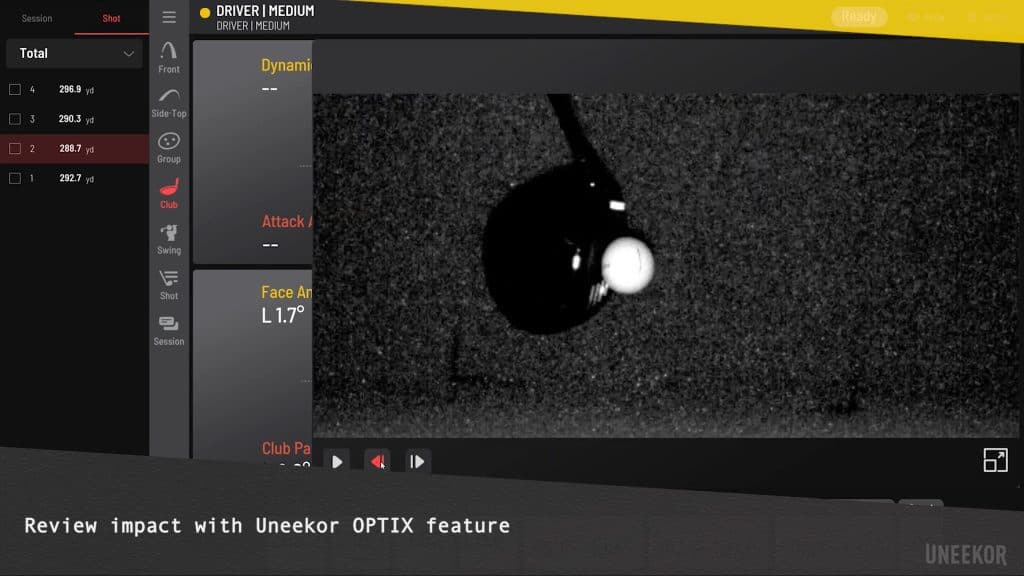
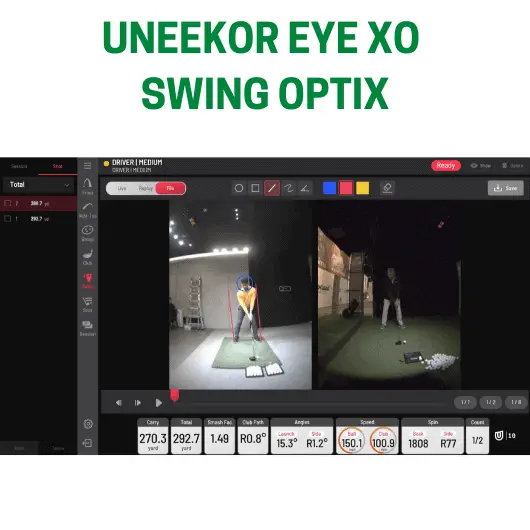
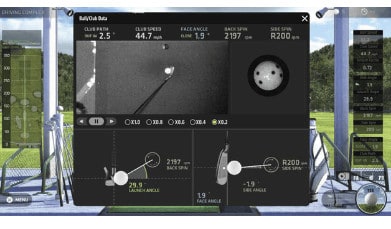
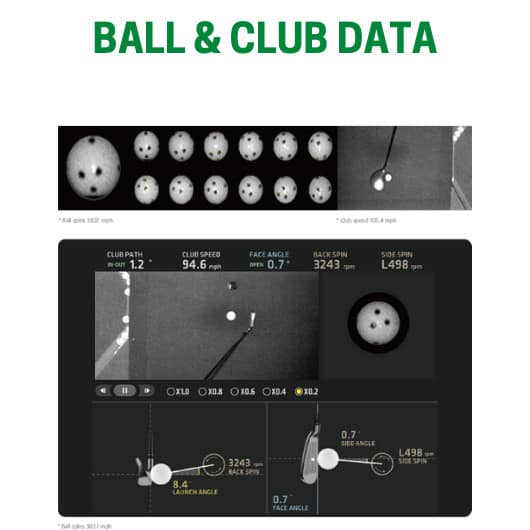
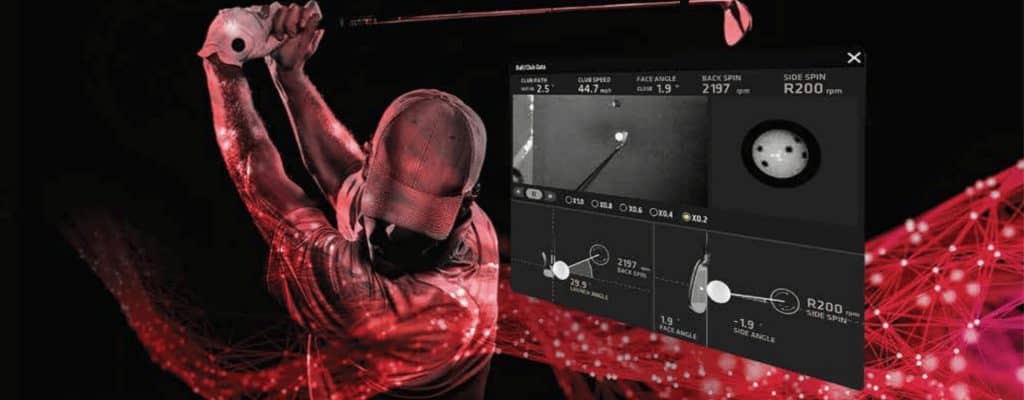
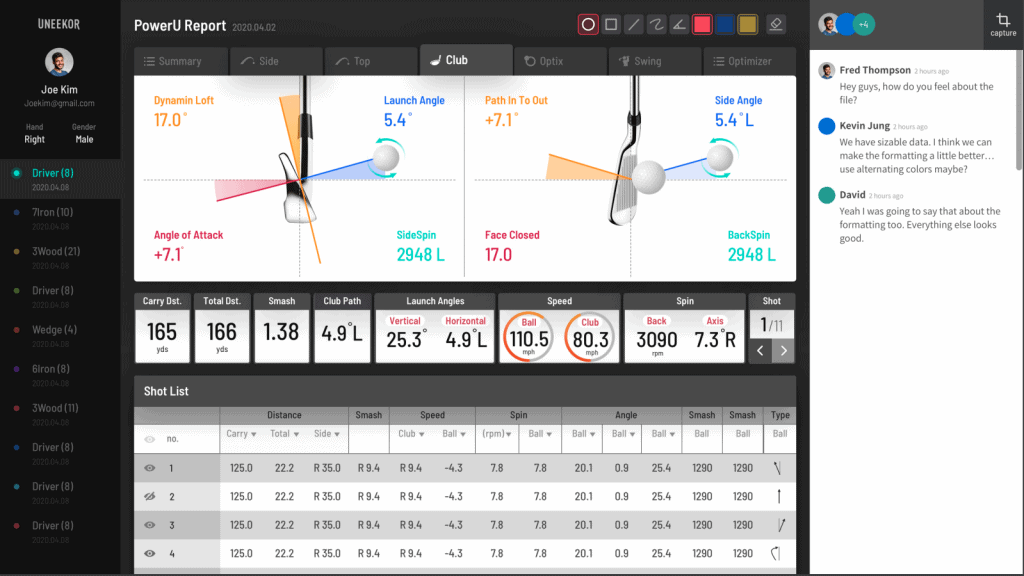
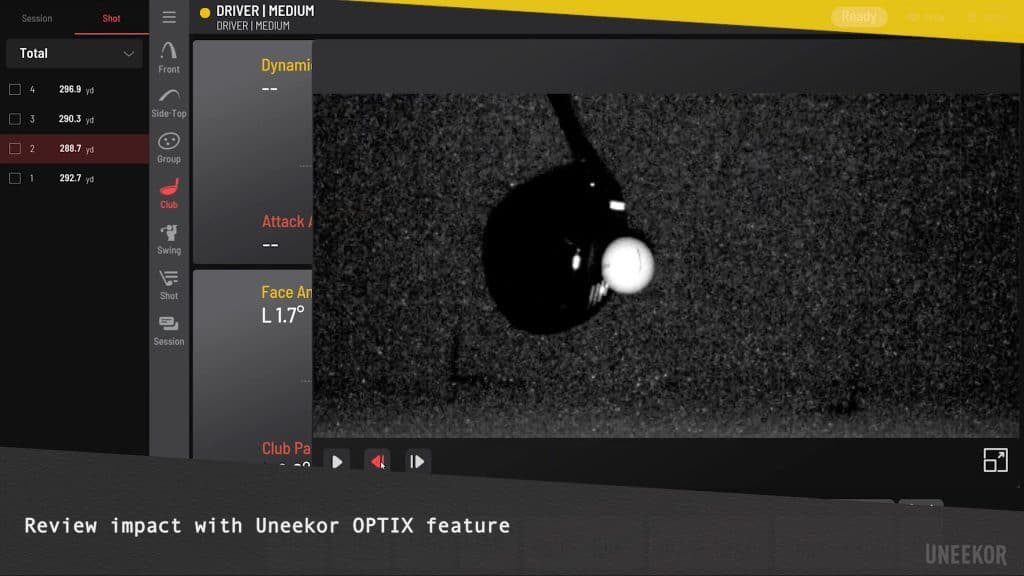
Club Optix is still the show. Real-time video of your club striking the ball, with the data overlaid. I love the Uneekor launch monitors — you get to see real-time footage of the impact between your club and golf ball, which makes visualizing exactly what the launch data parameters mean a lot easier. This is my favorite element of the Uneekor launch monitors when compared to SkyTrak, Mevo Plus or GC2 and the rest. If you’re a visual learner, then the Uneekor QED would be a fantastic investment in your game — and the same goes for its successors.
It’s also just so great to see the ball compress on the clubface. I never get tired of it!
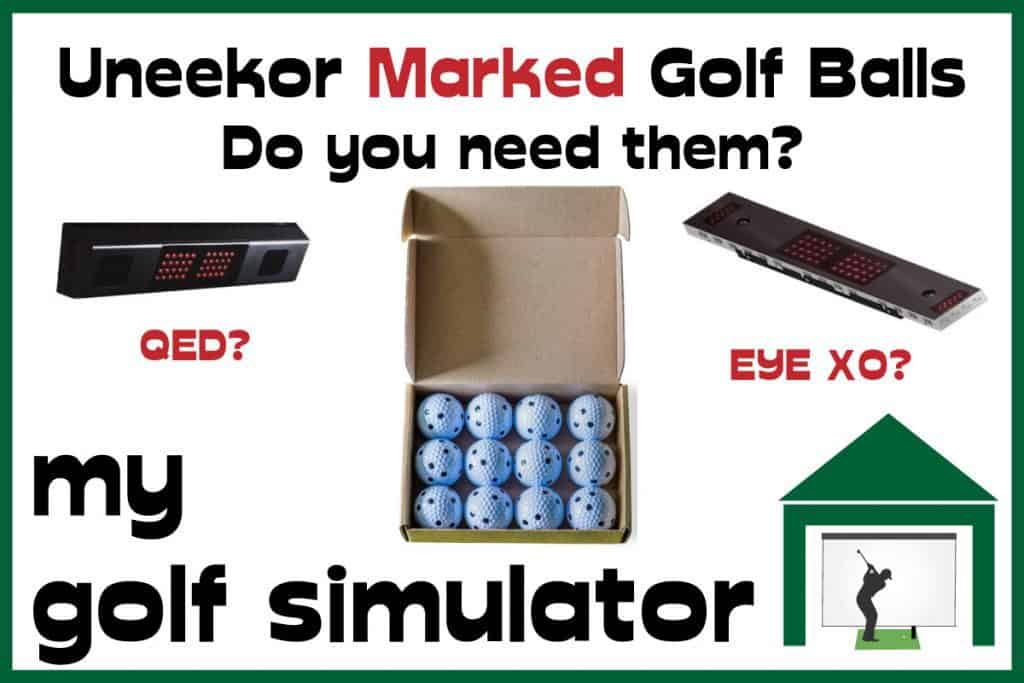
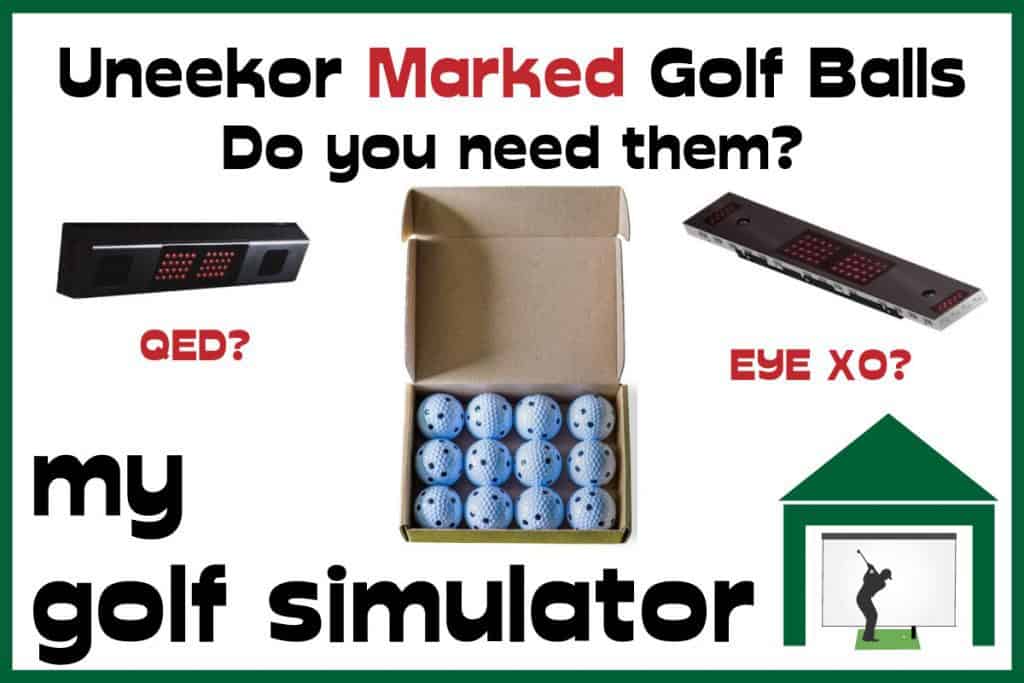
The marked-ball fork defines the choice. The QED requires balls printed with black dots to read spin — its single biggest drawback in owner evidence, because misreads climb sharply as the dots wear, and even fresh dotted balls spin poorly on approach shots versus premium balls (5 reports, 3 owners, rising). The EYE XO reads any ball, no marking — a convenience owners consistently call meaningful, with club stickers as an optional, one-time extra for the deeper club metrics.

Data, Side by Side
Quick translation for the club-data row below: smash factor = strike efficiency, attack angle = up-or-down at impact, dynamic loft = the club’s real loft at impact, face-to-path = open or closed relative to the swing path.

| QED | EYE XO | |
|---|---|---|
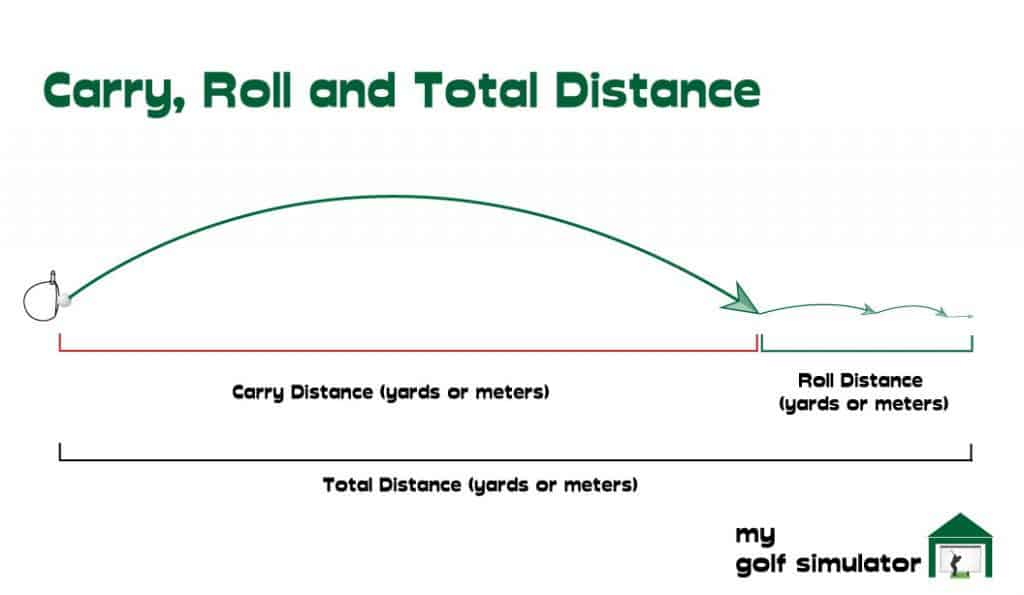
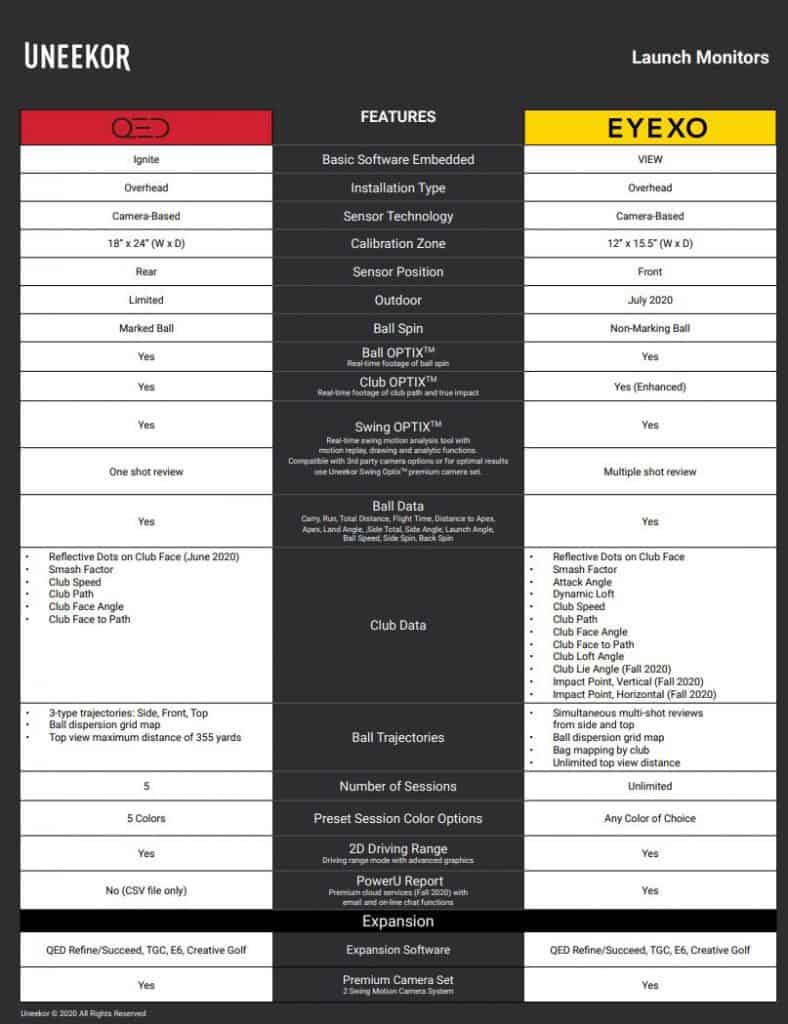
| Ball data | Ball speed, back spin, side spin, side angle, side total, launch angle (+ modeled flight time, apex, carry/run/total) | Identical ball suite |
| Club data | Club speed, smash factor, club path, club face angle, face-to-path | All of the QED’s, plus attack angle, dynamic loft, club lie angle, impact point (vertical & horizontal) |
| Balls | Marked balls required | Any ball |
| Club stickers | Not documented as required (the QED’s system reads club data via its marked-ball cameras) | Bar + dot stickers for the full club suite |
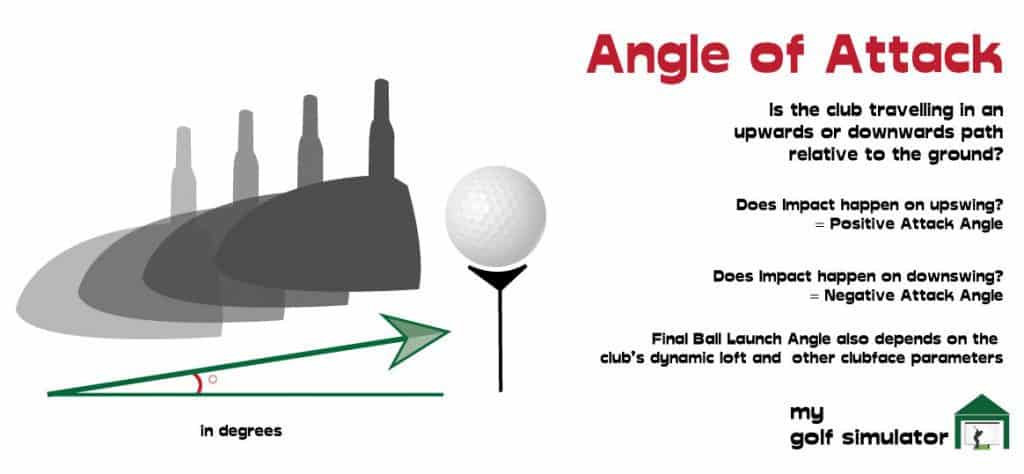
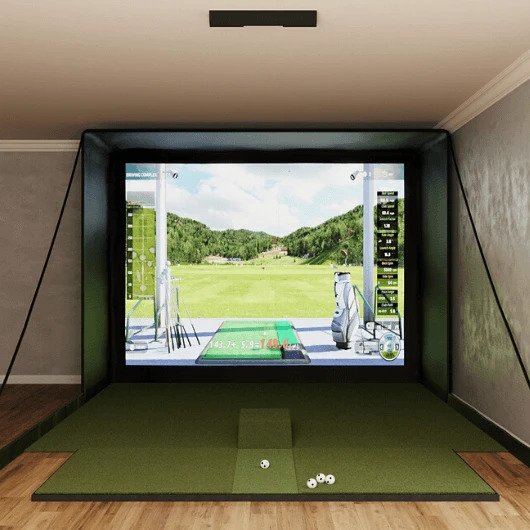
Two honesty notes on the counts. The “coming Fall 2020” items this article once listed for the XO (lie angle, impact point) shipped long ago — that table is history. And Uneekor’s own current documentation lists the fuller metric set under the QED too, in its “Understanding the Data” appendix — but nothing in the manual confirms the QED hardware outputs those extra parameters, and no changelog documents an upgrade. I’m leading with the five club parameters QED owners have always actually seen, and flagging the appendix as a documentation ambiguity rather than a spec.
The current line adds a third way worth knowing even in a QED-vs-XO decision: the EYE XR reads club data via AI tracking with no stickers at all — and its manual says plainly that face angle there is “calculated using a proprietary mathematical formula… providing an estimate.” Different method, honest label.
The QED in 2026
Uneekor’s own words: “We’re discontinuing the QED and placing it into end of life so that we can focus on engineering, updates, and support on our modern hardware.” Support — repairs, parts, software updates — ends December 31, 2026, and a trade-in program toward the EYE XR runs for QED owners. The announcement (September 2025) triggered real owner anxiety — a ~6-year lifecycle, future mechanical failures, whether GSPro support eventually drops (5 reports, 5 owners). One regional wrinkle I can’t resolve: Uneekor’s separate EU storefront still lists the QED as a normal product at €6,250 with no end-of-life messaging at all — a stale mirror or a genuinely different regional timeline; buyer beware either way.
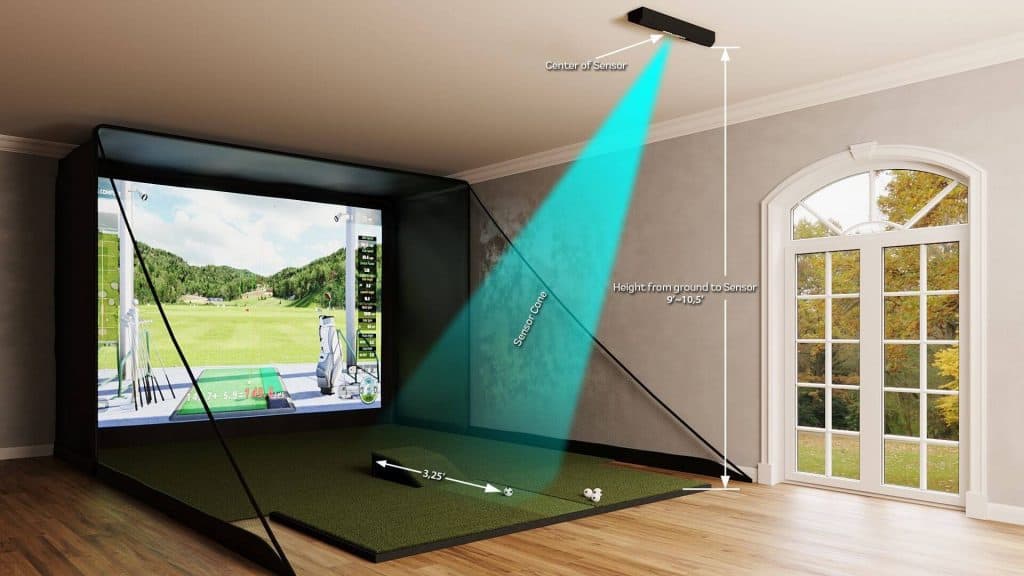
What the QED still is: the budget door into overhead club data. Its output — smash, speeds, face-to-path, path, spin — plus instant playback video draws consistent praise as rich training feedback (6 reports, 6 owners), and long-term owners five years in still recommend it. One reviewer FAQ claims accuracy “within 1% of monitors like Trackman” — the category’s benchmark launch monitor — though with no sample size disclosed, so treat that as sentiment, not a test. The manufacturer’s own caveat matters more: mounting must be exactly 3.5ft behind the tee at 9–10ft of ceiling, and “failure to meet these requirements will result in accuracy issues.”
Used-market reality check: registration transfers have real friction. Two independent buyers this summer hit “already registered” walls — one resolved by the seller deactivating their account, the other by emailing Uneekor support (“I had a reply from them in less than 8 hours”). Budget patience, and per older XO-side reports, transfer fees (~$100 unit, ~$50 per accessory license) and non-transferable warranties are the pattern (3 reports, 3 owners).
The EYE XO in 2026
The flagship of that generation now wears a Limited Availability badge, and the purchase path on Uneekor’s site is a single bundle: $6,499 for the EYE XO AI Studio — launch monitor, Swing Optix cameras, and a year of AI Trainer — against the $7,999 list. (June’s sale season saw $4,400 off XO-family units; one dealer’s quote this summer put the XO package at $6k including Swing Optix and GSPro, “only $500 more than XR” — one dealer’s word, worth treating as a data point rather than today’s price.)
What owners keep buying it for:
- “You get what you pay for” accuracy near GC Quad tier — Foresight’s flagship benchmark — at a lower price, plus the face-to-path club data cheaper units lack (8 reports, 8 owners).
- Short-game precision owners rate above systems their Trackman-equipped friends run (7 reports, 7 owners).
The trade-offs worth weighing:
- Club-data quirks for converts. A minority of owners coming from Foresight/Trackman backgrounds report inconsistent smash readings, and a putting line fixed to the sensor rather than your actual start line (4 reports, 3 owners, rising).
- View software is the acknowledged weak link — frequent crashes and a recurring cache-clearing issue, even among owners who love the hardware (2 reports across 2 clusters).
The Successors
The current ladder, ascending — with the one platform trap marked:
- EYE MINI LITE — ~$2,000. The entry point; requires a Windows PC (a hidden cost if you were planning on an iPad).
- EYE MINI — $3,000 (“price just reduced,” per an August market-map thread). Portable, screen-equipped, runs PC-free — the standalone path.
- EYE XR — the trade-in target; AI club tracking, no stickers, estimated face angle (manual’s own label).
- EYE XO — $6,499 bundle, limited availability — this article’s subject.
- EYE XO2 — the current flagship; the same club-data table as the XO with impact point split vertical/horizontal (ten line items by Uneekor’s fuller counting — their own tables count it nine or ten depending on how impact point is split). Review claims put it within 0.5% of a GC Quad on ball speed — one review, no disclosed test conditions, so treat that as unverified rather than a settled spec. Owner caution worth carrying: XO2 club data is questioned as inflated or occasionally impossible in a sizable cluster (11 reports, 10 owners) — ball data draws far more trust than club data across this family.
Subscriptions run $200–600/yr across the line, per that same August market map — which leads straight to the section that has aged worst.
Software in 2026 — the Section That Aged Worst
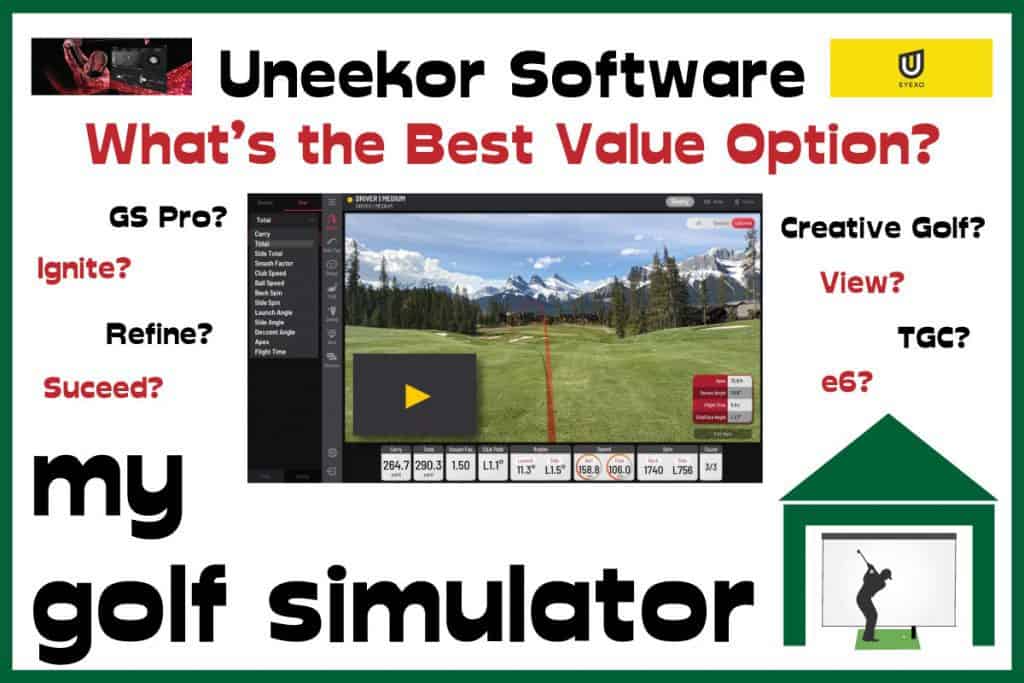
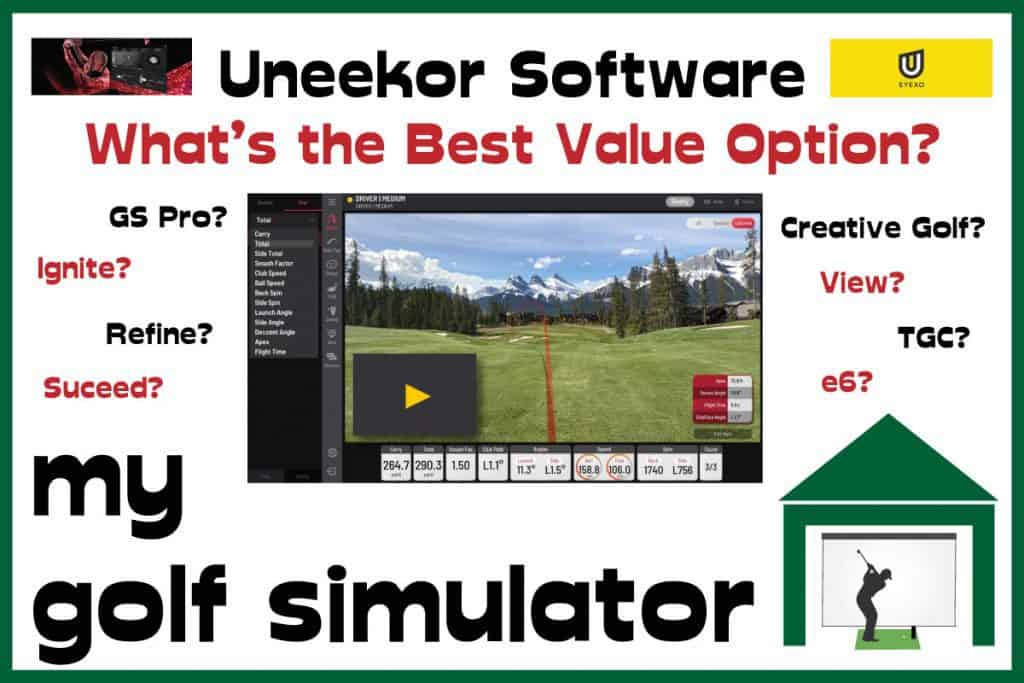
The original version of this article praised “QED Ignite.” Searching a full year of owner discussion, the name Ignite doesn’t appear once — the software owners actually discuss is View (the base app), Refine (the Pro Package tier, which includes the GSPro connector), and GameDay (Uneekor’s 2025 sim software). Here’s what each tier actually costs:
| Tier | Annual cost | What it unlocks |
|---|---|---|
| Pro Package (Refine) | $199 | Base subscription + GSPro connector |
| GSPro | $250 | The sim software itself |
| GameDay | $199 | Uneekor’s own 2025 sim software |
Owners themselves disagree on whether GameDay stacks on top of the Pro Package — some tally the combined cost at $398, others at $449 with GSPro included — which is itself part of the tier confusion. Some defend the structure as a fair hardware-subsidy trade (3 reports, 3 owners); the louder current runs the other way.
This July, Uneekor ran its biggest online tournament — on GSPro, not GameDay. The reaction, in owners’ own words:
- The irony, called out directly: “Game Day is $199 ON TOP of the $199 package – so $398 in total… GameDay was promoted as the future of online competitive play for Uneekor… Uneekor announces its largest online tournament — ON GSPRO!”
- A specific defection: “I recently sold my Eye XO 2 for a ProTee VX… The cherry on top has been zero subscription or add-on fees. When I was on Uneekor I truly felt like I was getting nickel and dimed, even after purchasing their flagship product.”
- A blunter market read: “Uneekor really isn’t in this fight, vtrack makes the protee hardware.”
For balance, other recent threads carry genuine praise — “XO2 is pretty incredible” — and the hardware’s reputation survives the software grumbling largely intact.
If you buy any Uneekor in 2026, price the stack: base subscription for the GSPro connector, GSPro itself, GameDay if you want it. Launch Monitor & Golf Simulation Software – Compatibility Guide for 2025
Space and Mounting — Stricter Than You Think
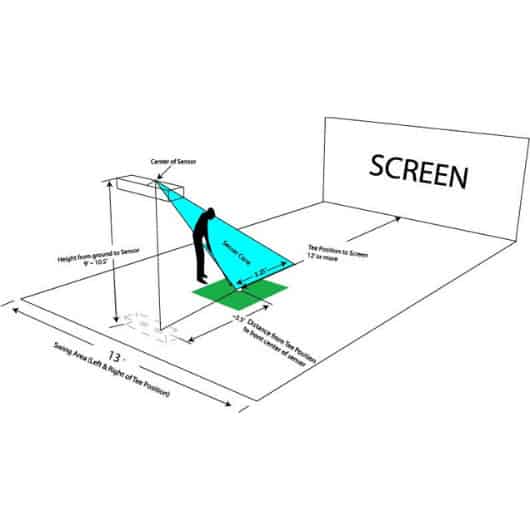
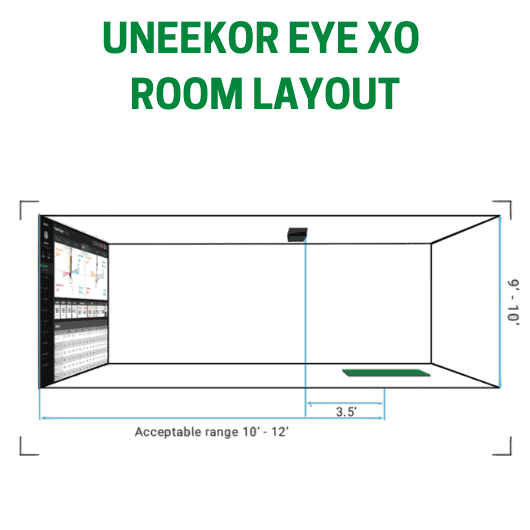
Both units demand a 9–10ft ceiling band, full stop — the manuals attach the same warning: miss the band and you get accuracy issues, not just inconvenience.
The difference earlier versions of this comparison glossed: the QED mounts 3.5ft BEHIND the tee; the EYE XO mounts 3.5ft IN FRONT of it. That flips your room plan:
- Projector position: QED owners often solve the conflict with an ultra-short-throw projector about 2ft in front of the unit (2 reports).
- Ceiling clearance: both need a clean run at the mount point, so check what else shares that ceiling space.
- Width: 13ft minimum for both-handed play, 15ft recommended for golfers over six feet.
- Drop-mount: the XO has a path for ceilings outside the band; the QED doesn’t.
- Bracket anchoring: anchor to joists, not drywall alone — the bracket’s multi-slot design makes catching two joists straightforward (2 reports).
- Tee-to-screen: owners converge on 8–10ft for the XO (5 reports, 5 owners).
Full room math: How much space do you need for a Golf Simulator?

How This Changed (2020 → 2026)
> TL;DR box: “Coming Fall 2020” features shipped → the whole generation got superseded → QED discontinued (announced Sept 2025, EOL Dec 31 2026, trade-in live) → EYE XO to Limited Availability at $6,499 → the subscription era arrived ($199 Pro Package + $250 GSPro + $199 GameDay stacking) → owner exits to ProTee VX/VTrack became a named pattern → and “Ignite” vanished from the community’s vocabulary entirely.
FAQ
Is a used QED worth it now?
As the cheapest overhead club-data entry: yes, with three eyes-open items — marked balls forever (and their wear problem), support ending December 31, 2026, and transfer friction that may need a support email to resolve. Price accordingly.
How does the QED trade-in work?
Uneekor’s program runs for QED units through the EOL window, trading toward the EYE XR. Terms shift — check Uneekor’s current page before deciding between trade-in and used-market sale.
Where do you get QED marked balls?
Pre-marked balls are sold by Uneekor and third parties, or you can dot your own with the template — and replace them sooner than feels necessary: worn dots are consistently the #1 accuracy complaint in owner reports.
QED vs EYE XO in one sentence?
Same ball data; the XO adds attack angle, dynamic loft, lie angle, and impact point, reads any ball unmarked, and mounts in front rather than behind — the QED’s case is purely price.
EYE XO vs EYE XO2?
Same data table by Uneekor’s own docs; the XO2 is the current flagship with the fresher platform — and the same trust gap holds here too: owners lean on its ball data far more than its club data.
Does the EYE XO hold up in a garage — heat, cold, humidity?
The most-asked practical question in the owner evidence (8 reports, 7 owners, rising): owners report years of trouble-free operation across 30s–100s°F swings, and Uneekor support confirms cold-end function provided the unit stays dry and warms up gradually. The real risk is moisture, not temperature — and unlike a portable unit, a ceiling-mounted XO can’t be stowed indoors between sessions, which is exactly why moisture-conscious patio builders often choose portable instead.
What subscriptions do I actually need?
Practice with included software: potentially none. Add GSPro for online play and budget roughly $449/yr (Pro Package plus GSPro’s own fee); add GameDay instead and owners’ own tallies vary between $398 and $449, depending on whether it stacks on the base package. Do this math before comparing hardware prices with any rival.
Final Thoughts
I said it in 2020 about the EYE XO and it still lands, reframed for 2026: you’re getting a whole lot more launch monitor for your money — the question now is which money. The $6,499 bundle against the successor ladder, the used QED against a calendar that runs out December 31, 2026, and every option against a software stack that owners have learned to price before they fall in love with the impact video. Uneekor still owns the overhead niche and the Club Optix magic; buy it with the lifecycle date and the subscription math on the table, and you’ll buy it happy.
Check current pricing and availability: Uneekor EYE XO bundle · EYE XO2 · EYE MINI. Wider context: How do Launch Monitors Work? – Radar vs Camera Systems · Golf Simulator Cost Calculator – How much do Golf Simulators Cost?

I hope you have found this guide useful — whichever ceiling this hardware ends up on, may the impact video never get old.
Carl’s Place Pro Golf Enclosure Review (2026): What’s in the Box, Real Cost and Owner Reports
Is SkyTrak Portable? Battery, Direct Mode and Range Days (2026)
ABOUT THE AUTHOR
Hello! My name is Alex and it is my mission to bring you all the information you need to build your own home golf simulator! I hope mygolfsimulator.com helps you on your journey to better golf at home!
LEGAL INFORMATION
On this site, you'll find articles on all aspects of building a golf simulator. I will also link to other sites where you can buy some of the simulator components. Some of these links may be affiliate links, which means if you click them I gain a small commission at no extra cost to you. This really helps out me and my site so thank you in advance! mygolfsimulator.com and all related social media accounts are property of Awonline LTD.