Golf Simulator for a Low Ceiling: What Actually Works (2026)
Posted in Room Setup, Your Swing Studio
A low ceiling can still hold a golf simulator, but it will limit what you hit, and the same ceiling works for one golfer and fails for another. Your height, how upright you swing, the mat under your feet and your tallest guest decide it. The fixes below run from least to most disruptive, so stop as soon as the room works.
In a Nutshell
A low ceiling usually limits a simulator rather than ruling it out: owners report short and mid irons at about 8 to 8.5 feet, mostly shorter golfers, and driver only from about 9 to 9.5 feet, with taller golfers needing more. Even when a swing fits, the ceiling shapes it, so change the club and the mat first, consider a floor launch monitor below about 9 feet, and treat cutting into the ceiling as a job for a structural engineer.
👉 Before you spend anything, test-swing a junk club in the room, slowly at first, from the spot you’ll hit from, in the shoes you’ll play in.
Jargon, once:
- Overhead vs floor launch monitor — one mounted above the ball, or one on the floor beside or behind it.
- Box-out — a recess cut between ceiling joists to make room for the club.
- Joist vs truss — solid ceiling beams vs engineered roof frames; cut neither without a structural engineer.
- Baffle — a strip of hanging vinyl that stops stray balls.
What Works at Each Ceiling Height
| Ceiling | What owners report swinging | Launch monitor fit | First fix to try |
|---|---|---|---|
| Under 8 ft (under 2.44 m) | Full swings limited; some can’t swing a wedge, especially tall golfers | Floor unit | Test-swing first; if a wedge hits, see the give-up section below |
| 8–8′6″ (2.44–2.59 m) | Short and mid irons, mostly for shorter golfers, with the ceiling still in play; driver only for some short or flat swings, and tight | Floor unit | Shorter clubs, thinner mat |
| 8′6″–9 ft (2.59–2.74 m) | Mid irons for most, though the ceiling still shapes the swing; hybrids and driver risky for many | Floor unit; VTrack, or Trackman iO with a thin mat, at the very top | Grip down, test-swing |
| 9–9′6″ (2.74–2.90 m) | Driver for most, with occasional scrapes | Floor unit or most overhead units | Pad the ceiling |
| 9′6″–10 ft+ (2.90–3.05 m) | Comfortable for nearly everyone | Any; EYE XR asks 10 ft | None needed |
Your height moves you about one row: taller golfers (about 6′2″ and up) read one row lower, shorter golfers one row higher. Plan for your tallest guest. At 9 ft, a 5′11″ owner swings driver with inches to spare, while a 6′2″ owner reports:
“Cannot swing driver.” (u/Mike-n-AZ, 2026-05-30)
How this was built: makers’ manuals and pages, mostly read on 2 October 2026; owner reports from Reddit and reviewer videos since 2021. Nothing here was tested hands-on.
Width, depth and standard ceiling minimums have their own guides:
How much space do you need for a Golf Simulator?
Tee to Screen Distance in a Golf Simulator – 2025 Update!
What’s the Minimum Golf Simulator Ceiling Height?
Test-Swing the Room First
Twelve owners report scraping or denting a ceiling, from about 8 feet to over 9½ feet. Three checks catch most problems:
- Measure to the lowest obstruction, not the drywall: a garage-door rail, a light, a duct or a sprinkler pipe often sits lower than the ceiling.
- Swing a junk club slowly from the planned hitting spot, then build up, wedges included: an owner warns a wedge’s steeper follow-through can hit first. Clear people and pets from the arc.
- Have your tallest guest swing too, since their arc sets the room’s limit.
More test methods are in the ceiling-height guide.
Change the Club Before the Ceiling
The most common workaround costs little (10 reports from 9 owners and reviewers):
- Grip down on longer clubs to shorten them.
- Start with wedges and short irons, then work up the bag as you learn where the ceiling is.
- Swap the driver for a shorter club. Reviewers report a one-length hybrid or mini driver gaining back distance; one owner put a 3-wood shaft in a driver head.
- Change the club, not your swing. Treat partial swings as a drill, not your normal motion.
Swinging scared is a risk of its own: fear of the ceiling makes golfers shorten, flatten or otherwise alter the swing (7 reports from 7 owners). One owner takes the opposite view, that the limit helped:
“It actually forced me to stop over swinging by shortening up my backswing” (u/Weak_Link_6969, 2026-09-06)
Indoor Swing Syndrome – 11 Tips for Better Indoor Golf
Win Back Inches From the Floor
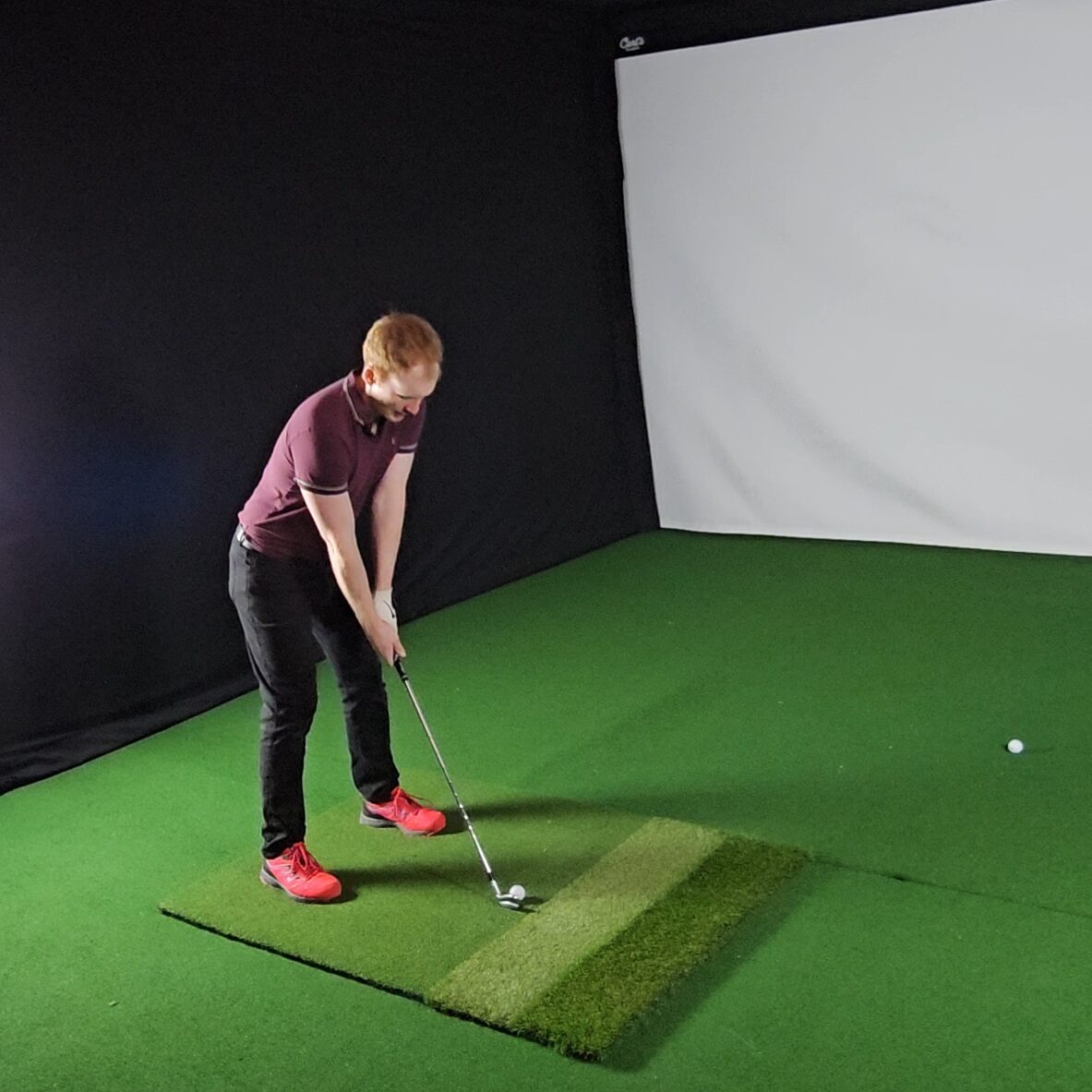
Every inch of floor comes off the top. Measure from the top of the surface you’ll stand on, not the floor. Uneekor’s Help Center measures from the top of the hitting area, so a 2-inch mat counts against its 9 ft.
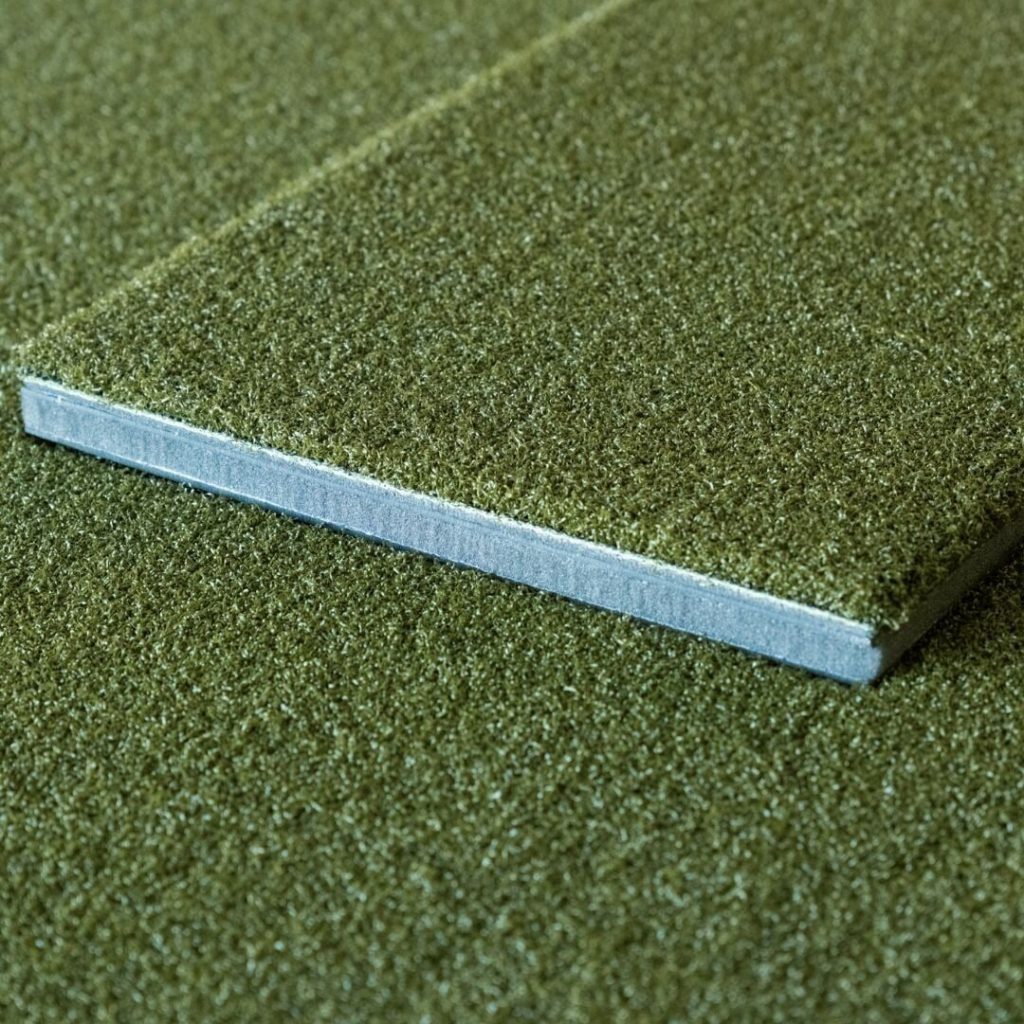
| What’s under your feet | Typical height | Source |
|---|---|---|
| SIGPRO Softy Lite strip | about 1¼ in (no real tee) | Shop Indoor Golf |
| SwingTurf mat | 1.7 in | Rain or Shine Golf (retailer) |
| Carl’s HotShot insert | 1.75 in | Carl’s Place |
| SIGPRO Softy strip | about 2⅜–2⅝ in, depending on the page | Shop Indoor Golf |
| Foam tiles under the mat | about 1 in; owners find ½ in bounces the ball | Owners |
Worked example: a 96 in (8 ft) ceiling, minus 1 in of foam and a 1.75 in HotShot insert, leaves 93¼ in to swing under.
One owner pulled out carpet and subfloor to go from 8′4″ to 8′9″. The Softy Lite saves height but cannot take a real tee.
Hitting Strip vs Golf Mat – Golf Simulator Mat Options
Pick a Launch Monitor That Fits a Low Room
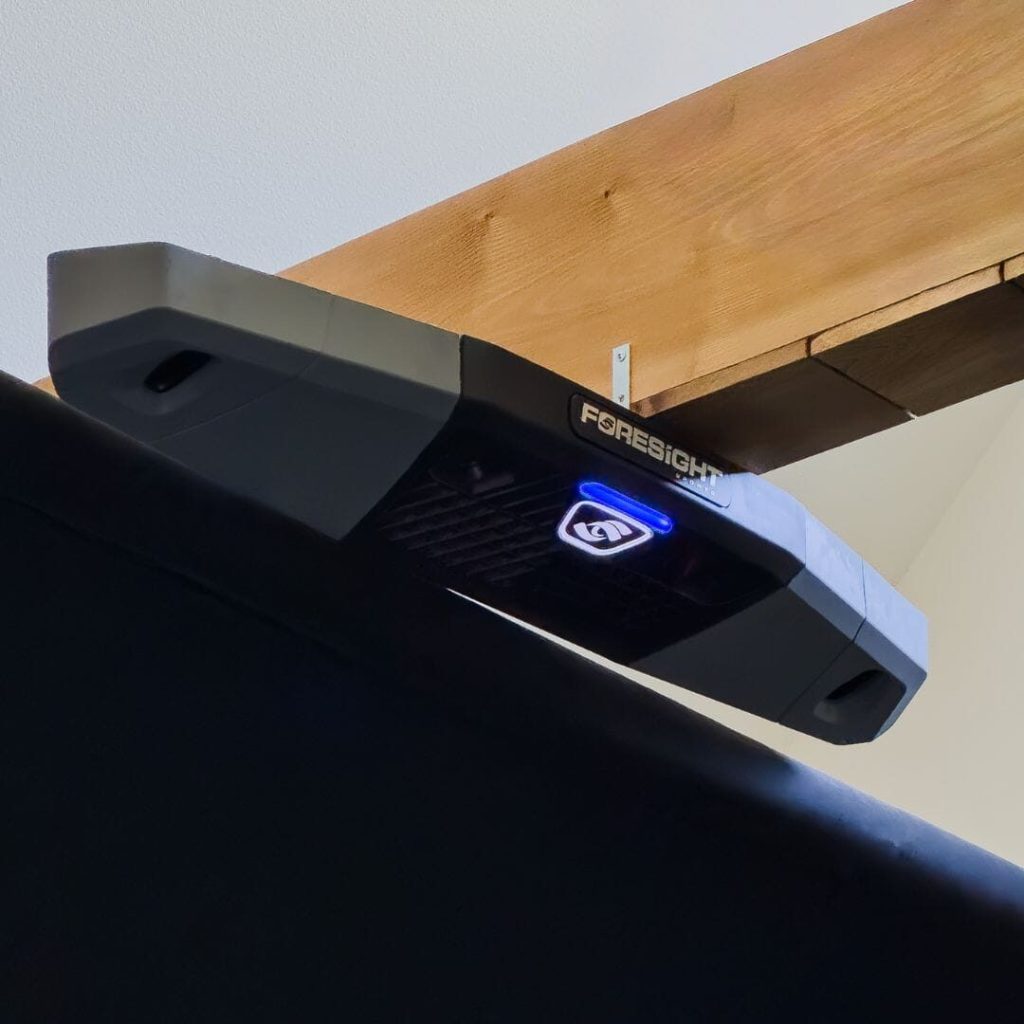
Overhead units hang above the ball, so they need height. Floor units sit beside or behind the ball, and most publish no ceiling figure.
| Unit | Where it sits | What the maker says about ceiling height |
|---|---|---|
| Trackman iO | Overhead | Lowest install band 270 cm (8′10″), mat to ceiling; its home-simulator page recommends a room 10 ft high |
| VTrack | Overhead | 2,700–3,100 mm, ground to ceiling, per its installation manual (checked 25 August 2026) |
| Uneekor EYE XO2 / QED | Overhead | 9–10 ft in the manuals; Help Center: “a minimum height of 9 ft is required” |
| Uneekor EYE XR | Overhead, rear | 9–10 ft in the manual; 10 ft on its product page |
| ProTee VX | Overhead | “at least 9 ft (2.75 m)” |
| Foresight Falcon | Overhead | “Ideally” 9.5 to 10.5 ft |
| SkyTrak+ (no longer sold new) | Floor, beside the ball | Manuals list a 10 ft clear area but say safe height varies by golfer |
| Garmin R10 / R50 | Floor | Asks for enough ceiling height; no number |
| Uneekor EYE MINI / Foresight GC3 | Floor, beside the ball | No ceiling figure |
Owners report running a ProTee VX at or just below its 9 ft minimum, but the maker’s figure is the one to plan around. Owners advise screwing an overhead unit into joists (three owners, one 2024 thread). Maker instructions vary, though: Foresight’s Falcon manual allows four rated drywall anchors, so follow your unit’s manual.
- What a floor unit costs you: side-of-ball camera units typically need to be moved for left- and right-handed golfers, and some radar units, such as the Garmin R10, need room behind the ball. Reviewers mostly say camera units read better indoors.
Best Launch Monitors for a Home Golf Simulator (2026), by Budget
Trackman Space Requirements – Indoor and Outdoor
Garmin R10 Space Requirements – Length, Width and Height
Projector and Screen in a Low Room
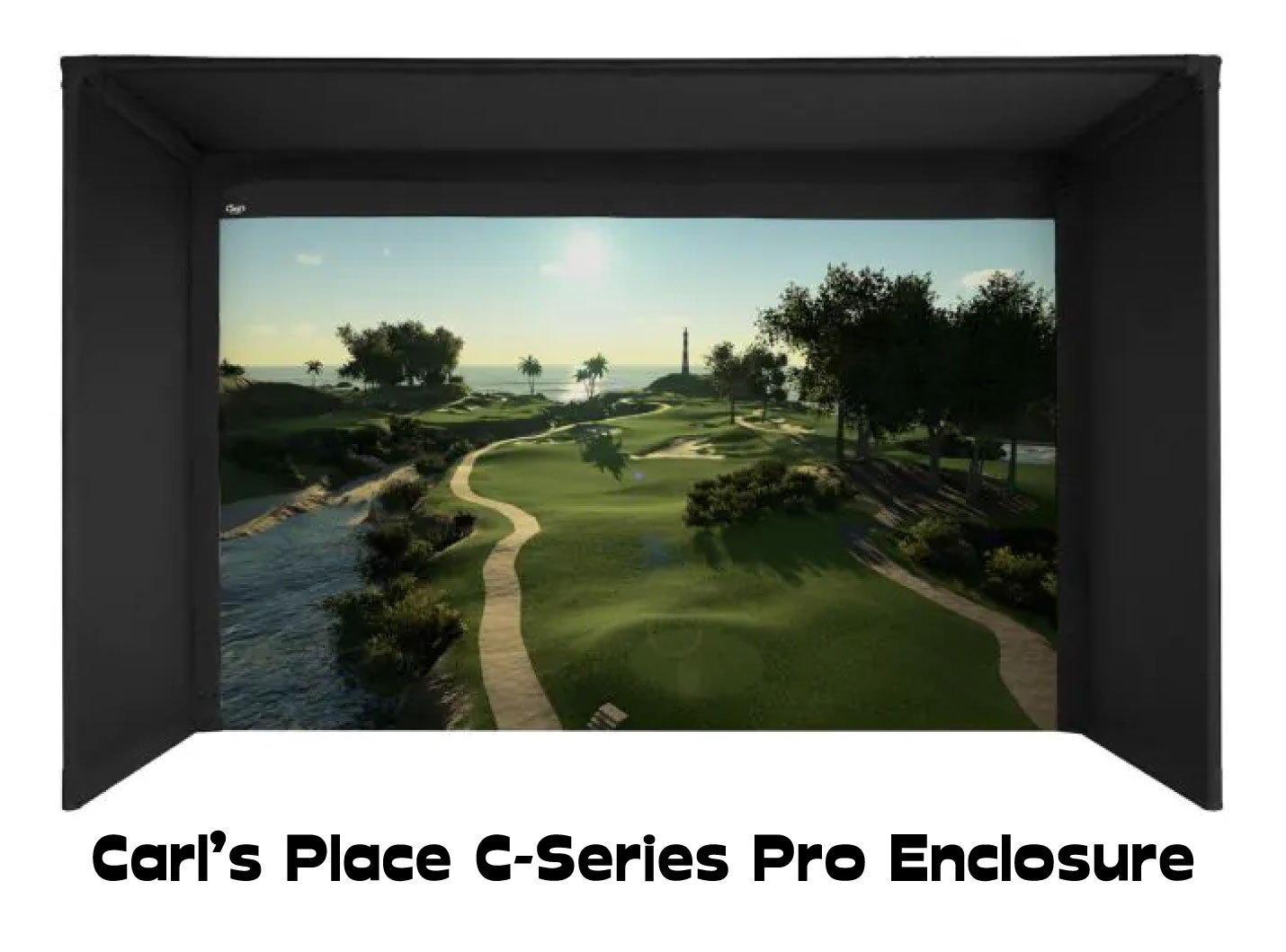
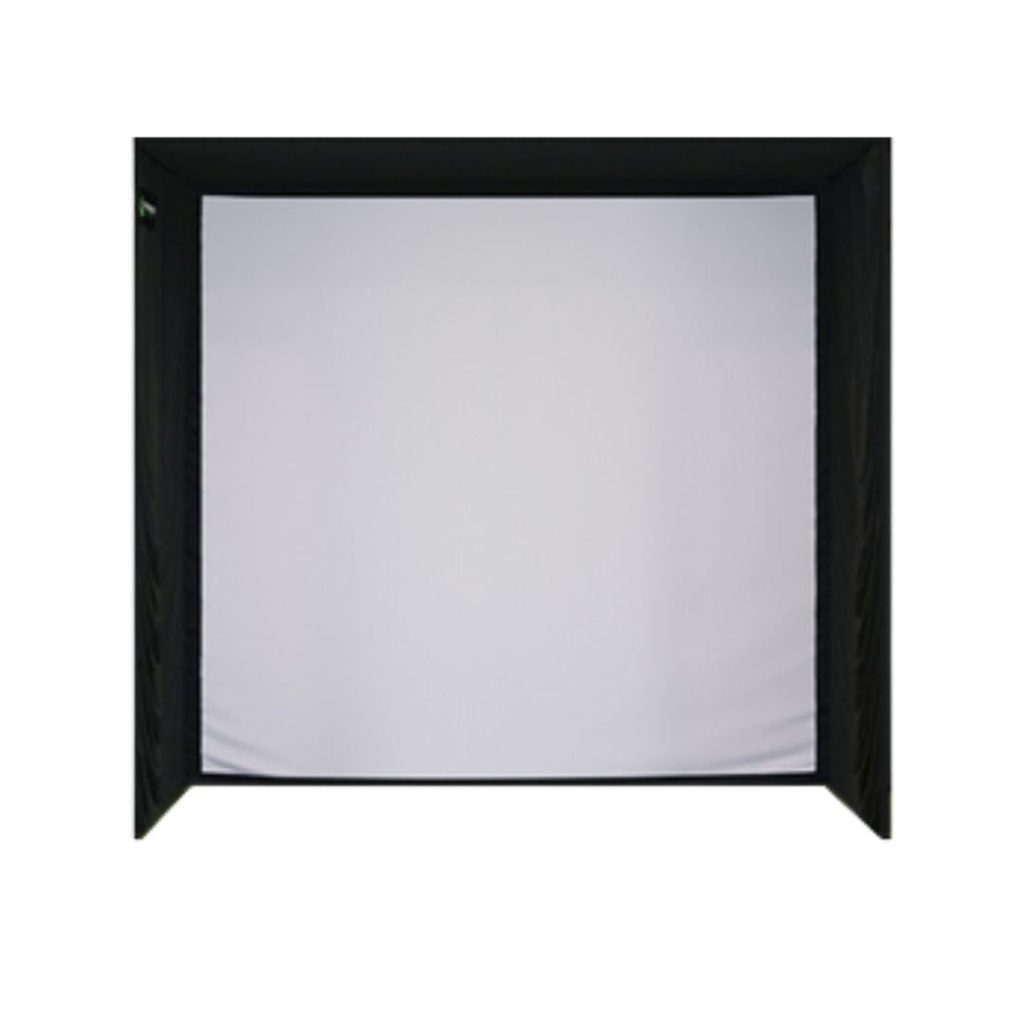
| Enclosure | Outer height | Ceiling the retailer lists |
|---|---|---|
| Carl’s DIY enclosure (7.7 × 10) | 95.8 in | Guide: nothing under 96 in tall; its room kit calls 9 ft best |
| SIG8 / SIG10 | 8′4″ | 9 ft |
| SIG12 | 9′4″ | 10 ft |
| SIGPRO Commercial | 8 ft | 9 ft |
An enclosure’s height is not the ceiling you need.
- Projector over or just behind the tee is the usual spot; if your follow-through clips it, offset it. One owner offset theirs about 6 in.
- Floor or stand projectors avoid the ceiling, but one owner says guests hit theirs every time friends come over, and another moved one to the ceiling after balls kept striking it.
- A TV behind the hitter got broken by a guest’s backswing in an owner’s room.
At 8 ft, plan a custom-height screen or a net-only setup.
Where to Mount your Golf Simulator Projector – Pitfalls + Example Placements
Impact Screen vs Net – Pros & Cons + Buying Guide
Fans, Lights, Beams and Garage-Door Openers
Renting? Fans, lights, openers and ducts are the landlord’s fixtures: get their OK before changing any, and skip the next section.
- Lights: one owner broke an overhead light twice with a 6-iron; moving one is electrical work, so check local code or hire an electrician.
- Ceiling fan: treat a fan-to-outlet swap as electrical work: check local code or hire an electrician, though owners call it a DIY job (6 reports from 5 owners). One owner warns against hardwiring the projector.
- Ducts and pipes: one commenter said ducting can be “squishy and moveable”; a sprinkler pipe capped another room at 9′6″.
- Beams: don’t cut, notch or remove a beam, joist or truss without a structural engineer’s written approval.
- Garage-door opener: owners swap a center-rail opener for a wall-mounted one to clear the swing path; leave opener and spring work to the installer.
“I got a wall mount opener for this very reason.” (u/A_Man_Panda-Watching, 2025-11-05)
Garage Golf Simulator – 13 Key Challenges + Tips & Tricks
Opening the Ceiling or Lowering the Floor
| Option | What it buys | Who does it | Applies to |
|---|---|---|---|
| Take down a drop ceiling or the drywall where you swing | About a foot in one owner thread, up to the joists | DIY, after the checks below | Finished garages and basements |
| Box out between joists, sized to the swing | The arc you need | Engineer, then a contractor | Garages with attic space above |
| Raise rafter ties or reinforce trusses | More headroom over the bay | Engineer required | Garages, outbuildings |
| Dig out the hitting area or the whole floor | Height from below | Engineer and excavation | Basements and slabs |
Engineer first. Several of the top replies in one 79-comment owner thread (September 2026) said to get an engineer before touching joists or trusses. One owner paid $1,200 CAD for engineering drawings. In a basement, a box-out cuts into the floor above, and lowering the floor brings drainage and sump questions. UK garage trusses are engineered too, so don’t cut one without an engineer’s drawing.
“Definitely don’t touch it without getting an engineer to draw and stamp something.” (u/Libertaliar, 2026-09-06)
Taking down a drop ceiling is the cheaper route owners mention (one October 2025 thread). Drywall is different. Check local building rules first, since some ceilings are part of a fire-rated assembly. Have an electrician make any exposed wiring safe, and soften hard edges.
Box-outs and engineer-led raises show up more often in owner and reviewer posts since late 2024. Cost ranges for raises and dig-outs are in the ceiling-height guide.
Protect the Ceiling
- Soft and thick beats thin and rigid. Owners hang gym tiles, EVA foam and vinyl-wrapped boards overhead; owners in other threads say thin, rigid materials send balls back hard while soft, thick padding absorbs better (8 reports from 8 owners).
- Every layer takes headroom: Carl’s vinyl baffles hang 12 in down.
- Keep padding clear of sprinkler heads and smoke detectors.
Protect Your Golf Simulator Walls and Ceiling – 12 Simulator Safety Tips
Sloped Ceilings, Attics and Basements
- Sloped or vaulted: set the tee off-center toward the tallest part of the room (7 reports from 5 owners). An off-center stance can put an overhead unit in the swing path, so a floor unit is safer.
- Attic: short screens get clipped by wedges and pop-ups (owners, 2021); a folding enclosure keeps an attic hatch usable.
- Basement: bulkheads and ducts set the real height, so measure under them, not the open ceiling.
Making a Basement Golf Simulator – Pros and Cons
When to Give Up on Driver, or on the Room
If the ceiling is under 8 feet, or your tallest swing still clips it after the simpler fixes, change the plan rather than the house. Owners in that spot practice putting, chipping and partial swings, use a short swing trainer, or move the simulator to a taller garage. An owner limited to hybrids and irons still calls it well worth having. Renters can use portable or quick-to-remove setups that leave the ceiling untouched. The downside, in one owner’s words:
“Broke a driver and ceiling light on the same day.” (u/Chasing-Shanks, 2026-03-10)
Retractable Golf Simulators – Ultimate Guide
Low-Ceiling Golf Simulator FAQ
Is an 8 ft ceiling enough for a golf simulator?
For short and mid irons, often, if you’re not tall, but the ceiling still limits the swing; not for driver.
Can you hit driver with a 9 ft ceiling?
Most owners can, with occasional scrapes; golfers of about 6′2″ and up often can’t.
Does your height, or your tallest friend’s, change the answer?
Yes. Taller golfers and upright swings need more room.
Do you need a floor launch monitor with a low ceiling?
Below about 9 ft, usually; the iO and VTrack document installs from 8′10″ (iO from the mat).
How much ceiling height does a hitting mat take?
About 1¼ to 2⅝ inches for the strips above, plus any foam.
Can you take down a drop ceiling to gain height?
Owners do; one thread reports about a foot. Pad the exposed framing.
Is it worth raising the ceiling or digging out the floor?
Only after the simpler fixes, and only with a structural engineer.
Does practicing under a low ceiling hurt your swing?
It can; change clubs, not your swing.
Final Thoughts
A low room can host a simulator, but expect the ceiling to shape what you hit, most if you’re tall or want driver. Fit your clubs to it, test first, and call an engineer before you cut.
Best Launch Monitors for a Home Golf Simulator (2026), by Budget
Mevo Gen 2 Space Requirements
ABOUT THE AUTHOR
Hello! My name is Alex and it is my mission to bring you all the information you need to build your own home golf simulator! I hope mygolfsimulator.com helps you on your journey to better golf at home!
LEGAL INFORMATION
On this site, you'll find articles on all aspects of building a golf simulator. I will also link to other sites where you can buy some of the simulator components. Some of these links may be affiliate links, which means if you click them I gain a small commission at no extra cost to you. This really helps out me and my site so thank you in advance! mygolfsimulator.com and all related social media accounts are property of Awonline LTD.