Golf Simulator Flooring (2026): What Goes Under and Around the Mat
Posted in Golf Hitting Mats, Room Setup
Golf simulator flooring is everything between the concrete slab and your shoes. It’s a base layer, turf over it, and the hitting strip (the cushioned insert you hit from) set into them. Below: base options priced on 3 October 2026, stack heights, and a recipe for each room type.
In a Nutshell
In owner posts, the usual golf simulator floor is a firm base of 1-inch foam gym tiles or 3/4-inch rubber stall mats, with turf on top, built up so the hitting strip sits flush. Your room decides what goes underneath: slope and a parked car in a garage, a moisture question on a basement slab, noise and weight upstairs.
👉 Expect your stance spot to wear out first, so build it to be swapped without lifting the rest of the floor.
Jargon, once:
- Base layer — the cushioned or firm layer under the turf: foam puzzle-mat tiles (EVA foam) or rubber stall mats (sold for horse stalls).
- Stance spot — where you stand to hit, beside the strip.
- Flush — the strip, turf and stance at one height.
- OSB — a plywood-like panel of pressed wood strands.
- Subfloor panel — a panel with its own moisture layer that sits on the slab.
- Vapor barrier — a plastic sheet that keeps damp from the slab out of the layers above.
The Layers, Bottom to Top
- Slab or existing floor.
- A moisture layer, where one is called for.
- Leveling or a platform, only if the floor slopes.
- Base: 1 in foam puzzle-mat tiles, 3/4 in stall mats, or both (1 3/4 in before turf).
- Turf: 1/4 in turf up to one owner’s 1 3/8 in big-box grass mat.
- Hitting strip, set flush.
Each layer you add is height your swing loses under the ceiling.
| Zone | What goes there | Why |
|---|---|---|
| Hitting zone | The strip set flush; a stance spot built to be swapped | The stance spot wears first |
| Strip to screen | The same base, with turf or a putting surface | The ball lands and bounces here |
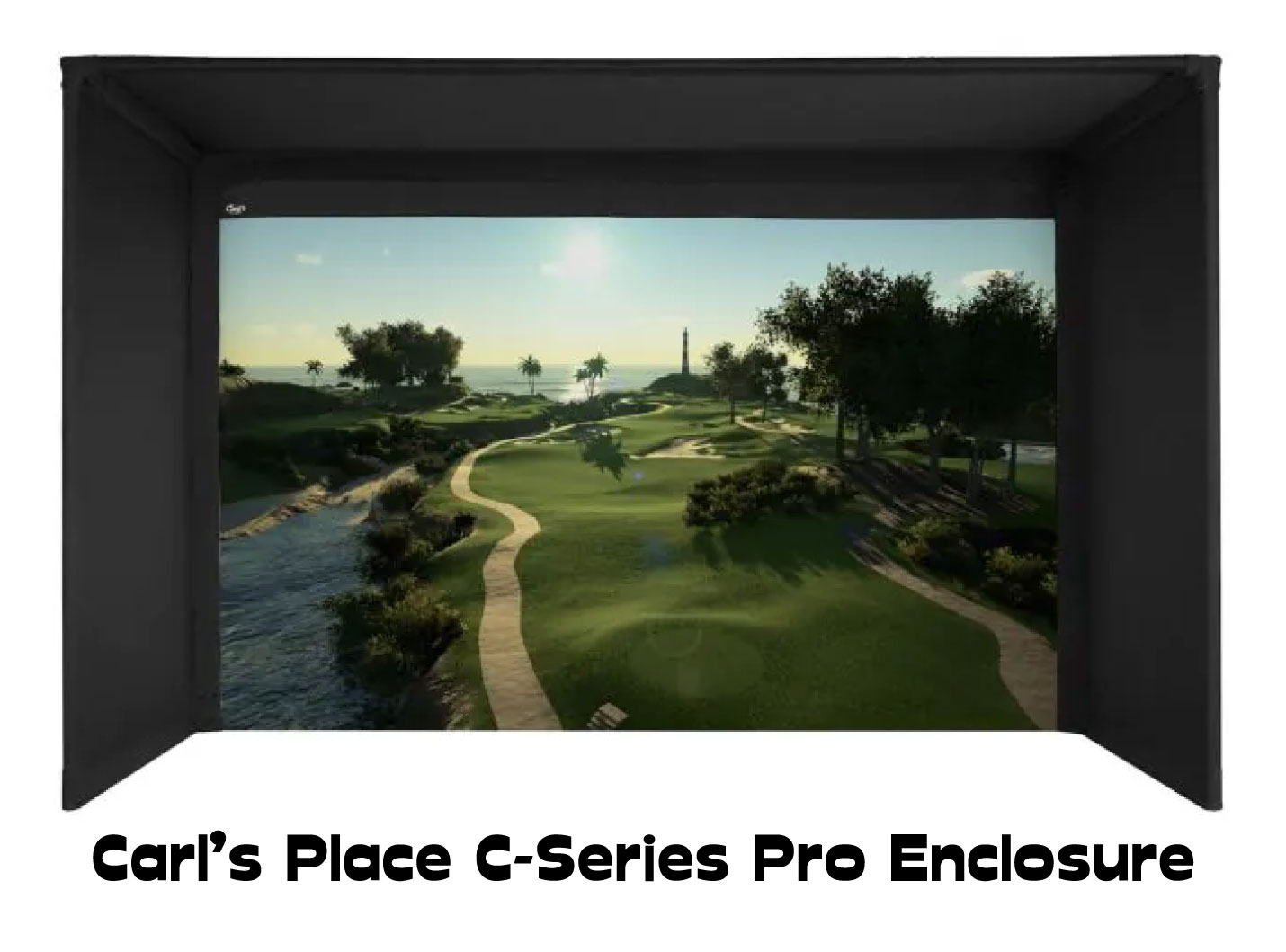
| Under the screen | Thick carpet or turf under an enclosure can leave a gap, Carl’s Place warns | Balls can get under the screen |
| Rest of the room | Some owners floor screen to mat; one advises only the hitting area plus a mishit strip | Floor area drives the cost |
How this was built: makers’ and retailers’ pages read on 3 October 2026, and a few manual and mat pages in August 2026; owner and reviewer reports from Reddit and YouTube since 2023. Nothing here was tested hands-on.
Golf Simulator for a Low Ceiling: What Actually Works (2026)
What to do with the Bottom of your Impact Screen?
Base Layers Compared
| Base layer | Thickness | Price read 3 Oct 2026 | Per sq ft (before delivery) | Notes |
|---|---|---|---|---|
| ProsourceFit puzzle-mat tiles | 1/2 in | $29.99 for 24 sq ft | $1.25 | Owners report ball bounce at 1/2 in |
| ProsourceFit puzzle-mat tiles | 1 in | $52.99 for 24 sq ft | $2.21 | The common default; some find foam too soft |
| Rubber stall mat, 4 × 6 ft | 3/4 in | $57.95 sale (list $63.49) at KBC Horse Supplies; $62.95 at BigDWeb; $123.45 at Greatmats | $2.41 to $5.30 | Firm; the surface owners trust under car tires |
| Shop Indoor Golf gym floor tiles | 1/2 to 1 in | $70 to $120 per 6 tiles (24 sq ft) | $2.92 to $5.00 | Seller’s own tile; material not stated on the page checked |
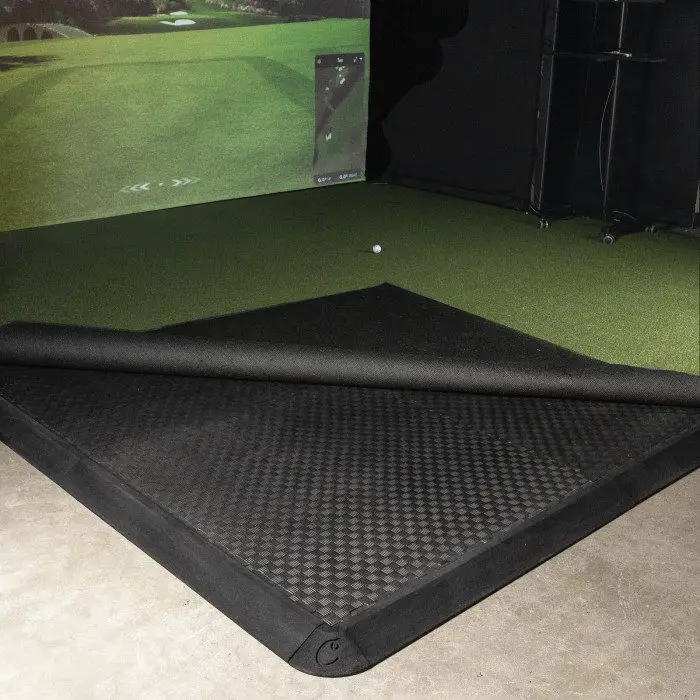
| Carl’s Golf Room Floor Tiles | 1.25 in | $229.95 for five 40.25 in tiles | $4.09 | Far dearer than generic tiles, owners say, but a true 1.25 in |
Prices as read on 3 October 2026 and re-checked on 14 October 2026. They change often, so check before you buy.
- Per-square-foot figures divide the price by the size the page gives.
- Carl’s works out to about 1.9 times the 1 in set per square foot, before edges ($109.95 per 6) and corners ($59.95 per 4). The 1 in set includes 12 end borders.
- BigDWeb’s minimum delivery charge is $225.
- A 10 × 12 ft floor at these rates, before delivery: about $150 (1/2 in tiles), $265 (1 in tiles), $290 to $640 (stall mats). Carl’s tiles need 12 for that room: two packs of six, $551.90, before edges.
- US retailers, US dollars (1 in is about 25 mm).
New rubber mats smell strongly at first; owners air or sun-cure them for days to weeks (10 reports from 10 owners, February 2025). One seller goes further:
“Mats have a high odor and are not intended for home use.” (Greatmats, $123.45 page)
Subfloor Options: Slab, Panel, Platform or Foam Board
| Option | Adds | What makers and owners say |
|---|---|---|
| Straight on the slab | Nothing | Works under a cushioned mat, says Carl’s (a seller); concrete is “hard, loud”, bouncing unpredictably |
| Subfloor panel (DRICORE) | 3/4 in | A “built-in moisture management system”; price not stated on the page checked |
| Wood platform | 2 × 4 frame plus 3/4 in plywood; more time and tools | Carl’s: most permanent route, easiest to a flush strip; frame typically spaced 16 in apart |
| Rigid foam board with a load-spreading layer | 1 to 2 in, as owners state | Several owners build on it; no maker page checked rates it for floor loads |
| One owner’s stack: foam board, OSB, tiles | Board plus OSB | No compression reported |
One owner, in December 2025, reported foam under turf (type and thickness not given) giving way:
“even after 200 or 250 times walking across it (even with a wood header) it was compressing and going out of level” (u/eurostylin, 2025-12-03)
How to Build a DIY Golf Simulator Enclosure – Steps, Tools, Costs + Materials
Build It to Your Hitting Strip’s Height
Base height = strip height − turf thickness. Carl’s tells builders to account for the mat’s thickness so it sits flush with the turf around it.
| Strip or kit | Height | Stack that reaches it |
|---|---|---|
| Carl’s HotShot | 1.75 in | 1 in + 1/2 in tiles + 1/4 in turf = 1 3/4 in; one owner built this stack for a Fiberbuilt mat of about the same height |
| Common drop-in insert | 1 3/8 in, one owner says | 1 in tiles + 3/8 in turf |
| SIGPRO flooring kit | 2.375 in | 2 in panels + 3/8 in turf |
| SIGPRO Softy | See the strip guide | Owners double 1 in tiles and add turf |
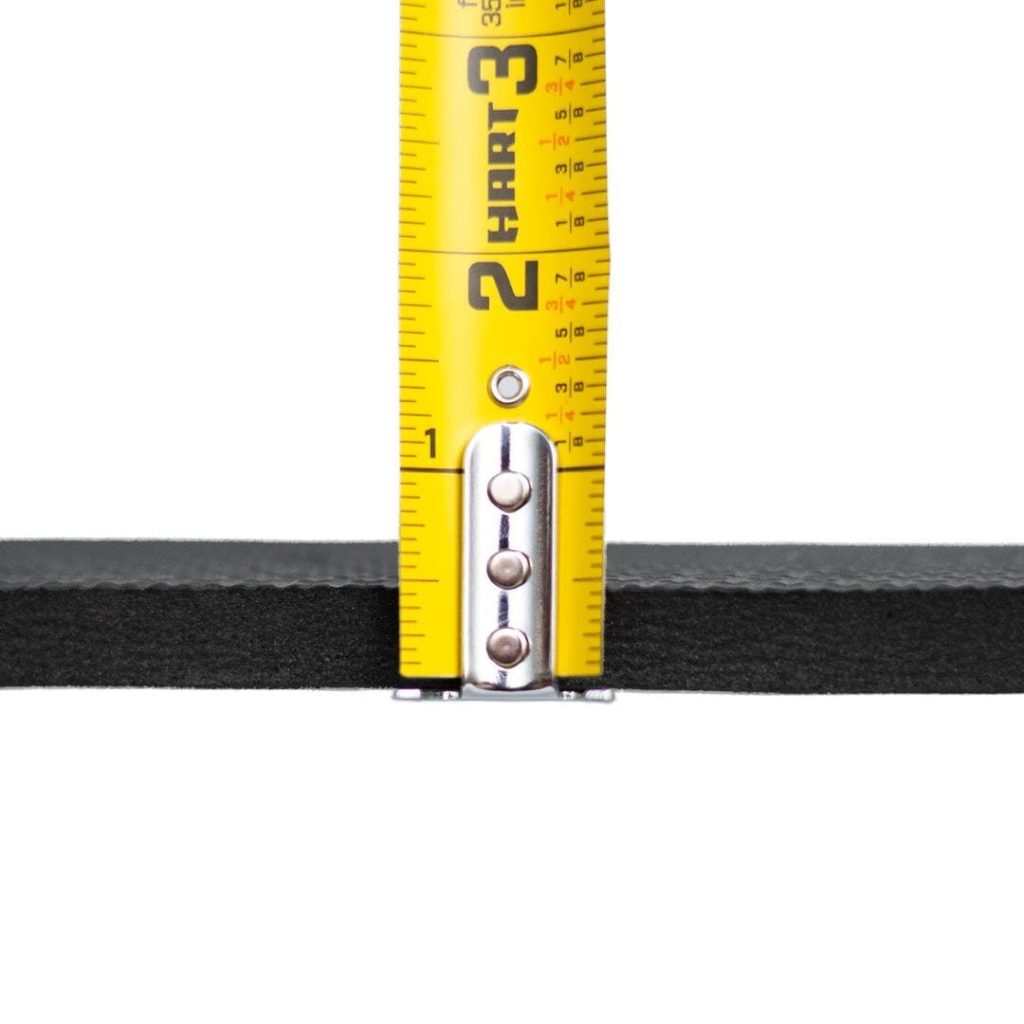
- Measure before you stack: two owners (December 2025 and March 2026) found some “1 in” tiles nearer 7/8 in. Two of them plus 3/8 in turf is 2 1/8 in, not 2 3/8 in. Carl’s states 1.25 in with a tolerance of up to 1/8 in.
- Launch-monitor height: Mevo Gen2’s manual allows up to 3 in between the unit’s floor and the hitting surface. Golfzon’s Wave says never lower than the hitting area. Check your own manual.
Hitting Strip vs Golf Mat – Golf Simulator Mat Options
Turf on Top: Where It Wears Out
- Where it wears: owners and bay operators say the stance spot goes first, though most owners and reviewers treat the wear as cosmetic (4 reports from 3 owners and reviewers, 2024–25).
- Make the stance swappable: a separate stance mat, a cut-out, loose tiles, or turf over the walk area only.
- Where to buy: Shop Indoor Golf cuts turf to order from $64.99 (unit not stated on the page checked). Carl’s Place sells Big Moss turf cut for its DIY enclosures: $1,816.95 for the 8 × 8 kit, about $18 a square foot, by freight.
- Cheaper routes: two owners quote 85 cents a square foot for Lowe’s indoor/outdoor carpet (not confirmed on Lowe’s site). Two others got turf-company offcuts for $50 and $200 (August 2026). One 2024 thread warns that big-box turf isn’t made to be hit from.
- Family rooms: one poster (June 2026) found turf scratchy on the skin. The one reply, on puzzle-mat tiles, reports permanent dents from foot pegs and a ladder.
Do You Wear Golf Shoes in a Golf Simulator?
Putting in a Golf Simulator: What Actually Works (2026)
Golf Simulator Putting Greens – Add a Putting Green to your Simulator Floor
Recipes by Room: Garage, Basement, Spare Room, Patio
Garage
- Slope and drains: owners report falls of about 3 in to a center drain and 3.5 to 4 in over 19 ft. They level with feet under a platform (one owner calls them “not the most durable”), stepped plywood, a platform spanning the slope, or cardboard or paper shims.
- Limits: DRICORE’s shims cover 1/4 in; above that it says to patch the concrete. No maker page checked covers falls this large, and in one April 2026 thread owners found a raised platform alone didn’t fix an uneven floor.
- Parked car: stall mats are the surface owners trust under tires. Some lay carpet or turf over them and one lays 2 × 4s under the wheels. Another pulls up two tile rows and calls the five-minute job “a barrier” to using the sim. One owner on stall mats with carpet on top:
“The car can drive over it all you want.” (u/Going_the, 2026-09-09)
- Panels and coatings: DRICORE panels end at least 1 ft from the garage door and take no epoxy paint directly. Owners warn that epoxy or sealed concrete turns slick when wet unless it has an anti-slip additive. One says a polyaspartic coating is “not porous” in a wet climate. Condensation risk to your gear on a cold slab: see the heating guide.
Garage Golf Simulator – 13 Key Challenges + Tips & Tricks
Heating in a Golf Simulator – 11 Simple Ways to Stay Warm
Basement
The vapor-barrier question depends on what goes on top:
| Layer on the slab | Barrier? | Source |
|---|---|---|
| Wood or OSB platform | Yes, under the wood, even with no visible damp | Carl’s Place guide |
| DRICORE-type subfloor panel | No extra plastic; a barrier over the concrete “is not recommended” | DRICORE |
| Tiles or stall mats straight on the slab | No maker states a position or gives a test | Commenters disagree (below) |
- In a February 2026 basement thread, one commenter and one owner backed a subfloor panel or a dimpled membrane. Another commenter said they wouldn’t be overly concerned about a new slab poured over plastic and gravel, and suggested a calcium chloride test.
- In a November 2025 pole-barn thread, commenters argued both ways. One warned that if a taped-plastic test shows moisture, a barrier alone can leave mold under the floor.
- In the Reddit threads read from the past year, no owner reported mold or damp under mats.
Making a Basement Golf Simulator – Pros and Cons
Spare room: carpet, weight and noise
- Carpet: owners in a December 2025 thread mostly advised against cutting it, keeping the mat movable until the room is permanent. Fiberbuilt says to tape the frame if the mat shifts slightly with the grain.
- Weight: stall mats weigh 80 to 155 lb each by seller, about 3 to 6.5 lb per square foot. No page checked rates a floor for them, so ask a builder before covering an upstairs room.
- Noise: no owner measured a floor build-up’s noise. Owners most often name the ball hitting the screen as the loudest sound (7 reports from 6 owners); in the room the club strike can be louder, but the screen’s thud is what travels.
Building a Quiet Golf Simulator – Soundproofing Tips for 2025
Patio or outdoor slab
Foam and rubber underlayment can trap moisture and stain concrete (5 reports from 5 owners, February 2025). One 2026 owner put stall mats around a patio setup to limit bounce and calls it effective so far.
Renting: nothing glued
Renters: check the lease before cutting carpet or fixing anything down. Loose-laid tiles and mats come up when you leave. For tape and Velcro, see the fixing table; one owner stopped a mat sliding on concrete with rubber mats underneath.
Building in a shed or outbuilding? Golf Simulator Sheds – Size, Cost, Options & Ideas
Best Golf Mat for a Golf Simulator – 10 Step Buying Guide
Fixing Tiles and Finishing the Edges
| Method | Works on | What owners report |
|---|---|---|
| Carpet tape | Smooth-surface tiles, turf seams | A common method (5 reports from 4 owners, November 2025) |
| Carpet tape | Diamond-pattern tiles | Two owners say it did not stick; a third says it works at about 80% coverage |
| Construction adhesive | Stacked foam tiles | “nowhere near enough” for one owner |
| Spray adhesive plus roofing nails | Stacked foam tiles | The same owner’s fix, still holding a year on |
| Double-sided tape plus self-tapping screws | A 16 × 14 ft floor | One owner |
| Outdoor Velcro strips | Turf on concrete | Held one owner’s turf |
| Double-sided tape or urethane glue | Rubber rolls | The rubber-roll maker’s own advice |
| Ramp | Raised floors | One owner’s 2 in ramp brings balls back onto the turf |
| Edge pieces and corners | Raised floors | Carl’s sells both (prices above); a tapered edge softens the step at the floor’s edge |
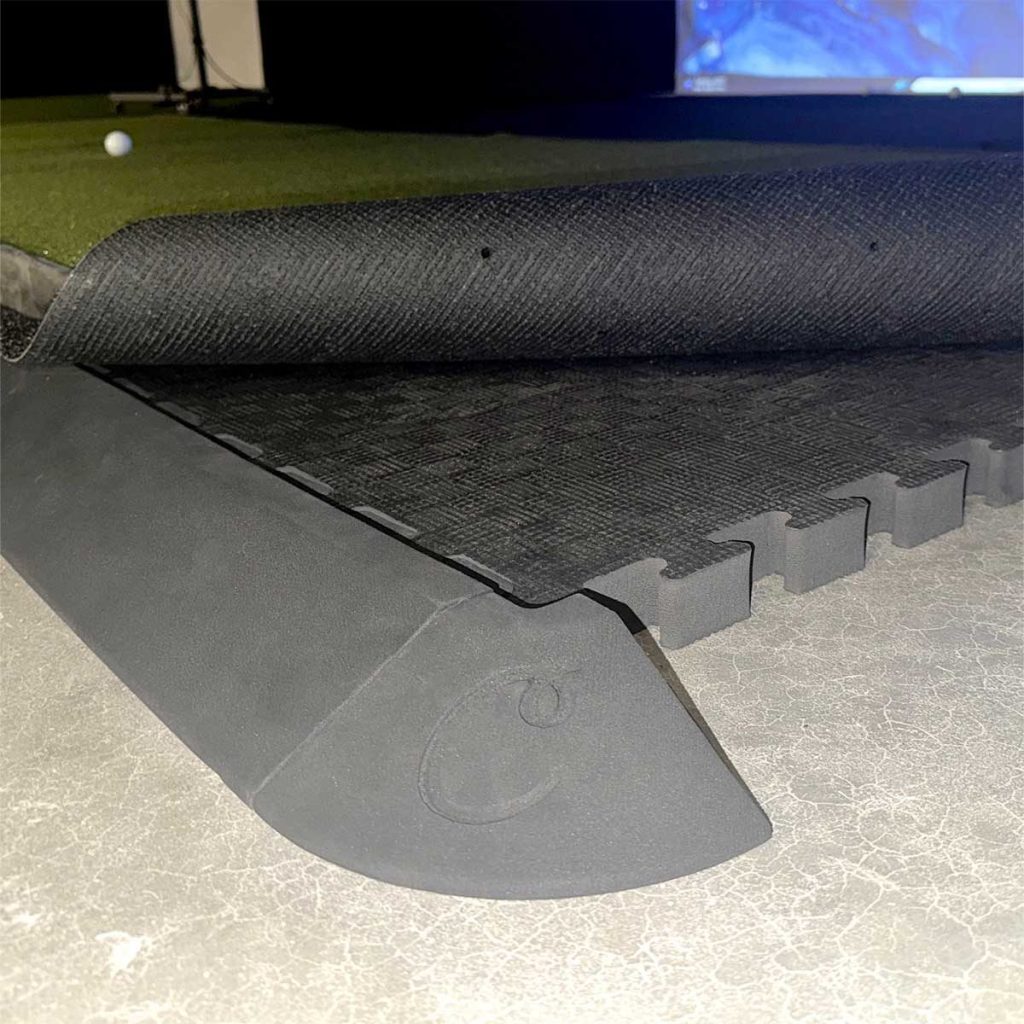
Bounce and Sore Joints
- Bounce: eight reports from six owners (November 2025 to March 2026) say 1/2 in tiles bounce the ball. Two 2026 owners with 1/2 in foam say balls still die: one under thin cheap turf, who adds that the bounce that matters comes off the screen, and one under a 1 3/8 in big-box grass mat. A third, with no base under the landing mat, has little trouble with bounce. One inch is the safer pick where the ceiling allows.
- Sore joints: padding helped one owner, who put 2 in of foam tiles under a mat that had hurt the owner’s elbow and wrist on concrete. Another wrote:
“putting the foam tiles and rubber horse stall mats underneath does not provide the relief i thought it would” (u/BlickyWitTheSticky, 2026-07-24)
Two others say padding won’t rescue a cheap mat; the fix they name is a strip cut into it.
What a Simulator Floor Costs
- About $80: one owner’s whole floor of resale puzzle tiles and Menards turf, July 2026, size not stated.
- About $125: one owner’s platform of two 1/2 in foam layers, OSB and thin turf, including a $75 strip, October 2026.
- About $400: one owner’s 4 × 10 ft platform of insulation board and foam tiles, including a $250 strip, October 2026.
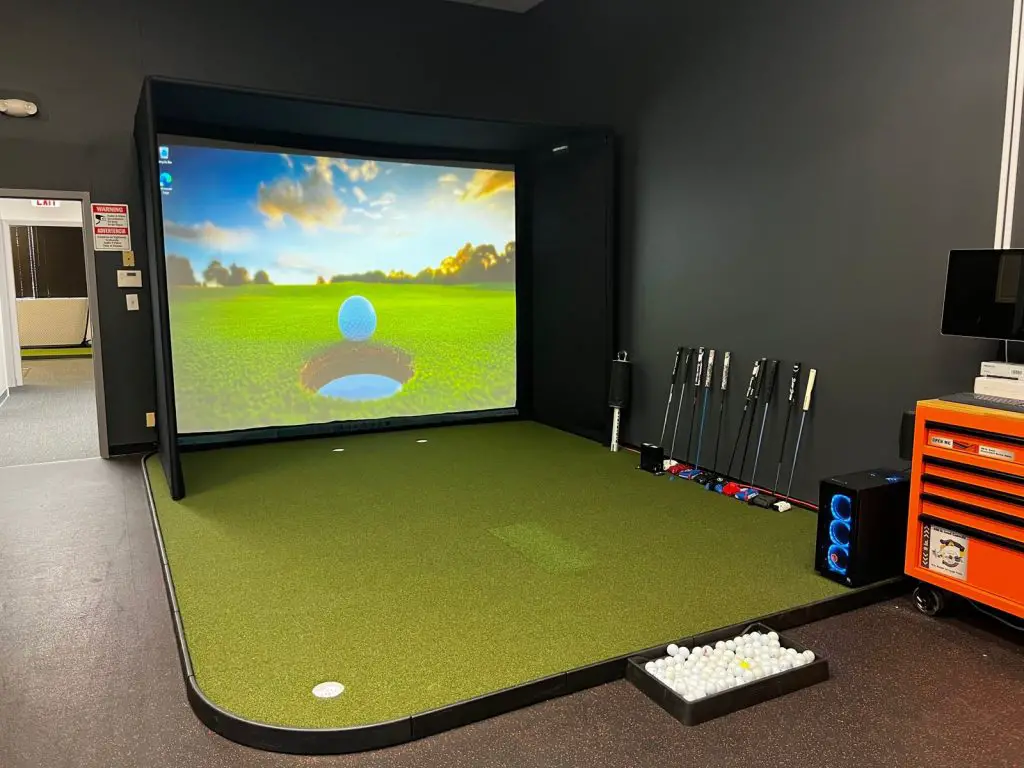
- SIGPRO Golf Simulator Flooring kit: a hitting strip and a four-cup putting green are built in. It suits a fixed room that wants all three in one order. It costs more per square foot than any base above, though the price includes the strip and green. Its 2 3/8 in height comes off your ceiling.
| SIGPRO flooring | Price read 14 Oct 2026 | Size | Per sq ft |
|---|---|---|---|
| SIG8 | $3,359.99 sale (was $4,199.99) | Not stated on the page checked | n/a |
| SIG10 | $3,919.99 sale (was $4,899.99) | 11 ft 7 in × 15 ft 6 in | About $21.83 |
| SIG12 | $4,399.99 sale (was $5,499.99) | 13 ft 6 in × 15 ft 6 in | About $21.03 |
Prices as read on 3 October 2026 and re-checked on 14 October 2026. They change often, so check before you buy.
Golf Simulator Budget Builds: Five Builds Priced Part by Part, From $1,600 to $24,000 (2026)
Golf Simulator Cost Calculator – How much do Golf Simulators Cost?
Golf Simulator Flooring FAQ
What is the best flooring for a golf simulator?
In owner posts, 1 in foam puzzle-mat tiles or 3/4 in stall mats under turf, built up to the strip’s height.
Do you need a vapor barrier on a concrete floor?
It depends on the layer above: Carl’s advises one under a wood floor, no extra plastic under a DRICORE-type panel. Under tiles or mats no maker says either way, so check the slab first.
Are horse stall mats good for a golf simulator?
Owners praise them (9 reports from 6 owners, 2024–26): firm and durable. They’re heavy, and new mats smell strongly at first.
How thick should foam tiles be?
One inch is the common pick; owners report bounce at 1/2 in. Measure them, since some “1 in” tiles run nearer 7/8 in.
Can you park a car on a simulator floor?
On stall mats, owners say yes; tiles flatten or need lifting.
How do you level a sloped garage floor for a simulator?
Owners use leveling feet under a platform, stepped plywood or shims; DRICORE’s shims cover only 1/4 in.
Can you put a simulator on carpet?
Turf over flat, stable carpet works, Carl’s says; owners advise against cutting the carpet until the room is permanent.
Can you use foam insulation board under the floor?
Several owners do, under OSB or tiles; one reports foam compressing out of level.
How much does golf simulator flooring cost?
About $1.25 to $5.30 a square foot for the base layer, before delivery and turf. The base-layer section works through a 10 × 12 ft room.
Do you need a subfloor, or can the mat go straight on concrete?
It’s optional: a mat on bare concrete works, but Carl’s calls concrete hard and loud. A panel or platform gives you control of moisture, level and height.
Final Thoughts
Pick the base for your room, build it to the strip’s height, and make the stance spot easy to swap. Price it in the cost calculator first.
GSPro vs E6 Connect (2026): Which Simulator Software Should You Buy?
Best Launch Monitor Under $1,000 (2026): Picks by Room and Software Bill
ABOUT THE AUTHOR
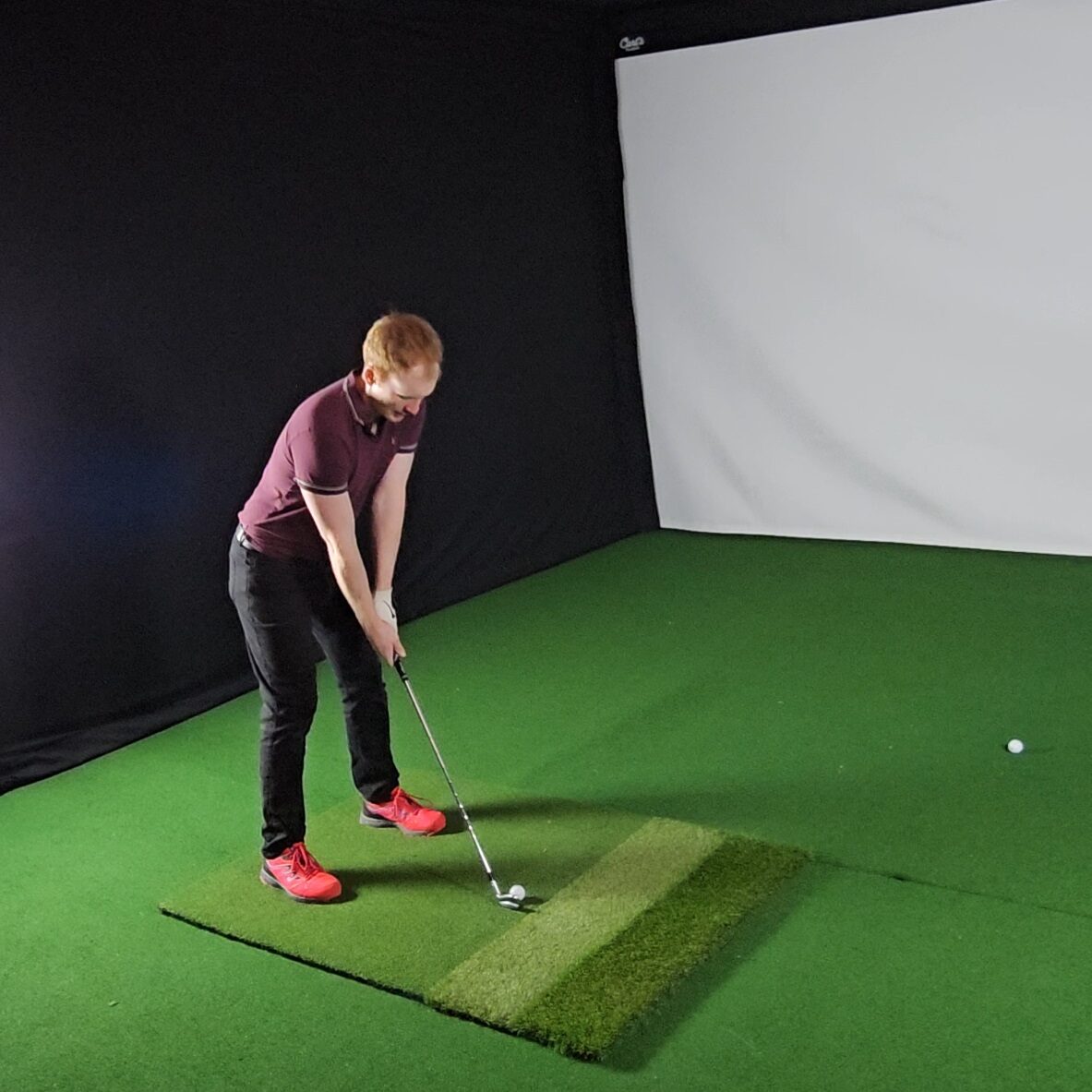
Hello! My name is Alex and it is my mission to bring you all the information you need to build your own home golf simulator! I hope mygolfsimulator.com helps you on your journey to better golf at home!
LEGAL INFORMATION
On this site, you'll find articles on all aspects of building a golf simulator. I will also link to other sites where you can buy some of the simulator components. Some of these links may be affiliate links, which means if you click them I gain a small commission at no extra cost to you. This really helps out me and my site so thank you in advance! mygolfsimulator.com and all related social media accounts are property of Awonline LTD.