Retractable Golf Simulators – Ultimate Guide
Posted in Golf Impact Screens, Room Setup
A retractable golf simulator is a setup you can clear out of the way in minutes — the screen rolls up, the gear stows, and the garage goes back to being a garage. The short answer: the SportScreen Vanish is the retractable enclosure owners recommend most, the HomeCourse ProScreen 180 is the simple wireless roll-up screen I recommend, and a DIY roller build now gets you there for roughly $600–$1,600 in owner reports (one buyer’s all-in combo ran closer to $1,900). 👉 The Quick Verdict matches each of the four routes to the golfer it suits.
In a Nutshell
A retractable golf simulator rolls its screen up so the room, usually a garage, goes back to normal use in minutes. There are four routes: the SportScreen Vanish enclosure owners recommend most (SportScreen’s store showed every size sold out on 21 October 2026, so check stock), the HomeCourse ProScreen 180 roll-up screen, a DIY roller build at roughly half the commercial price, or a net you break down after each session.
👉 Not sure? Buy the SportScreen Vanish — it’s the best all-round retractable setup and the one owners recommend most (though SportScreen’s store showed every size sold out on 21 October 2026, so check stock first). Want simple and wireless instead? The HomeCourse ProScreen 180. Budget first? The DIY roller route delivers a serious screen for roughly half the commercial price — you become your own installer. Only play occasionally? A quality net you can break down beats all three.
In this guide:
Jargon, once: an impact screen is the tensioned fabric you hit into and project onto; a baffle is a hanging panel that stops balls escaping above or beside the screen; a jackshaft opener is a garage-door motor mounted beside the door rather than on a ceiling rail — it matters here because ceiling rails and retractable screens fight for the same space.
| Route | What it is | Honest caveat |
|---|---|---|
| Retractable enclosure — SportScreen Vanish | Motorized or crank roll-up enclosure with sides, ceiling panel and baffles; 5 sizes | Baffles still attach/remove by hand; wide units can sag without tension tricks |
| Roll-up screen — HomeCourse ProScreen 180 | Wireless remote roll-up impact screen + netting, one size (8×8ft) | One size only; screen is a warranty “wear item,” and sag reports exist |
| DIY roller build | Roller hardware (e.g. Metech) + your choice of impact screen | You engineer your own tension, containment and support — and some screen vendors won’t warranty retractable use |
| Fast-dismantle net | Freestanding net (SIGPRO, Net Return, Spornia) you assemble per session | No projection screen — data-first practice, not a visual sim |
- Why golfers want a retractable simulator
- The four retractable routes explained
- Retractable screen systems compared
- HomeCourse ProScreen 180 — the roll-up screen route
- SportScreen Vanish — the retractable enclosure route
- The DIY roller route
- Fast-dismantle setups
- How long does setup and teardown actually take?
- Where will you build it?
- Limitations of a retractable golf simulator
- FAQ

Why golfers want a retractable simulator
The number one driver, by a distance, is parking the car. Reclaiming the garage between sessions is the core reason owners go non-permanent (7 comments, 7 authors), and as one Vanish owner put it: “I have one in the garage. It’s fantastic. I usually just leave it down all the time but i like the ability to roll it up if i need it.”
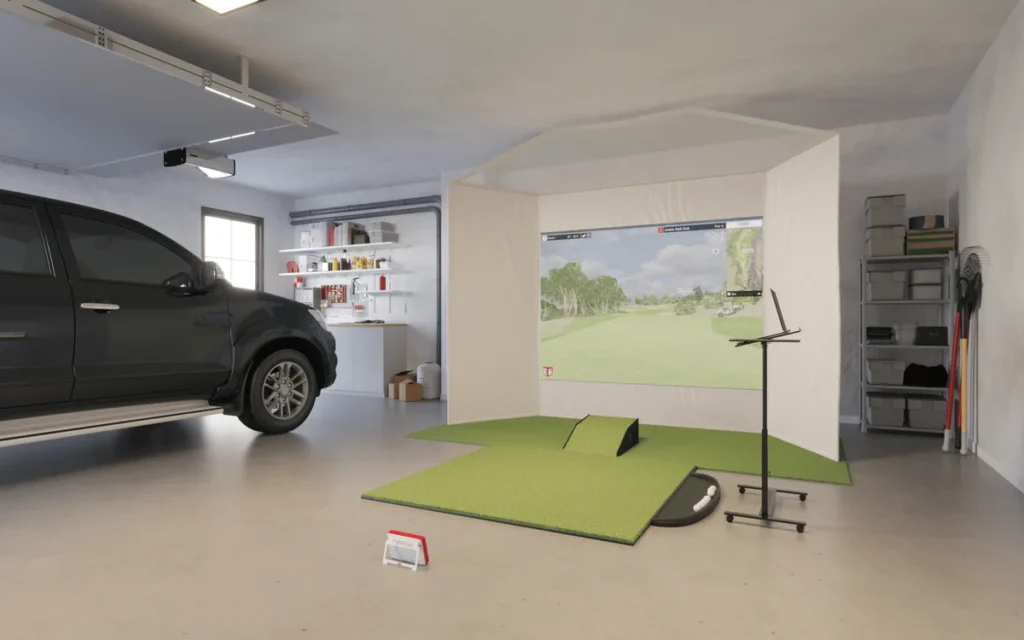
There’s a seasonal rhythm to it too. It is often the summer when golfers turn their garages back into storage and enjoy golf outside. I love to continue to use my simulator throughout the summer too. I enjoy honing specific parts of my game in the peak of the season to keep myself sharp between competitions and matches.
The four retractable routes explained
Retractable enclosure systems. An all-in-one product — screen, side panels, ceiling panel and baffles — that rolls up on a motorized or hand-cranked tube. The SportScreen Vanish series leads this route. Best for golfers who will use the sim several times a week and want the lowest daily friction.
Roll-up screen products. Just the screen and its containment netting on a wireless roll-up unit — the HomeCourse ProScreen 180 is the established name. Simpler and cheaper than an enclosure; you accept one size and lighter side protection.
DIY roller builds. Roller hardware plus a separately sourced impact screen. Half the price of commercial kits, with the trade-offs covered in the DIY section below.
Fast-dismantle setups. No permanent anything: a freestanding net, a lightweight mat, and a launch monitor that packs away. The right answer for occasional use, outdoor summers, and renters.
Budget sidebar from recent owner threads: movable alternatives that aren’t rollers at all — a $160 GoSports Range Cage that tips flat against a wall, a screen frame built from 3/4″ conduit that swings open like a door, a net hauled up on a pulley rope (several approaches shared within one recent thread) — or, if you’d retract only rarely, a simple fold-and-clip side screen instead of a motorized roller (4 comments, 4 authors).
Retractable screen systems compared
| Product | Screen size | Room needed | Retraction | Price | Warranty |
|---|---|---|---|---|---|
| SportScreen Vanish 9 | 89×89in (1:1) | Ceiling 108–126in · width 101–116in · length 204in (enclosure 96–102in tall) | Crank or motorized | $2,999.99 crank / $3,999.99 motorized | 2 years (registration required) |
| SportScreen Vanish 11 | 120×90in (4:3) | Ceiling 108–126in · width 135–147in · length 204in (enclosure 96–102in tall) | Crank or motorized | $3,499.99 crank / $4,499.99 motorized | 2 years |
| SportScreen Vanish 13H | 143×107.5in (4:3) | Ceiling 125.5–143.5in · width 156–171in · length 204in (enclosure 116.5–119.5in tall) | Crank or motorized | $3,999.99 crank / $4,999.99 motorized | 2 years |
| SportScreen Vanish 16 | 183×90in (16:9) | Ceiling 108–126in · width 198–210in · length 204in (enclosure 96–102in tall) | Crank or motorized | $4,499.99 crank / $5,499.99 motorized | 2 years |
| SportScreen Vanish 16H | 183×102in (16:9) | Ceiling 120–138in · width 198–210in · length 204in (enclosure 112–115in tall) | Crank or motorized | $4,499.99 crank / $5,499.99 motorized | 2 years |
| HomeCourse ProScreen 180 | 8×8ft (one size) | Width 10’6″ · depth 12′ · ceiling 8′ recommended | Wireless remote, battery | $2,299 list at HomeCourse; $1,999 on sale at Shop Indoor Golf | 1 year (screen is a “wear item”) |
The Vanish room figures are SportScreen’s own per-size room requirements as listed on its product page on 21 October 2026; its diagrams give the wall and ceiling clearances, so check them before a tight-fit build.
Two blank-honest notes on that table. Neither manufacturer publishes a ball-speed rating for its screen — both say “ballistic grade” or “premium 3-ply” and stop there (“Not published in current materials” is the accurate cell). For contrast, dedicated nets do publish numbers: The Net Return Pro is rated to 225 mph and SIG enclosure screens to 250 mph — that’s a difference in disclosure, not proof of a difference in strength. Prices in the table are as listed on 21 October 2026, when SportScreen’s own store showed every Vanish Series size as sold out, so check stock before you plan around one.
Custom sizing exists on the Vanish side (made-to-order up to 16ft wide), and SportScreen also now sells a cheaper “Vanish LITE Hybrid-Retractable” line from $2,299.99 — worth a look if the flagship stretches the budget.
HomeCourse ProScreen 180 — the roll-up screen route
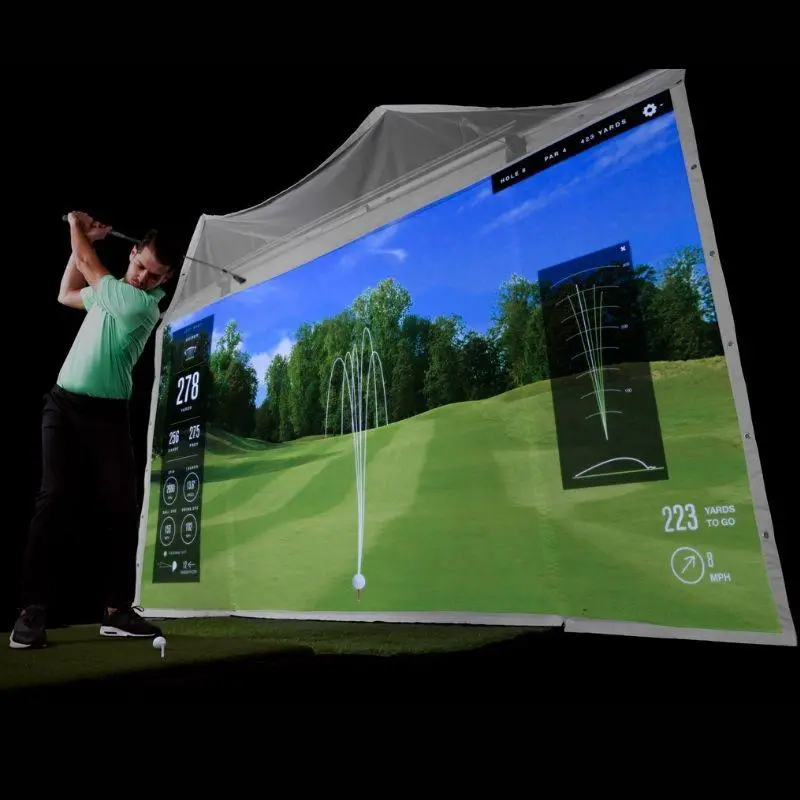
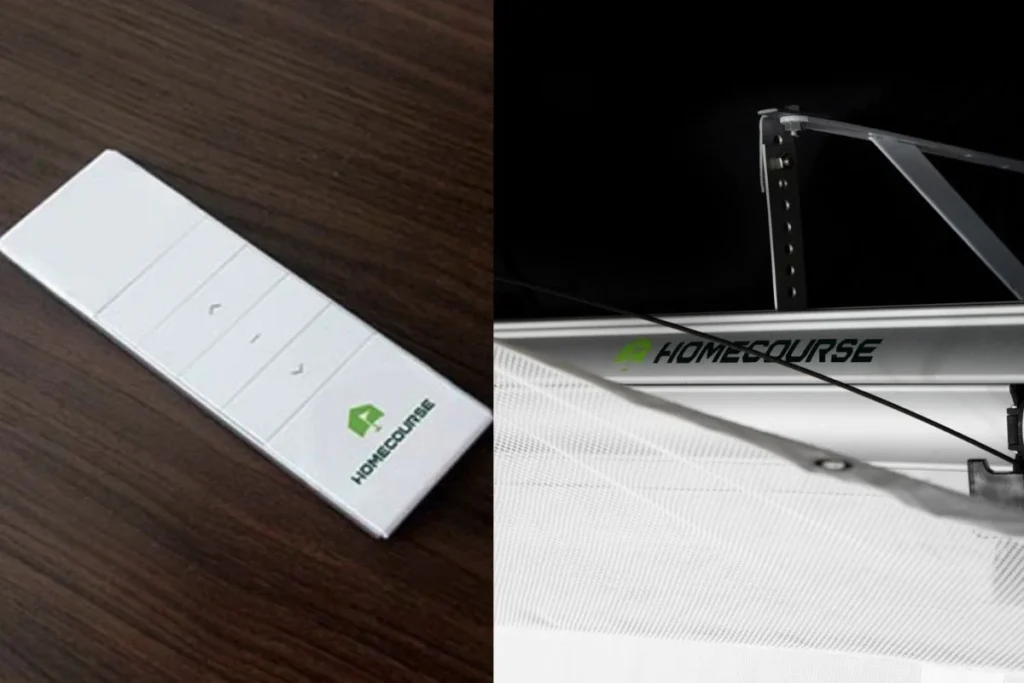
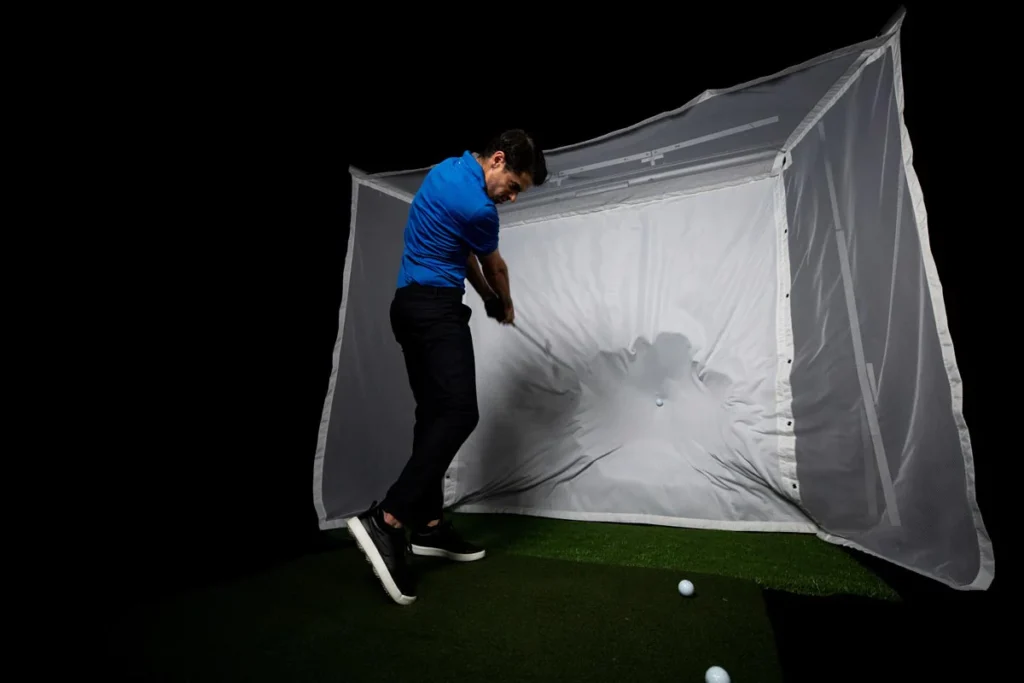
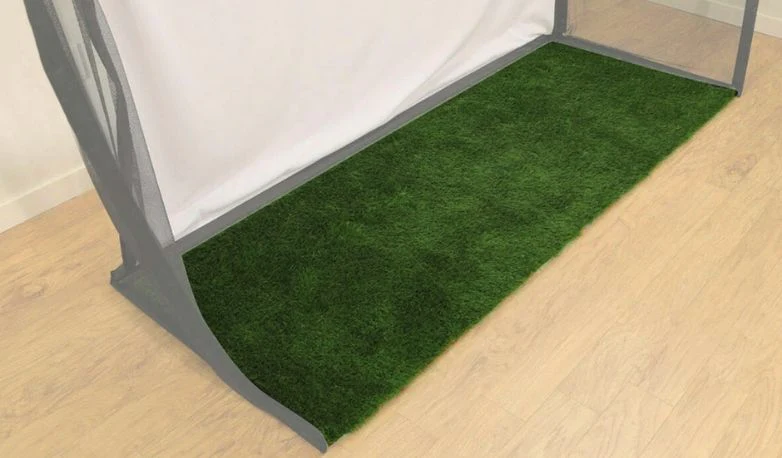
I recommend the HomeCourse Pro Retractable Impact Screen, which features a high-quality ballistic-grade surface, side protection against mishits, and an easy-to-use wireless remote that rolls up the whole screen with just one press. The HomeCourse Pro is my recommended option for a roll-up golf simulator impact screen.
That recommendation now comes with 2026 candor attached, because the owner record has grown some wrinkles:
- Sag and stitching reports exist. A small cluster of owners (4 comments, 2 authors) reports impact-zone sagging and stitching tears: “I’ve had one for about two months and it has developed sagging in the impact zone and the stitching tore at the bottom of the screen in the back.. I’m not a big hitter by any stretch, e.g. my best drives go about 155mph, so I’m surprised about this to say the least.” The company replaced that screen free of charge — and the owner reported “the new screen is having the same problems, so i’ll just live with it because i’m still having a blast”.
- The screen is officially a consumable. HomeCourse’s own warranty classifies the projection screen as a “wear item” — expected to degrade with normal use and excluded from warranty replacement. Go in with your eyes open.
- Owner discussion has gone quiet. The r/Golfsimulator search for this refresh found no HomeCourse Pro reviews, complaints or price chatter at all in the last three months. That’s not a verdict either way — it just means there’s little fresh word on it, and the sag reports above are from earlier seasons.
- No EU vendor. European buyers face a manual shipping quote from the US store; one German prospective buyer walked away over shipping and import taxes.
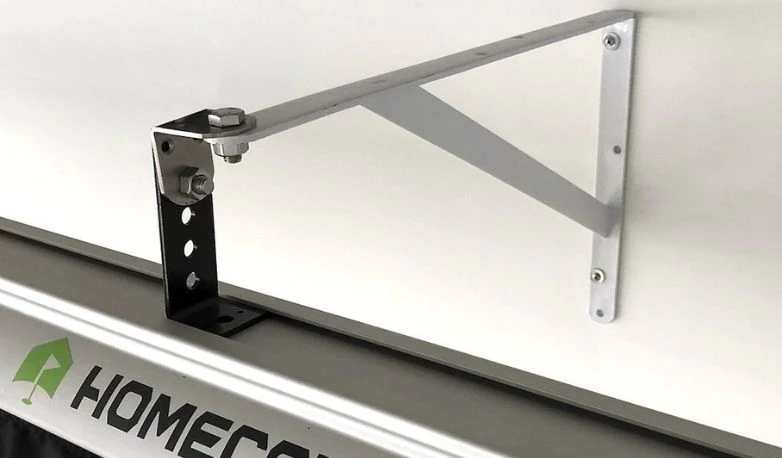
The practical strengths that made it my pick still stand. It mounts to studs no more than 8ft from the ground so the screen bottom touches the floor — note that “mounts under an 8ft wall” is a mounting spec, not a claim that 8ft of ceiling is enough room to swing a driver (for that question, see my What’s the Minimum Golf Simulator Ceiling Height? guide), and it wants 18 inches of clearance behind it for impact absorption. One satisfied owner clocks the routine at speed: “Charge it once every 3-6 months. Start to finish setup or take down is about 7 minutes for my whole sim.” The optional Pro Rack (80in × 30in × 8’8″) makes it portable around the house or outside.
SportScreen Vanish — the retractable enclosure route
The Vanish is the product owners mention most often when the retractable question comes up, and the praise clusters around two things. Build quality first (9 comments, 7 authors): “Impressed with the quality/sturdiness of it. Screen seems very high quality. Has all the things needed, side panels, baffles, top panel and just overall they don’t seem they cheaped out on anything. So far, so good.” One relocated unit was still going strong after two years, aluminum frame and all: “Works great. Made of aluminum. Haven’t had any problems 2 years later.”
And second, the retract-to-park lifestyle itself — the single biggest reason Vanish buyers name (14 comments from 12 owners), with the rolled-up unit taking only about 6–7 inches of ceiling depth.
You get five sizes (see the table above), hand-crank or motorized retraction — the motorized version pairs with Google Home, Alexa and the Tuya app — and a 2-year warranty. Two operating notes from the manual worth knowing before you buy: continuous motorized retraction can trip a thermal cutoff that needs a 10–15 minute cooldown (normal, not a fault), and the bottom of the screen tensions to the floor via a D-ring, carabiner and bungee system that’s doing real work keeping the screen flat.
Installation is genuinely DIY-able for a handy owner — the consistent report from owners who did it themselves (10 comments, 4 authors) is moderate difficulty, a few hours to a day: “Took a few hours to install but was able to do it entirely by myself with basic tools and a ladder. Measure twice! I found a room laser level on a tripod to be very helpful at ensuring each side was aligned.” The counterweight: a smaller group finds SportScreen’s install videos too long and unclear for the fiddly steps. The manufacturer itself recommends two people minimum and suggests a contractor for the mounting.
The honest issues — each one a real pattern in the owner record:
- Wide-unit sag. 16ft-width units sag in the middle and wrinkle when rolled; owners fix it with bungees, clips, or a sand-filled weight bar (7 comments, 7 authors — and the fixes work well enough that owners sound more resigned than annoyed about it).
- The containment gap question. Where the retractable side panel meets the front screen there’s a seam a fixed, bungee-tensioned enclosure doesn’t have. Prospective buyers ask about it constantly and owners acknowledge it: “There is always some concern of a gap where the side meets the front screen as compared to a standard setup.” Concern, notably — not a record of balls actually escaping.
- Baffle friction. One owner’s account: the roll itself is fast, “although remember the baffles still need to to be attached before hitting or removed before retracting the screen and that is always a legit 10-15 minute procedure.” [sic]
- Import costs for US buyers. The Vanish is made in Canada, and tariff exposure is a real decision factor (6 comments, 6 authors). One buyer walked: “I was going to buy this retractable setup, but the tariffs/taxes scared me off. I ended up going with the GungHo route instead.” Another went ahead: “I was nervous about customs/tariffs(comes from Canada) but ended up arriving via UPS in about two weeks. Expecting a tariff bill from UPS soon…even with that it will be cheaper then the retractable one from Gung-ho made in Texas last time and checked.” [sic]
On price comparisons, the picture is genuinely market-dependent right now: one August thread quoted a Vanish 11 with remote at ~$4,500 USD against a comparable Gung Ho at ~$3,600, while a second commenter the same week quoted CAD list prices that flip the ranking ($5,354.99 vs $5,825). Both are single accounts — treat the ranking as unresolved and get current quotes in your own currency. One commenter also mentioned a new SportScreen “Lite series” — unconfirmed as a distinct SKU beyond the LITE Hybrid-Retractable line noted above, so ask SportScreen directly.
The DIY roller route
This is where budget buyers have converged, and the pattern is consistent enough to call: Metech roller hardware plus a Spectrum Poly Spacer impact screen — a combo recommended independently across multiple threads this summer — with Spectrum now selling the Metech hardware directly so you’re not sourcing from two vendors. One buyer’s all-in figure for that direct package: “It was about $1,900. So a way better price than Gung Ho or SportScreen.” Fully self-built winch-and-screen rigs come in lower still — roughly $600–$1,600 in the community’s price reports (7 comments, 7 authors).
The trade-offs are real, and they’re the reason commercial kits cost double:
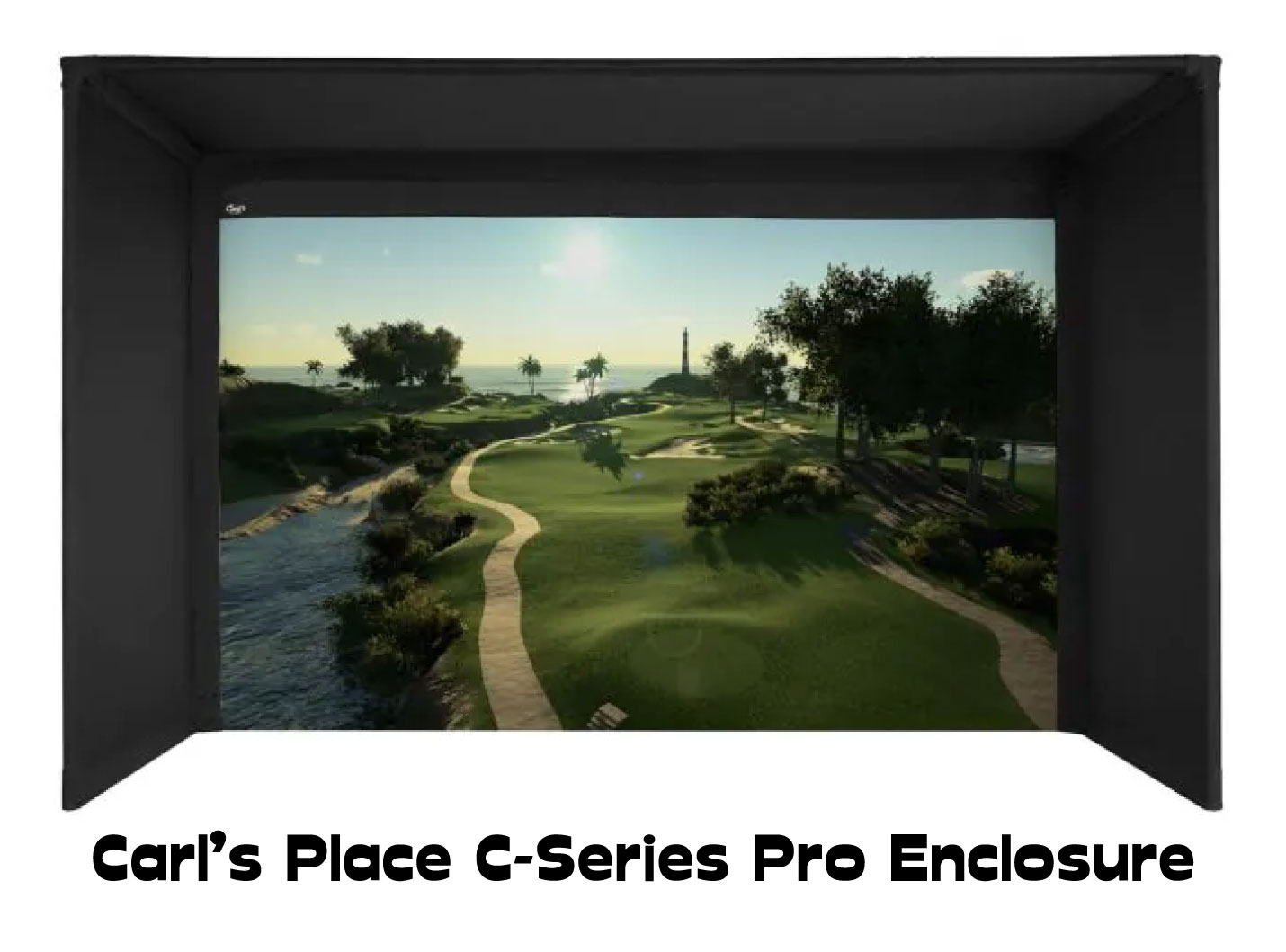
- Some screen vendors won’t back retractable use. Owner reports are consistent that Carl’s Place — a screen maker owners otherwise rate highly — won’t guarantee its screens used on a roller (3 comments, 3 authors; vendor policy as owners report it, not a published statement). That’s not a footnote; it’s the clearest signal that rolling a tensioned impact screen daily is hard on the fabric.
- You engineer the tension. The recurring craft tip, corroborated across threads: a rigid second bar at the very bottom of the screen beats rope or battle-rope weights for stopping billow and “waving” on impact.
- Protect the exposed roller. One owner took a 60-degree wedge shot bounce-back off an unprotected roller tube and now recommends foam padding around it — a single account, but a cheap fix for an obvious hazard.
- Concealment needs planning. If you’re boxing the roller behind a soffit, one concrete build report puts the needed depth at roughly 12 inches for a 14ft screen (rolled screen 7–8in, weight bar, mounting standoffs) — closer to 10 if you flush-mount.
Fast-dismantle setups
If you’ll set up and tear down per session rather than retract, keep it simple:
- Velcro and cable ties over permanent fixings
- A floor-standing projector rather than a ceiling mount
- A lightweight rollable mat (Cimarron’s Ultimate Mat remains the reference example)
For nets, the SIGPRO Golf Net covers quick-assembly and quick-disassembly setups — my full recommendation is in the outdoor section below. Two alternatives worth considering:
- The Net Return Pro Series — assembles tool-free in under 5 minutes via color-coded push-together tubes (rated to 225 mph — see the note above). One caution: at 7’6″ tall, one buyer found it too tall for their garage door rail as installed and had to adjust the door’s stop limit to make it fit — check your opener clearance before assuming it clears.
- The Spornia SPG range (5’5″ to 8ft cubes, 15–30 lbs) — the lightest credible option for tight spaces and travel.
On launch monitors, the principle still holds — some units are grab-and-go portable, some are permanent overhead installs — but the 2026 lineup has changed. Here’s the current split, cross-checked on 29 August 2026 against our manufacturer-lifecycle records and re-checked on the makers’ sites on 21 October 2026:
- Portable-class (fits a retractable room): SkyTrak ST MAX · FlightScope Mevo Gen2 · Bushnell Launch Pro · Foresight GC3 · Uneekor Eye Mini. (The SkyTrak+ also belongs in this class but is discontinued — SkyTrak now sells it only certified pre-owned, though some retailer bundles still list it.)
- Fixed overhead (fights the whole point of a retractable room): Uneekor QED (discontinued; support ends December 31, 2026) · Uneekor EYE XO family (EYE XO and EYE XO2 both still sold by Uneekor) · Foresight GC Hawk (discontinued).
A retractable room strongly favors the portable class — an overhead unit makes the “clear the space” premise moot.
How long does setup and teardown actually take?
The real numbers, sourced honestly:
| Setup | Time | Source |
|---|---|---|
| HomeCourse ProScreen 180 — full sim away | ~7 minutes | One owner’s routine, screen to PC |
| SportScreen Vanish — screen roll | “Seconds” per marketing; ~5 minutes for one owner’s full cycle (unreconciled) — plus 10–15 minutes for baffle attach/remove | Marketing claim + one owner’s account each |
| DIY roller | Comparable to Vanish once built | Depends on your tensioning design |
| Freestanding net (Net Return) | Under 5 minutes, tool-free | Manufacturer assembly spec |
| Full traditional enclosure | A couple of hours to disassemble | Standing site guidance — and why “semi-permanent” setups rarely move |
The number that matters most isn’t in the table: daily friction. The setup ritual — hauling out a PC, rolling the mat, powering everything on — has genuinely mothballed sims. Five separate owners raised exactly that, unprompted and bitterly, and it’s the best argument for paying more for one-button retraction: the sim you actually use beats the cheaper one you stopped setting up.
Where will you build it?
Garage retractable golf simulators
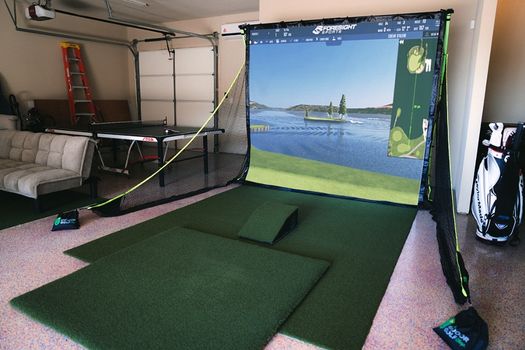
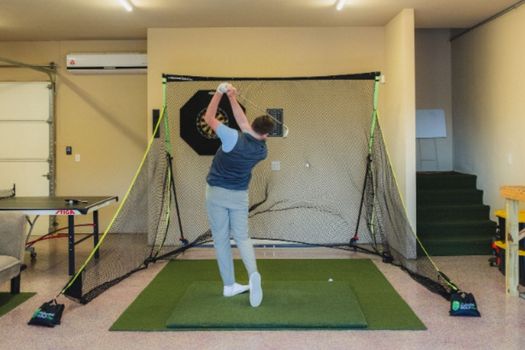
The garage is the natural home for a retractable setup, and it has one signature conflict: the garage door opener. A standard ceiling-rail opener blocks full-height travel of a retractable screen, and the standard fix — the broadest-consensus advice owners give on this topic, by distinct voices (9 comments, 9 authors) — is converting to a jackshaft or wall-mounted side-mount opener. Budget for it in the plan, not as a surprise. The Vanish’s mounting brackets help here too: owners mount them to walls, ceiling, or tucked inside, outside or under the door rails, and hand-crank units can be upgraded to motorized later.
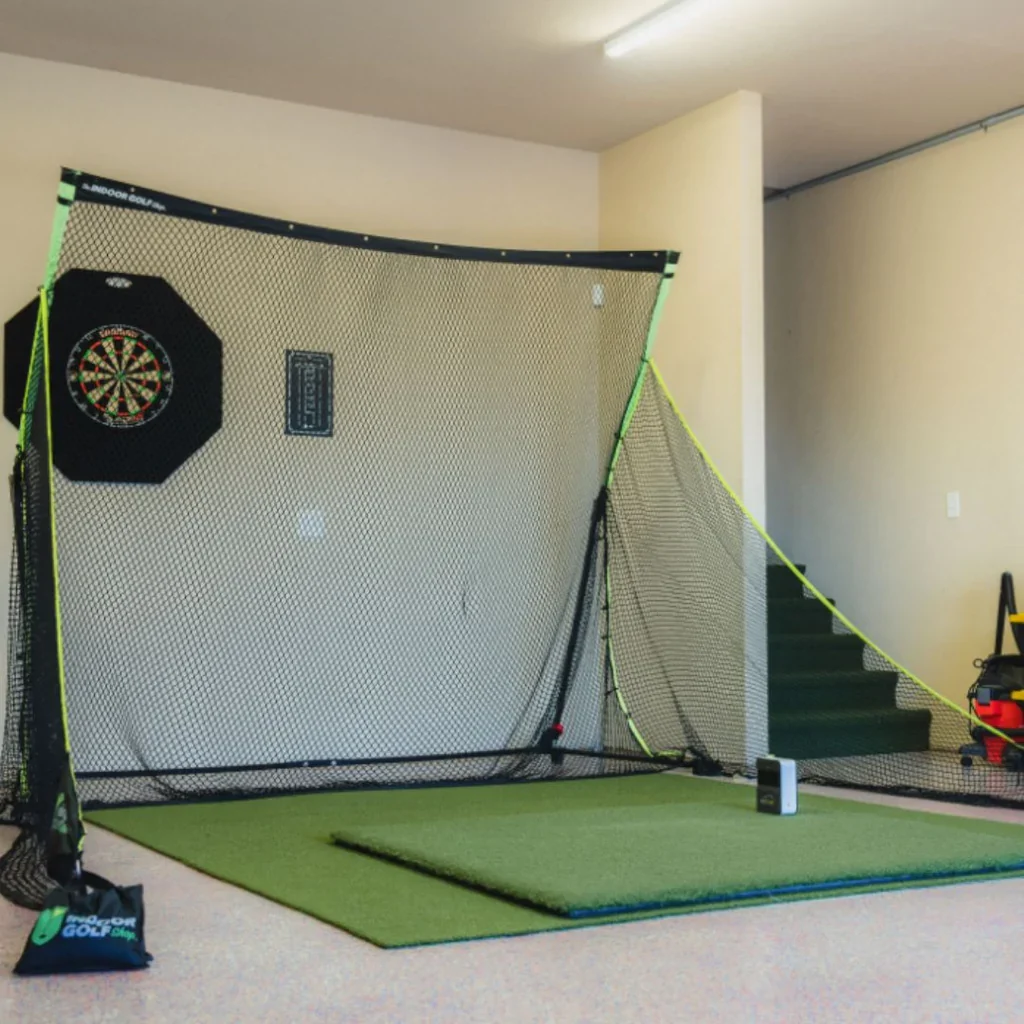
Check out my dedicated article all about garage golf simulators and the key points you need to think about when building your simulator in your garage. Garage Golf Simulator – 13 Key Challenges + Tips & Tricks
Basement retractable golf simulators
A basement can be an even better retractable home — no car negotiation, stable temperature — with its own ceiling and moisture questions, covered in my dedicated guide: Making a Basement Golf Simulator – Pros and Cons.
Outdoor retractable golf simulators
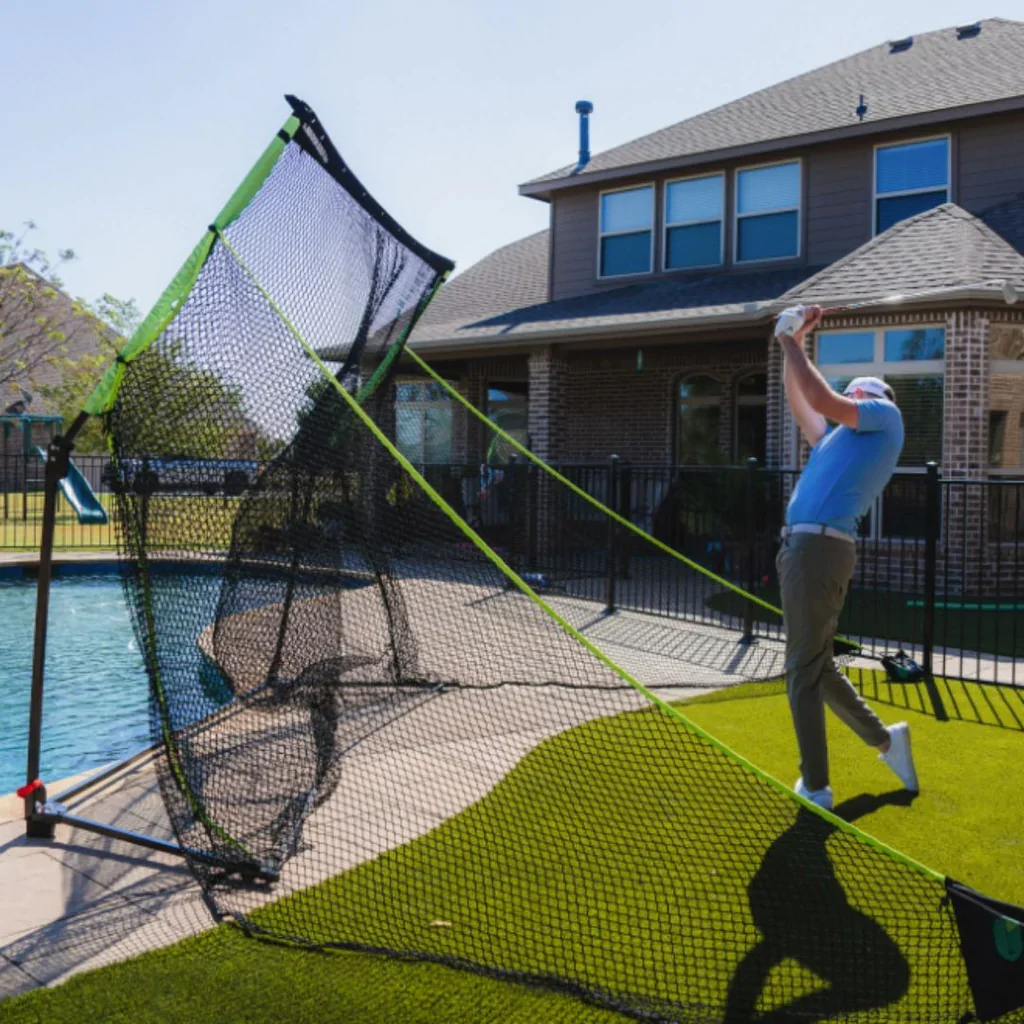
For summer, the fast-dismantle route wins. I recommend the SIGPRO Golf Net for quick-assembly and disassembly outdoor setups. Add SIGPRO’s impact screen to the same frame if you want projection outdoors — it assembles in minutes — and see the opening section for the seasonal indoor-winter, outdoor-summer rhythm that makes this route work.
Limitations of a retractable golf simulator
The trade-offs here are real, and the owner record has sharpened them rather than softened them:
- A retracted screen is never drum-tight. Rolling the fabric daily fights the tension a fixed frame holds permanently; sag-and-tension is the most consistent complaint pattern across every rollable product in this guide (3 comments, 3 authors on generic rollers, plus the product-specific reports above). Too much added tension creates its own problem — bounce-back.
- Containment is a seam-by-seam question. Fixed enclosures tension netting on all four edges. Retractable designs have gaps — side-to-front seams, roller openings — that owners monitor rather than ignore.
- The most impressive setups online are the least movable. Every step toward showroom polish is a step away from clearing the space in minutes.
- Daily friction compounds. See the teardown section — the honest failure mode of budget retractable setups isn’t breakage, it’s disuse.
FAQ
Is an 8ft-wide screen wide enough for my launch monitor?
Buyers ask this constantly and there’s no owner-settled answer, so here’s the rule of thumb rather than a measured fact: camera units that sit beside the ball are comfortable at 8ft if everyone hitting in the bay shares the same handedness; radar units need alignment to the target line and space behind the ball, which an 8ft-wide bay makes tight. A household with both right- and left-handed golfers — or a radar unit — should look at the wider Vanish sizes or DIY widths.
Can balls get through the gap where the side panel meets the front screen?
Owners and prospective buyers report concern rather than incidents (5 comments, 4 authors). The seam exists; a fixed bungee-tensioned enclosure doesn’t have it. If shanks are part of your game, position the bay so the miss side faces a wall.
How much ceiling height do I need?
For the HomeCourse Pro, the unit mounts no higher than 8ft so the screen reaches the floor — but that’s the mounting spec, not swing clearance — and some owners drop the mounting brackets down from the ceiling to fit, which can look unsightly when the screen’s retracted (3 comments, 2 authors). Vanish models are built for ceilings of 108–126in (Vanish 9, 11 and 16), 120–138in (16H) or 125.5–143.5in (13H), per SportScreen’s room requirements. Whether YOU can swing a driver under any given ceiling is a separate question — my What’s the Minimum Golf Simulator Ceiling Height? guide covers it by height and swing.
Do I pay import duty on a Vanish in the US?
It’s made in Canada, and one owner’s account documents a UPS tariff bill on top of the purchase — while another buyer abandoned the purchase over exactly that risk. Duty exposure changes with trade policy; get a landed-cost quote before ordering.
Summary
Four routes, one honest decision tree. Daily player who wants the garage back: SportScreen Vanish (sold out in every size at SportScreen on 21 October 2026, so check stock), and accept the baffle ritual. Simplicity-first: HomeCourse ProScreen 180, knowing the screen is a wear item. Budget-first and handy: Metech + Spectrum DIY roller at roughly half the commercial price, engineering your own tension. Occasional player: a SIGPRO or Net Return net and a portable launch monitor, no screen at all. For planning the space itself, start with my How much space do you need for a Golf Simulator? guide.
Overhead vs Floor Launch Monitors: Which Suits Your Room?
Square Golf Omni Review: What Owners Report
ABOUT THE AUTHOR
Hello! My name is Alex and it is my mission to bring you all the information you need to build your own home golf simulator! I hope mygolfsimulator.com helps you on your journey to better golf at home!
LEGAL INFORMATION
On this site, you'll find articles on all aspects of building a golf simulator. I will also link to other sites where you can buy some of the simulator components. Some of these links may be affiliate links, which means if you click them I gain a small commission at no extra cost to you. This really helps out me and my site so thank you in advance! mygolfsimulator.com and all related social media accounts are property of Awonline LTD.