Garmin R10 Space Requirements – Length, Width and Height
Posted in Launch Monitors
The Garmin Approach R10 sits 6–8 feet BEHIND your ball, and Garmin requires at least 8 feet of ball flight in front of it — so plan on roughly 15 feet of room depth as your minimum, with 17 feet or more for comfort. Width-wise you’ll need at least 10 feet, and while the R10 itself adds no ceiling requirement, your swing does: 9–10 feet of ceiling height is the safe zone. That’s the whole answer in one breath. The rest of this guide shows you where those numbers come from — Garmin’s own manual, this summer’s real-world builds, and the community’s hard-won workarounds — plus the fork in the road if your room fails the depth math.
This post may contain affiliate links, which means I may earn a small commission at no extra cost to you. This really helps out me and my site so thank you in advance!
In a Nutshell
The Garmin R10 sits 6–8 ft behind the ball and needs at least 8 ft of ball flight in front of it, so plan on about 15 ft of room depth (17 ft or more for comfort), at least 10 ft of width and a 9–10 ft ceiling for your swing.
👉 Once your room passes, measure the R10-to-tee distance and enter it exactly, and set the unit level with the base of the ball; the setup section shows how.
In this guide: The depth math · Width · Ceiling height · Setup for accuracy · The camera-unit fork · R10 vs R50 · FAQ
| Dimension | Minimum | Comfortable | Where it comes from |
|---|---|---|---|
| Device to ball | 6ft | 7–8ft | Garmin manual (6–8ft stated range) |
| Ball to net/screen | 8ft | 10ft+ | Garmin manual (8ft is the stated floor) |
| Total room depth | ~15ft | 17ft+ | Manual figures + buffer behind the screen |
| Room width | 10ft | 15ft (central aim) | Working guidance, backed by owner reports |
| Ceiling height | 9–10ft | 9.5ft+ | Community consensus — not an R10 spec |
| Hitting zone | 2ft × 2ft | — | Garmin manual (tee can move ±1ft laterally) |
👉 Bottom line: if you can’t give the R10 about 15 feet front-to-back, don’t force it — buy a camera-based unit instead. That’s the fork, and the rest of your room budget follows from it. (Jump to the fork.)

How much room length does the R10 actually need?
The R10 is a Doppler radar unit. It doesn’t photograph the ball at impact the way camera units do — it tracks the ball in flight, which is why it needs distance on both sides of you. Garmin’s manual is specific: the unit sits on the ground 6–8 feet behind the tee, aligned with your target, and the tee must be at least 8 feet from the net or screen indoors.

Stack the chain up and the minimum reveals itself:
- 6–8ft from the R10 to your ball (manual spec)
- 8ft minimum from ball to net or screen (manual spec) — more flight is better for the radar
- ~1ft behind the screen. I always recommend at least 1ft of space behind your impact screen to allow the screen to deform backward when struck and to minimize the bounceback reflection of the ball. How much your screen will send the ball hurtling back at you will depend on how tightly it is attached to your enclosure.
- A little stance and walk-around room
That lands you at roughly 15 feet as the absolute floor and 17–18 feet for a setup you’ll actually enjoy. This summer’s Reddit builds back the math almost exactly: one August build ran “7 feet behind ball and ball to screen is about 10 feet,” and a June thread converged on the same guidance for an 18.5-foot garage — around 7 feet behind the ball and 8 feet or more of flight. Telling detail: a golf retailer in that thread called even 18.5 feet of depth “quite snug.” Minimum and comfortable are different rooms.
💡 One owner’s tip for tight rooms is worth carrying: “try decreasing the distance from you and the R10 (6′) and increasing the distance between the ball and net (9′). It’s better to have more ball time for the R10 to read than for it to be farther away from you.” That’s a single account, not a Garmin recommendation — but it agrees with the physics of a radar that reads flight.
There are outliers — one owner reports a working setup with the unit just 3 feet behind the ball — but that’s a lone report against a wall of 6–8ft experiences. Build to the manual.
Room width and the central aim point
Minimum: 10ft (workable but cramped, wall-strike risk) · Comfortable: 15ft (central aim point).
Width is about your swing and your aim line, not the device — the R10 sits behind you, out of the way. I believe you could theoretically use the Garmin R10 launch monitor in a room smaller than 10ft wide depending on your height and swing plane, but it would be cramped and you’d be at risk of striking the wall. 15ft of room width would allow you to address the ball with a central aim point.


Two details make width more forgiving than it looks:
- The manual gives you a 2ft × 2ft hitting zone with the tee free to move up to a foot either side of the target line — handy when your mat wears.
- Owners describe the practical width rule as clearance to the side wall roughly matching your vertical clearance, because the club head swings through both arcs. If your backswing brushes drywall, the room is too narrow no matter what the tape measure says.
Ceiling height: the universal constraint, not an R10 one
Here’s the honest framing: the R10 has no ceiling requirement of its own. It’s a floor unit sitting behind you — no published clearance figure exists for it, and months of owner threads never raise radar-cone height as a real constraint. The ceiling number is about your swing, full stop.
The community’s numbers, drawn from hundreds of owner reports:
| Ceiling | What owners report |
|---|---|
| 9–10ft | The consensus safe minimum for swinging driver comfortably (14 reports across 11 owners) |
| 9–9.5ft | Enough for most golfers — including plenty over 6ft — without ever touching the ceiling |
| 8’4″–8’8″ | Contested. Nine owners call this a mid-irons-only band with drivers risking the ceiling on follow-through — while six others at the same heights swing driver without issue. Your height and swing plane decide it. |
| Under 8.5ft | Drivers and woods go unusable for most; scraped-ceiling stories cluster here |
You may be able to use 9.5ft or even less depending on your height, your swing and your relationship with indoor swing syndrome. And remember the detail people forget: your hitting mat steals 2–2.5 inches of that clearance before you ever swing. A fresh August thread put it bluntly for the tall — a 6’5″ golfer: “there is a dent in my ceiling from my half-length swing trainer. 8′ isnt even enough to swing a lob wedge.”
If your ceiling is the constraint, the structural fixes (engineer-assisted rafter work, targeted cutouts, even floor recesses) have their own economics — all covered in the dedicated guide: What’s the Minimum Golf Simulator Ceiling Height?. For the whole-room picture across every launch monitor type, see How much space do you need for a Golf Simulator?.
Setting up the R10 so the numbers are accurate
A radar unit in a tight indoor space rewards precision. The manual’s recipe:
- Align the red line. The R10’s red alignment line must point through your tee to the target. The manual’s own trick: lay a golf club on the ground between the alignment line and the tee to confirm the lineup.
- Enter the exact distance. When simulator mode prompts you for the launch-monitor-to-tee distance, measure it — don’t eyeball it.
- Level with the ball’s base. This is fine for those with the golf mat built into their simulator floor. However, those with thick raised golf mats (including those at the driving range) will need to elevate the R10 up a few centimeters so that its feet sit level with the base of the golf ball. That mat trick is now official guidance, too: Garmin’s manual says the unit’s bottom edge must sit above the mat.
- Watch the environment. One August troubleshooting thread traced bad indoor numbers to a unit sitting fractionally off-level — “it was about 3/4 of an inch low which I didnt think was a big deal … it was incredble the change it made,” the owner wrote after fixing it. The same thread’s other suspects: exposed concrete and fluorescent lighting near the unit, and non-RCT range balls (RCT balls carry the reflective marking radar units read best). One thread’s findings, not gospel — but cheap to rule out.
This excellent video from Garmin on YouTube covers how to set up and align the Approach R10.
Left-handed players: the R10’s quiet advantage
Because the R10 sits behind the ball rather than beside it, a lefty and a righty can share a setup without moving the unit — if your room is wide enough for a central hitting position with a mat on either side (see the width section above). In a narrower room you’ll still flip the mat around and re-square the R10 behind the new hitting position, like any other unit.

Compare that with side-mounted camera units, which owners describe physically carrying to the other side of the mat every time the opposite-handed player steps up — a real workflow tax in mixed households.
Not enough depth? This is the fork in the road
The single clearest space lesson from this summer’s threads: buyers with pinched rooms don’t make the R10 work — they buy a different architecture. Radar units that sit behind the ball (R10, Mevo+, MLM2Pro) need throw distance. Camera-based units that sit beside or in front of the ball don’t — and owners hitting from just 6–9 feet of ball flight with photometric units report it works fine, with several finding the shorter distance more immersive.

Real buyer behavior, August 2026: a tight-patio builder wrote “I know my space is not long enough for a doppler unit that sits behind the ball” — and shopped camera units instead. A July garage thread reached the same verdict: “if you’re pinched for space then you need to go with the skytrak.”
| Radar behind ball (R10) | Camera beside/front (SkyTrak family, Square, R50) | |
|---|---|---|
| Placement | 6–8ft behind you | Beside the ball or facing you |
| Practical minimum depth | ~15ft total | ~10–12ft total (6–9ft of flight) |
| Lefty/righty switching | No unit move (wide rooms) | Physical reposition each time (side units) |
| Ball flight needed | 8ft+ — more is better | A few feet |
Full head-to-heads: Skytrak vs Garmin R10 – Complete Guide (19 Key Comparisons) · Skytrak Space Requirements – A Must Read guide! · Mevo Plus vs Garmin R10 – 18 Key Comparison Guide.
R10 vs R50: space edition
Garmin’s Approach R50 didn’t exist until late 2024, and in space terms the two couldn’t be more different. Because the R50 sits beside rather than behind the tee — see the placement table above — the R10’s throw-distance math disappears entirely, and it solves the lefty question digitally rather than by repositioning.
| Garmin R10 | Garmin R50 | |
|---|---|---|
| Placement | 6–8ft behind the ball | ~1.5ft beside the tee, at tee height |
| Screen distance | Needs 8ft+ of flight | Affects comfort and screen wear only, not accuracy |
| Lefty handling | Physical setup (width-dependent) | Left/right profile + up to 10° digital re-aim (range mode) |
| Price | $499.99 MSRP and street (October 2026) | $4,999.99 MSRP and street (October 2026) |
But nobody buys an R50 to save floor space. They solve different problems: the R10 is the budget door into simulator golf; the R50 is an all-in-one for a different wallet. Community reception frames the R50 as a convenience play rather than an accuracy leap — the full comparison lives in Mevo Plus vs Garmin R10 – 18 Key Comparison Guide and the R50 coverage. Check the Garmin R50 here: Garmin R50.
Outdoor use: where the R10 stretches out
Outdoors the same geometry applies — one owner confirms “about 7′ behind the ball and 8′ of flight works just fine” into a net — but the constraints relax. The R10 is built for it: IPX7 water resistance (rain-proof, safe in weather), up to 10 hours of battery, and an operating range of -10 to 55°C. A garage with the door open is the classic depth cheat: the unit sits inside, the net catches the ball, and the driveway donates the flight distance. More on that build style in Garage Golf Simulator – 13 Key Challenges + Tips & Tricks.
What the R10 measures (and what it calculates)
Worth knowing before you fight your room for accuracy — what’s measured versus what’s math:
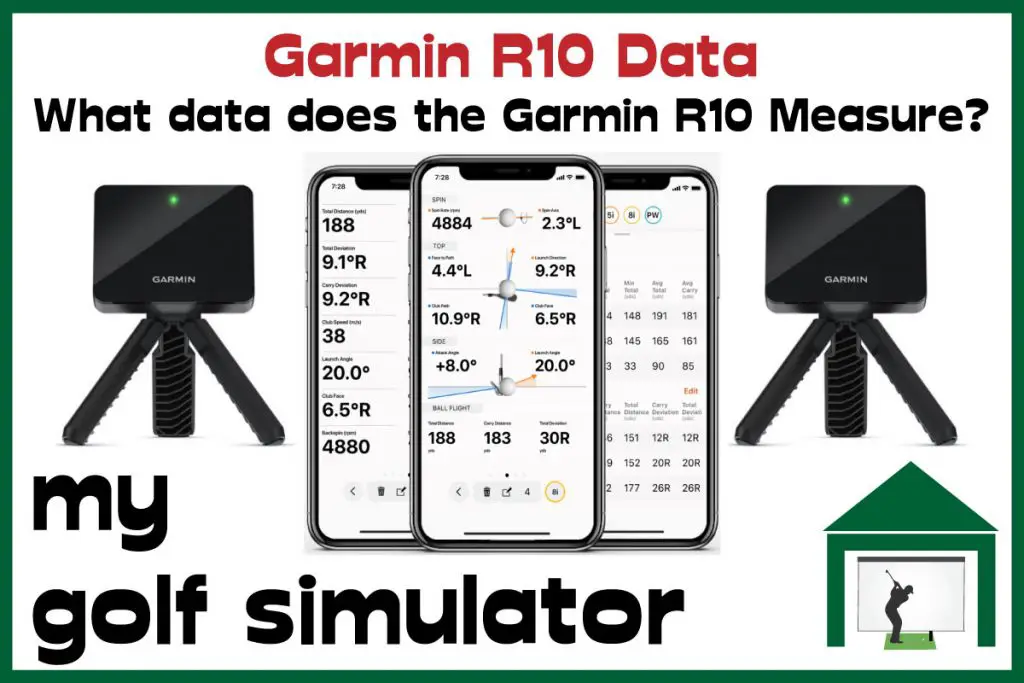
- Measured directly off the radar (4): club head speed · ball speed · launch angle · launch direction
- Calculated from those four (~10): spin rate, spin axis, carry distance, face angle and the rest
Garmin’s published accuracy specs, benchmarked against Trackman:
| Metric | Published accuracy |
|---|---|
| Club head speed | ±3 mph |
| Ball speed | ±1 mph |
| Launch angle/direction | ±1 degree |
| Carry distance | ±5 yards |
That’s why tight setups and interference show up first as weird spin and carry numbers: the measured four are robust, the calculated ten inherit any noise. The full data deep-dive lives in Garmin R10 Data – What Data does Garmin Approach R10 Measure?.
What the R10 costs in 2026
The “new $600 gadget” framing of 2021 is history. Garmin now lists the R10 at $499.99 (down from $599.99), Shop Indoor Golf and Carl’s Place charged the same on 21 October 2026, and the used market is where the action is:
- $450 — Facebook Marketplace, August (dated signal, not today’s price)
- $330 — eBay, August (same caveat)
The line item space planners forget: Garmin Golf membership at $9.99/month or $99.99/year if you want Home Tee Hero course play. Budget the room first, then the subscription.
Garmin R10 space FAQ
Is a 9ft-ceiling spare room viable for an R10?
Buyers ask this constantly, and the answer is yes — if the depth clears roughly 15 feet. The ceiling suits most swings at 9ft; the depth is usually the real gate.
How far behind the ball does the R10 sit?
6–8 feet, per Garmin’s manual — and owners repeatedly land on about 7 feet in practice.
Is 16.5–17ft of room depth enough?
Yes, comfortably — that covers the device gap, the 8ft+ flight, and screen clearance with room to spare.
Can I use the R10 in a 10ft-deep garage?
Not realistically. That’s camera-unit territory — see the fork.
Does the R10 need to be moved for left-handers?
No — provided your room is wide enough for a central hitting position with a mat on either side. In narrow rooms, expect to flip the mat and re-square the unit.
Does the R10 work outdoors into a net?
Yes — same 7ft-behind, 8ft-flight geometry, and the hardware is rated for weather and long sessions.
Do I need the Garmin subscription?
Not for practice and the measured data. Home Tee Hero course play needs the membership ($9.99/month or $99.99/year).
Final Thoughts
Five years on, the verdict I gave the R10 at launch has aged into something more specific: it’s still the cheapest credible route into simulator golf — the used-market default, even — but only for rooms that pass the depth math. If your space gives it 15 honest feet, the R10 delivers remarkable value for the money. If it doesn’t, that’s not a discount problem, it’s physics — buy for the room you have, and a camera unit will make you happier than a radar unit ever could in a squeezed bay.

Measure twice, buy once.
Check the Garmin Approach R10 here: Garmin R10 — Take a Look!
Also worth a look for tight rooms: Garmin R50 · hitting mats
Carl’s Place Pro Golf Enclosure Review (2026): What’s in the Box, Real Cost and Owner Reports
Is SkyTrak Portable? Battery, Direct Mode and Range Days (2026)
ABOUT THE AUTHOR
Hello! My name is Alex and it is my mission to bring you all the information you need to build your own home golf simulator! I hope mygolfsimulator.com helps you on your journey to better golf at home!
LEGAL INFORMATION
On this site, you'll find articles on all aspects of building a golf simulator. I will also link to other sites where you can buy some of the simulator components. Some of these links may be affiliate links, which means if you click them I gain a small commission at no extra cost to you. This really helps out me and my site so thank you in advance! mygolfsimulator.com and all related social media accounts are property of Awonline LTD.