SkyTrak Shot Delay? – How to Fix a Slow SkyTrak
Posted in Launch Monitors
Expect roughly 2–3 seconds between striking the ball and seeing its flight on screen with a SkyTrak — that’s the design working as intended, not a fault. Five seconds or more is a real problem, and it’s usually fixable, in this order: the device running the app, then software settings, then the connection. That guidance holds across all three generations — the original SkyTrak, the discontinued SkyTrak+, and the current ST MAX. 👉 The Quick Verdict has the fix order; the rest of this guide explains the why, the wedge quirk, and what the delay conversation looks like in 2026.
In a Nutshell
A 2–3 second delay between impact and ball flight is normal on every SkyTrak, because your device, not the unit, processes the shot images. Five seconds or more means something in your chain is underpowered or misbehaving: check the device first, then your graphics settings, then the connection.
👉 A 2–3 second shot delay is normal on every SkyTrak. Don’t chase zero — chase stable. Anything beyond 4–5 seconds means something in YOUR chain is underpowered or misbehaving, and the fix order below finds it.
In this guide:
| Step | Check | Why first |
|---|---|---|
| 1 | The device’s computing power | The most common cause by far |
| 2 | Graphics settings in your sim software | Free fix — lower settings, test again |
| 3 | Connection mode (direct vs network vs USB) | Dropouts masquerade as slowness |
| 4 | Ball position (wedges especially) | The viewing-window quirk — see below |
| 5 | SkyTrak support | If 4–5s+ persists after all of the above |
Generation note, stated honestly: owners who upgraded OG→SkyTrak+ corroborate the Plus reduced the lag; whether the ST MAX improved on the Plus is genuinely split among owners. Details in the expectations section.
Jargon, once: shot-to-show is the time from impact to rendered ball flight; photometric means camera-based — the SkyTrak photographs the ball rather than tracking it by radar; direct mode connects the unit straight to your device over its own Wi-Fi signal, while network mode routes through your home router; an SSID is simply a Wi-Fi network’s broadcast name.
- Why a delay exists at all
- What delay should you expect in 2026?
- Can some delay be a good thing?
- Cause #1: the device running SkyTrak
- Cause #2: the simulation software
- Cause #3: connection mode
- Why wedges feel slower
- Delay vs misreads — where the 2026 conversation actually is
- How the SkyTrak line has changed
- Done with the delay? 2026 upgrade paths
- Delay prevention checklist
- FAQ

Why a delay exists at all
I researched golf simulator forums extensively for this post, and the clearest explanation of the delay came from SkyTrak’s own representatives. The unit itself isn’t thinking — as a SkyTrak representative put it, commenting on Golf Simulator Forum: “There is no processing that happens on the unit itself, we’re just sending images”.
So every shot walks the same pipeline:
- The cameras capture high-speed images of the ball at impact
- The images transfer to your device
- Your device’s processor extracts launch parameters (ball speed, launch angle, spin)
- The modeling software computes the full flight
- The graphics engine renders it
- Checks and re-checks run just before the shot appears, to make sure the data and the rendered flight agree

Each step costs fractions of a second; together they cost about two. The heavy lifting happens on YOUR device — which is why the single biggest lever on delay is the computer, tablet or phone you run the app on, and why the same SkyTrak unit can feel snappy on one setup and sluggish on another.
What delay should you expect in 2026?
Around 2–3 seconds, corroborated by current owners. From a comparison thread this summer, two owners independently: “the shot delay, theres a couple seconds between hitting and seeing the ball on screen, but for practice its totally fine.” and “There is a delay between hitting the shot and seeing it appear, maybe 2-3 seconds? However… the delay can be a good thing or at least not as big a negative as you might think… After years of that, I have gotten pretty good at predicting the outcome before the flight shows up.” The original guidance stands with them: don’t expect under two seconds — that’s the processing floor — and treat anything beyond 4–5 seconds as a problem worth chasing.
The generational picture, with the evidence laid out honestly:
- OG → SkyTrak+: improved, owner-corroborated. Upgraders report a clear all-round improvement — including less lag and fewer mishit misreads (8 reports from 7 owners, stable across a year and a half of reports). A separate six-owner pattern pegs the Plus’s delay at 1–2 seconds — shorter than the original’s, though still noticeable in group play.
- SkyTrak+ → ST MAX: genuinely split. Three owners and reviewers find the MAX noticeably faster and credit the dual USB-C wired connection. Four others say the “faster processor” barely moved it — one cluster puts the improvement at roughly 2.6 seconds down to 2. No measured, controlled comparison has been published for any of these; that is owner sentiment, and the MAX-vs-Plus question stays open.
A word on the famous SkyTrak advert, which showed near-instant ball flight: I understand that the SkyTrak team had to fit their advert into a certain time and decided to cut the shot delay and even speed up the ball flight in order to get everything in. I imagine it is hard to produce an advert with all the imagery and information included whilst sticking to a strict time, but any SkyTrak users with a significant shot delay will be frustrated watching the advert. Expect the real thing to take its two seconds — and then the ball shows up, grinning all the way. I love mine!
Can some delay be a good thing?
At Skytrak’s price point, I think you have to accept some delay. I am totally in agreement that excess post-shot delays will reduce the immersiveness of a golf simulator, especially for those using projectors and impact screens. However, every cloud has a silver lining. The 3-4 second delay in my Skytrak setup allows me to ensure I complete my swing properly, making a proper follow through without lifting my head to see where it has gone. I am able to retrieve my ball and take a break between shots too.

I believe in deliberate, targeted golf practice. You need to be able to work on a specific drill or feeling in your practice. My short Skytrak delay is noticeable but it allows me to make the most of the shots I do hit. I know I would end up hitting more balls if I had zero delay but I do question whether I would gain anything extra from doing so.
You have to make sure your slower, more targeted practice doesn’t translate into slow play on the course though.
I would ask though, is a short delay really the end of the world? Of all the problems you could face, this is quite a minor one. (That 3–4 second figure dates from the original-SkyTrak era — the expectations section covers where the newer generations land.)
For balance: plenty of frustrated owners now steer buyers toward Square, Bushnell or the Eye Mini on reliability grounds — while one detailed account from an owner who ran BOTH an ST MAX and a Square ultimately preferred the SkyTrak for practice and data quality, after a Square software update bricked both of that household’s units. One owner’s experience against a broader steer-away current: the trade-off is real in both directions.
Cause #1: the device running SkyTrak
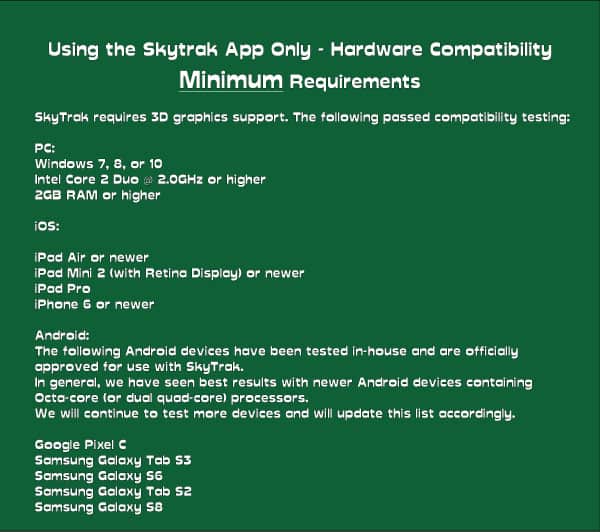
Computing power remains the top cause of excess delay. The old TGC-2019 spec lists are gone with the software era that needed them — here are the current official minimums for the unified SKYTRAK app:
| Platform | Minimum |
|---|---|
| PC | Windows 10 64-bit · i3-10100F / Ryzen 5 2600 · 8GB RAM · GTX 1650 / RX 580 · 128GB SSD |
| Mac | Apple Silicon M1 or newer · macOS Ventura+ |
| iPad | M1 iPads or newer |
| Android | 2020+ device · 12GB RAM |

I recommend aiming your system requirements towards that which will run 3rd party simulation software — the app minimums get the SkyTrak working; they don’t make GSPro or E6 (the two third-party course-play titles, covered below) fly at high settings. The three-tier logic, in today’s part classes:
- Comfortable: a current upper-mid graphics card — the RTX 4070-Super class the projector guide uses as its 4K floor — runs everything at high resolution
- Compromise: a mainstream card one or two tiers down, if you’re not fussed about maxed settings
- Last lever: if everything else checks out and you still sit beyond 4–5 seconds, a processor upgrade — i7-class rather than mid-range i5


On tablets and phones: the M1-iPad requirement does the gatekeeping the old “borrow a newer tablet” advice used to do — but the borrow-test itself remains the cheapest diagnostic there is. Run the app on a friend’s newer device; if the delay drops, you’ve found your answer without spending anything.
Cause #2: the simulation software
The software landscape has turned over completely since this article’s first version. TGC 2019 — the era’s default — is gone. Today: E6 Connect — the long-running commercial course-play title — is discontinued for new SkyTrak customers (existing licences still connect), and GSPro — the community-driven realism benchmark — is not officially supported: owners reach it through a community-built bridge that works without a SkyTrak subscription, with the caveats unofficial software always carries: it can break with updates, and nobody owes you support when it does (a well-established owner practice, 4 owners).
Whatever you run, the free fix comes first: graphics settings. Lower the resolution and effects, test, and note the difference between two distinct problems — stuttering and juddering DURING ball flight is a rendering problem; a long pause BEFORE the flight appears is the shot-to-show delay this article is about. Settings cure the first and only trim the second.

Cause #3: connection mode
Here’s the counterintuitive part, again from a SkyTrak representative commenting on Golf Simulator Forum: “it’s not the transfer of data that takes the time – it’s the image processing on the computer/iPad before we can fly the ball”. So the connection mode won’t change a healthy delay much — but an UNSTABLE connection reads as slowness: dropped packets, re-sends, and mid-round disconnects that feel like the unit thinking forever.
Per-generation connection options:
| Generation | Modes | Notes |
|---|---|---|
| SkyTrak (OG) | Direct · Network (2.4GHz only) · USB | USB runs at USB-2 speeds — fine, since transfer isn’t the bottleneck |
| SkyTrak+ | Direct · Network (recommended) · USB via splitter cable | The splitter cable is the manual’s documented path |
| ST MAX | Direct (SSID STMAX_xxxx) · Network (recommended) · USB-C | USB-C data works on Windows only — not Mac, iPad or Android |
The community’s stability playbook (7 reports from 6 owners):
- Give the unit a dedicated Wi-Fi SSID
- Prefer direct mode over network mode if your router placement is marginal
- Keep USB as the fallback

One detailed account from late August shows the realistic worst case: an ST+ owner whose network mode “would always quit mid round” switched to direct — which still drops about weekly. One owner’s experience, but a useful calibration: modes change failure frequency, not the processing floor. For the full diagnosis tree, see my dedicated guide: Skytrak Connection Problems – The Ultimate Guide.

Why wedges feel slower
High wedge shots genuinely take longer to process, and the mechanism is the imaging window: the SkyTrak photographs the ball in a defined zone above the unit, and a high-launching shot exits that window quickly — sometimes before the cameras have captured enough good frames. The system then runs extra validation. A SkyTrak representative, commenting on Golf Simulator Forum: “I believe the image processing does a ‘second look’ at shots that may fall outside average launch conditions – just to make sure it is reading correctly. There are checks and rechecks in place for accuracy, hence why we can’t just be instantaneous”. Extremely low shots can trigger the same rechecks.
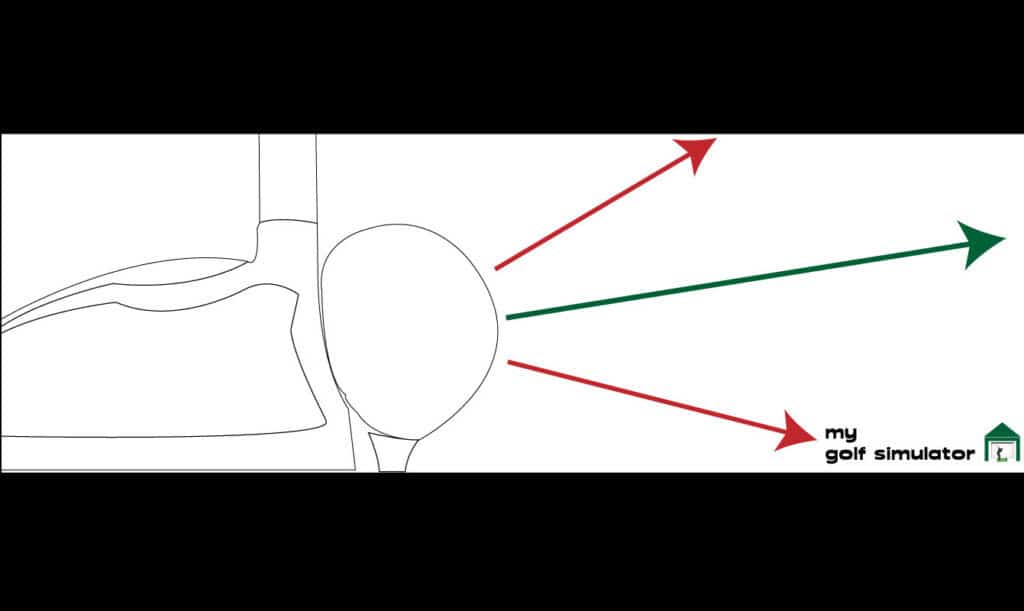
The fix that’s circulated in the community since this article’s first version: move the ball very slightly forward of the red dot, down your target line, so the ball stays in the viewing window a beat longer. For the baseline, the current manual guidance places the ball on the red dot or up to 3 inches behind it — treat that as the starting position, and the slight-forward shift as the wedge-specific workaround when delay bites.
Delay vs misreads — where the 2026 conversation actually is
Honesty about the current owner conversation: the 2-second wait is no longer the complaint that dominates. Misreads and no-reads are — the strongest and still-rising complaint in SkyTrak owner reports (14 distinct owners): “The most frustrating thing about the OG is honestly the misreads. I’ve had shots where it just completely whiffs the read, and I have to re-hit it. With thousands of shots logged, I’ve prob re-hit 200+ times due to no-reads.” The pattern reaches the current generation too — from an ST MAX thread in August: “The disconnects and misreads were horrendous.”
If that’s your actual problem, the proven mitigation bundle (10 owners) is:
- Precise ball placement relative to the red dot, offset by club type
- Alignment-pattern balls — Callaway’s soccer-ball-pattern models, TaylorMade Pix/Truvis
- A spotlight or dark background behind the hitting zone
- No white shafts, no white tees
The full treatment lives in my dedicated articles — How Accurate is Skytrak? – 8 Easy Ways to Maximise Skytrak Accuracy and 13 Reasons why Skytrak Misses Shots – with Fixes! — this article stays in its lane: the delay.
How the SkyTrak line has changed
Context for upgraders, most recent first:
- 2026 — ST MAX sale pricing ran around $1,995 (list $2,995) through late August; on 21 October 2026 SkyTrak’s own store had it at $1,695 on sale, list still $2,995.
- October 2025 — ST MAX released; requires app version 5.8+.
- 2025 — SkyTrak+ discontinued, manufacturer-confirmed “no longer available” — clearance and refurb pricing has been moving fast and sources conflict on the current number; on 21 October 2026 SkyTrak’s own certified pre-owned SkyTrak+ was $895 on sale (list $2,495).
- Ongoing — the OG remains a thriving used-market staple at $450–$1,000 (commonly $550–$750) across a large owner pool, and SkyTrak itself still sells it new at $695 on sale (list $1,995; 21 October 2026).
- Software era — TGC 2019 gone; E6 Connect closed to new SkyTrak customers (existing licences still connect); GSPro unofficial via the community bridge; the SkyTrak subscription’s entry tier runs $99.99/yr (the old “Game Improvement Plan ($99.95/yr)” naming is retired).
Done with the delay? 2026 upgrade paths
If you’ve done everything above and the wait still grates, the honest answer is architecture: photometric-plus-your-device has a floor. The 2026 step-ups, each for a different reason:
- Foresight GC3 — does its computation in-house, on the unit; no external device needed until you add sim software. The architectural fix for delay — confirm Foresight’s current model naming and pricing when you shop.
- Bushnell Launch Pro — the GC3’s subscription-based sibling; Bushnell lists it at $2,999.99 (21 October 2026).
- Square Omni — the community’s most-recommended SkyTrak alternative at similar money, on reliability and response grounds.
- Uneekor EYE MINI family — camera-based with genuinely portable credentials and strong club data.
(Earlier versions of this article pointed to the Uneekor QED here — it’s discontinued with support ending December 31, 2026, so it leaves the list; my Uneekor QED Accuracy – Data, Error Margins, Setup & More guide covers what that means for owners.)

Delay prevention checklist
- Test the device first. Borrow or install on a more powerful machine; if the delay drops, you have your diagnosis.
- Keep the app and firmware current — the ST MAX needs app 5.8 or newer; updates have historically moved performance.
- Sanity-check your broadband if you play connected modes — slow internet doesn’t cause shot delay, but it does cause everything around it to crawl.
- Mode-switch test: direct vs network vs USB per the generation table above; a dedicated SSID if you stay on network mode.
- Wedge delay specifically: ball slightly forward of the red dot.
- Still 4–5+ seconds? Contact SkyTrak support with your device specs and connection mode written down — it shortens the conversation.

My goals are to improve the experience of everyone with a home golf simulator and to provide all the information needed for prospective buyers before they make their choice. A two-second wait, understood and tuned, has never stopped either.

FAQ
Is a 2–3 second delay normal?
Yes — it’s the design. The processing happens on your device after the images transfer, and about two seconds is the floor even on strong hardware.
Did SkyTrak+ or ST MAX fix the delay?
The Plus improved on the OG by owner corroboration (less lag among the upgrade benefits, ~1–2s reported). MAX-vs-Plus is split — some credit the USB-C connection with real gains, others measured barely any. No controlled comparison exists.
Does a USB-C cable make it faster?
It makes it more STABLE on the ST MAX — and only on Windows, where USB-C data is supported. Speed-wise, SkyTrak’s own reps are clear that transfer isn’t the bottleneck; processing is.
Why are wedge shots slowest?
High launch exits the imaging window early, triggering the system’s “second look” validation. Ball slightly forward of the red dot is the workaround.
My shots aren’t registering at all — same problem?
No — that’s a misread/no-read issue, and it has its own playbook (placement, patterned balls, lighting). Start with 13 Reasons why Skytrak Misses Shots – with Fixes! and Skytrak Connection Problems – The Ultimate Guide.
Summary
Two to three seconds is the SkyTrak living as designed; five or more is your chain asking for attention — device power first, then settings, then connection, then ball position. Owners credit the Plus with trimming the OG’s wait; the MAX’s further gain is genuinely disputed — and no generation abolished it. The honest 2026 conversation has moved on to read reliability anyway. Tune what you can, use the pause the way deliberate practice always has, and if zero-delay matters more than budget, the GC3-class units compute in-house for exactly that reason. If this article has helped you, please share it on social media! It really helps me and mygolfsimulator.com out.
Related reading: Skytrak Connection Problems – The Ultimate Guide · iPad vs PC for Skytrak – Choose your Skytrak device · Skytrak vs Garmin R10 – Complete Guide (19 Key Comparisons) · Skytrak vs Mevo Plus – 27 Points Compared
Bushnell Launch Pro vs SkyTrak ST MAX (2026)
Golf Simulator Packages vs Building Your Own: Which Is Better Value?
ABOUT THE AUTHOR
Hello! My name is Alex and it is my mission to bring you all the information you need to build your own home golf simulator! I hope mygolfsimulator.com helps you on your journey to better golf at home!
LEGAL INFORMATION
On this site, you'll find articles on all aspects of building a golf simulator. I will also link to other sites where you can buy some of the simulator components. Some of these links may be affiliate links, which means if you click them I gain a small commission at no extra cost to you. This really helps out me and my site so thank you in advance! mygolfsimulator.com and all related social media accounts are property of Awonline LTD.