Golf Simulator in a Spare Bedroom: Sizes, Layouts and Limits
Posted in Room Setup
A spare bedroom can hold a golf simulator, but it is usually tight on ceiling, width and depth at once, and it is the one sim room that shares walls with people trying to sleep. In a bedroom, check width and noise as carefully as the ceiling.
In a Nutshell
A spare bedroom limits a simulator more often than it rules one out: the ceiling decides your clubs, the width decides your layout and the depth decides your launch monitor. It suits solo or two-person iron practice with a compact floor unit; full driver swings, radar units behind the ball and late-night sessions are where bedrooms fall short.
👉 Tape out the hitting spot and test-swing a junk club slowly, in your playing shoes, before ordering a screen.
Jargon, once:
- Floor vs overhead launch monitor — a unit that sits on the floor beside or behind the ball, or one mounted on the ceiling above it.
- Radar vs camera — radar units track the ball in flight from behind it; camera units read the ball at impact from beside it.
- Offset hitting — standing to one side of the screen’s center and angling the mat back toward it.
How this was built: makers’ manuals and product pages read in August and October 2026; owner and reviewer reports from Reddit and YouTube since 2020. Nothing here was tested hands-on.
Measure Three Numbers First
Measure ceiling, width and depth at the spot you’ll hit from, not at the room’s widest point. Then take off the height of your mat and anything under it: about 1¼ to 2⅝ inches for common strips and mats, plus any foam.
| Dimension | Tight but possible | Usually workable | Comfortable |
|---|---|---|---|
| Ceiling | 8–8.5 ft (2.44–2.59 m): irons only for many | 9–9.5 ft (2.74–2.90 m) | 10 ft (3.05 m) |
| Width | 10 ft (3.05 m) with an offset hitting spot | 11–12 ft (3.35–3.66 m), still tight | About 4–4.5 m (13–15 ft) for a centered tee left- and right-handed golfers share, per reviewers |
| Depth | About 10–13 ft (3.05–3.96 m) with a camera unit beside the ball | 13 ft (3.96 m) or more | 15–20 ft (4.57–6.10 m) for radar units |
Your own height moves the ceiling line: taller golfers need more, and the ceiling guide breaks it down by height and swing.
What’s the Minimum Golf Simulator Ceiling Height?
Under about 8 to 8.5 feet, many owners find driver and even hybrids unusable and play mid to short irons (8 reports from 8 owners).
The most common advice costs nothing: swing every club, slowly at first, in the actual room before you build (4 reports from 4 owners).
What Fits at Each Bedroom Size
Floor space picks the launch monitor before anything else. The question usually arrives in this form:
“Could it be done in a 12×11 spare bedroom for example?” (Reddit user, 2023-02-17)
| Bedroom floor | What to expect | Launch monitor type that fits |
|---|---|---|
| About 10 × 10 ft (3.05 × 3.05 m) | Right at SkyTrak+’s stated 10 ft minimum in each direction; offset hitting, irons first | Floor camera unit beside the ball |
| About 10 × 12 to 11 × 12 ft | Room for a short enclosure; width still tight for a centered stance | Floor camera unit; Uneekor’s EYE XO asks for 13 ft of width |
| About 12 × 14 ft and up | Close to the 13 ft of depth many camera and overhead setups use | Camera units; radar only if the long wall gives 14–16 ft plus the screen gap |
The rows assume about a 9-foot ceiling, so read the ceiling line above first. Buyers with modest spare rooms, roughly 11 to 14 feet by 12 to 18 feet with 9-foot ceilings, ask this often, and some owners report rooms as narrow as 2.4 m (about 7 ft 10 in) still fitting a sim (6 reports from 4 owners and reviewers). Treat that narrow end as the rare case, not the target.
Which Launch Monitor Suits a Bedroom
In most bedrooms a floor camera unit beside the ball fits best: it needs the least depth.
- Floor camera units. SkyTrak+ (no longer sold new) asks for 10 ft clear in each direction; its ceiling figure varies with golfer height and club length. Bushnell’s Launch Pro i bundle page (read 11 October 2026, sold out) recommends at least 10 ft wide and 18 ft deep for its 8 ft enclosure.
- Radar units behind the ball. Garmin’s R10 sits 6–8 ft behind the tee and needs at least 8 ft of ball flight to the net: 14–16 ft before the screen gap. Rapsodo’s MLM2PRO: 6.5–8.5 ft behind the ball plus at least 8 ft in Net Mode, so 14.5–16.5 ft.
- Overhead units. Most need more than a 10-ft-wide, 9-ft-high room. Trackman iO comes closest on paper, but its lowest band starts at 270 cm (about 8 ft 10 in) above the hitting mat, so a 9 ft room needs a mat under about 1.7 in. Foresight’s Falcon manual recommends 9.5–10.5 ft of ceiling; Uneekor’s EYE XO manual asks for 13 ft of width, 15 ft for golfers over 6 ft.
How much space do you need for a Golf Simulator?
Best Launch Monitors for a Home Golf Simulator (2026), by Budget
Layouts: Offset, Long Wall and the Door
Hit along the longest wall, and expect to stand off center.
- Use the long wall for depth. Screen on a short wall, so swing and ball flight get the room’s full length.
- Offset and angle. The standard narrow-room fix moves the hitting spot to one side and angles the mat and screen back toward center; owners report builds as tight as 8.5 to 9 ft wide working long term, with the software shifting the ball on screen (10 reports from 8 owners).
- Leave a gap behind the screen. Reviewers set the impact screen about 12 in (30 cm) off the back wall (3 reports from 3 reviewers).
- Keep the door out of the swing. Block any door or closet that opens into the backswing while someone is hitting.
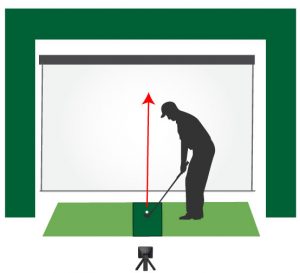
- Left- and right-handed players. A wide strip, or two mats with taped marks, lets a mixed household switch in seconds (4 reports from 4 owners).
“off-center hitting sounds annoying but you’ll adjust in a week” (Reddit user, 2026-07-07)
Protect Walls, Windows and the Closet
Drywall, windows and closet doors sit close to the ball in a bedroom, so pad before the first shank. Owners report real holes and dents in unprotected walls and ceilings, not just scuffs (5 reports from 5 owners).
Heavy curtains, hung on a cable a few inches off the wall or fixed to the screen and floor, are a favorite fix that stops shanks with little rebound (5 reports from 5 owners). Cover any window near the hitting area with padding or netting.
Protect Your Golf Simulator Walls and Ceiling – 12 Simulator Safety Tips
Noise and the Rest of the House
A bedroom sim shares walls and floors with rooms where people sleep, and that limits when you can play. Owners most often name the ball hitting the screen as the loudest sound (7 reports from 6 owners); in the room the club strike can be louder, but the screen’s thud is what travels.
That sound carries through floors, ceilings and walls to nearby bedrooms, often heard as a thud or a slammed door (7 reports from 6 owners).
Owners describe family limits: no driver at night, no play at nap time (5 reports from 5 owners).
“Loud enough for my wife to text me so she can sleep.” (Reddit owner, July 2026)
Irons and wedges are noticeably quieter than driver and woods, so many owners stick to irons when noise matters (6 reports from 6 owners). The quiet guide covers screens, padding and placement; an upstairs timber floor also passes impact down:
Building a Quiet Golf Simulator – Soundproofing Tips for 2025
Golf Simulator Flooring (2026): What Goes Under and Around the Mat
Guest Room or Sim Room?
A room that also hosts guests needs a setup that packs away. For rentals and shared rooms, owners use retractable nets or curtain-track screens that pull out for play and stow afterward (3 reports from 3 owners).
Plan around your tallest guest: a ceiling that fits the owner often doesn’t fit taller friends or family with longer clubs (4 reports from 4 owners).
A closed room with a projector and PC running warms up fast; owners in closed attic sim rooms report heat buildup (3 reports from 3 owners).
When to Pick Another Room
Some bedrooms are the wrong room, and a tape measure finds out for free. Owners say rooms under about 9 ft wide feel too tight, and even 11 to 12 ft gets called barely big enough (5 reports from 5 owners). Look at the garage or basement if:
- the ceiling is under about 8 ft at the hitting spot, or under about 9 ft and driver matters to you;
- no wall gives the depth your launch monitor’s maker asks for;
- the room shares a wall or floor with someone who sleeps while you’d play.
Golf Simulator for a Low Ceiling: What Actually Works (2026)
Garage Golf Simulator – 13 Key Challenges + Tips & Tricks
Making a Basement Golf Simulator – Pros and Cons
Spare Bedroom Golf Simulator FAQ
Can you put a golf simulator in a bedroom?
Often, with limits. Measure ceiling, width and depth first; most bedroom builds suit iron practice for one or two golfers with a floor camera unit.
What size bedroom do you need for a golf simulator?
Start from the maker’s minimum and a test swing: SkyTrak+ (no longer sold new) states 10 ft in each direction, and Bushnell’s bundle asks for more depth. Below about 9 ft of ceiling, expect irons.
Can you swing a driver in a spare bedroom?
Only if the ceiling suits your height. Owners report driver only from about 9 to 9.5 ft for most golfers, and taller golfers need more; under about 8.5 ft, many are limited to irons. Plan for your tallest guest.
What’s the best launch monitor for a small bedroom?
A floor camera unit beside the ball usually fits best. Radar behind the ball needs about 14 to 16 ft plus the screen gap.
How loud is a golf simulator in a bedroom?
Loud enough to carry to other rooms. The screen’s thud is what travels; in the room the club strike can be louder. Irons are quieter than driver.
Can a guest room double as a simulator room?
Yes, if the screen or net retracts or folds away.
Will a golf simulator damage a bedroom?
It can. Unpadded drywall takes real holes from mishits, so pad walls, cover windows and protect the ceiling first.
Final Thoughts
Measure the three numbers at the hitting spot, test-swing every club, then pick the launch monitor the room can host. If the bedroom fails on noise or width, another room will likely serve better.
Golf Simulator Black Friday Deals: What’s Really Discounted
Golf Simulator Setup for Left- and Right-Handed Golfers in One Household
ABOUT THE AUTHOR
Hello! My name is Alex and it is my mission to bring you all the information you need to build your own home golf simulator! I hope mygolfsimulator.com helps you on your journey to better golf at home!
LEGAL INFORMATION
On this site, you'll find articles on all aspects of building a golf simulator. I will also link to other sites where you can buy some of the simulator components. Some of these links may be affiliate links, which means if you click them I gain a small commission at no extra cost to you. This really helps out me and my site so thank you in advance! mygolfsimulator.com and all related social media accounts are property of Awonline LTD.