Uneekor EYE XO Vs Foresight GC Quad – 18 Key Comparisons
Posted in Launch Monitors
Both are premium photometric launch monitors, and they solve the same problem from opposite ends of the room: the EYE XO mounts overhead in front of the tee; the GCQuad sits beside the ball. In 2026 the XO’s case is value — $6,499 bundled against $15,999 list — and the GCQuad’s is portability plus its standing as the club-data benchmark. And both now compete with their own successors, which changes how you should shop this comparison. 👉 Quick Verdict.
In a Nutshell
For a fixed home simulator bought on value, the EYE XO is the pick at $6,499 against the GCQuad’s $15,999 list; for portability, standalone range use and fitting-grade club data, the GCQuad earns its roughly 2.5× price.
👉 For a fixed home sim bought on value, the EYE XO remains the pick — the author’s 2022 call, now cheaper than it was then. For portability, standalone range use, and fitting-grade club data, the GCQuad — at roughly 2.5× the money. And check the successors first: the XO2 and QuadMAX are where both brands’ attention lives. One honesty note up front: no one in the current record has run both units side-by-side, so this is spec-vs-spec, not a shootout.
| You want | Pick | Why |
|---|---|---|
| Best value fixed sim | EYE XO | $6,499 bundle, widest measured ball suite, lefty/righty with zero repositioning |
| Range + sim + fittings | GCQuad | Battery, LCD, no PC needed, the club-data reference |
| The newest thing | XO2 / QuadMAX | Where the R&D goes now — price them before buying either unit here |
| Tightest room | EYE XO | Overhead mount, nothing beside the ball |
Jargon, once: photometric = high-speed-camera tracking. Overhead vs beside-ball = where the unit lives, the biggest practical difference below. Club markers/stickers = reflective dots the cameras read for club data. Quadrascopic = the GCQuad’s four-camera 3D capture. Registration renewal = Foresight’s 45-day online check-in.

How this has changed
- Prices moved, in opposite directions. The XO’s $7,999 MSRP now sells as a $6,499 AI Studio bundle (Swing Optix cameras + 1yr AI Trainer included) badged “Essential” in Uneekor’s lineup, where it wore “Limited Availability” in August — financing runs as low as $226/mo at 0% APR (21 October 2026). The GCQuad lists at $15,999, US-only direct checkout, 2-year warranty included. The original’s era of “$14k base / ~$20k full-featured / $4k club add-on” is gone.
- Both live in successors’ shadows. Bring up the XO and the reflexive community response is “Gotta compare it against the XO2” — corroborated across commenters. One of them characterizes the XO2 as adding a third camera and bringing accuracy up to GCHawk class (a single commenter’s characterization, not manufacturer spec). Above the GCQuad sits the QuadMAX, which Foresight lists at $19,999 on its own store (21 October 2026).
- Foresight’s platform has shifted. One detailed account reports the line moving to subscription-based software for new sales — “Existing accounts with lifetime 2020 and Play will remain the same. New sales will be subscription based and include their new software version” — with the changeover date already slipping once. Foresight has since made it official: new devices come with a 30-day trial of Foresight+, whose plans run Silver $199 and Gold $599 a year, and existing FSX licenses keep working (Foresight’s pages, 21 October 2026). It’s still a real purchase-hesitation driver: one current Foresight owner says he’d only buy a Quad if his existing account carries over.
- The used market said the value gap out loud. One mint GCQuad with full accessories — rangefinder, FSX Pro, FSX Play, FSX 2020, GSPro time included — was tracked from $10,500 to $9,500 to a “FINAL PRICE DROP” $8,500 in a single week without selling (bought “for just over $12,000 last year”): one listing, dated trail, but a striking one for a unit that lists at $15,999. An XO listed at $6,500 days earlier, its owner downgrading over ceiling height — and turning down a trade offer to hold out for cash. Neither is a market index; both are the kind of data point spec sheets never show.
- The mood music matters too: two separate single-witness reports frame Uneekor’s overheads as “a full generation behind” newer sticker-less rivals and note the XO no longer gets flagship development attention. That’s how commenters talk, not a measured fact — but it’s the air the XO now sells in.
Placement and space — the biggest practical difference
| Dimension | EYE XO | GCQuad |
|---|---|---|
| Where it lives | Overhead, ceiling-mounted, in FRONT of the tee | Beside the ball, on the floor |
| Mount height | 9–10ft ceiling band (hard requirement) | None — lays flat at surface level |
| Setback | 3.5ft in front of tee, measured from the device | 22in from unit to hitting-zone center |
| Room width | 13ft min · 15ft for 6ft+ golfers | No stated width figure; the unit adds ~2ft beside the ball |
| Tee-to-screen | 9–10ft | Your choice — the unit doesn’t care |
| Hitting zone | Fixed calibrated zone | 14×14in (ball+club) · 18×14in (ball only) |
| Handedness | Central-aim planning; no repositioning | Electronic L/R toggle on the LCD |

One honest wrinkle in the XO column: the manual calls it a “front-mounted design” in marketing text while its own spec table says “Rear Mounted” — the sensor watches the ball from in front of the hitting zone while mounting overhead. Follow the install diagram, not the labels.

What the table means in practice: the XO consumes ceiling and demands a 9–10ft mounting band, but leaves the floor completely clear — nothing beside the ball, nothing to trip on, nothing to reposition, ever. The GCQuad asks nothing of your ceiling and only its 22-inch offset beside the ball, aligns to any target via its alignment stick (up to 10° of adjustment, resetting on power-off), and moves rooms as easily as a toaster. For a multi-use garage, that mobility is the argument; for a dedicated bay, the XO’s invisibility is.
The author’s readings of these numbers stand from the original. On the XO’s screen distance: “I believe the minimum of 10ft mounting distance between the Eye Xo and the impact screen is more a suggested distance to avoid the risk of dangerous bounceback, rather than a minimum distance that is intrinsic to the function of the launch monitor.” — a call the sibling space article now shows corroborated by real installs. On comfort: “I recommend a room width of more than 15ft to comfortably swing from a central hitting position that is perpendicular to the center of your impact screen.” and “I recommend 20ft of room length in order to do everything comfortably with a Uneekor Eye Xo golf simulator.” Both deliberately exceed the manual minimums — comfort recommendations, labeled as such.


The GCQuad’s beside-ball position has its own friction — every handedness switch on a side-placed unit historically meant moving something. The author’s favorite workaround story: “I once saw a very well-engineered slide system that had been designed for Skytrak (which has the same problem given its similar placement) on Facebook. The Skytrak slid around the back of the golf mat on fixed tracks and into perfect position on the other side. Perhaps such a slide system could be adopted in a GC Quad golf simulator – you’d need better DIY and design skills than I have though!” In fairness to the 2026 GCQuad: its electronic handedness toggle means the unit itself stays put — the slide-system era problem is mostly solved. Full XO room math: Uneekor EYE XO Space Requirements.


Data capture
| EYE XO | GCQuad | |
|---|---|---|
| Ball data | 14 measured metrics per the manual’s own table: speed, back/side spin, spin axis, side angle, side distance, launch, descent, apex, distance-to-apex, flight time, run, carry, total | 6 listed: launch, side angle, speed, total spin, spin axis, carry (QuadMAX adds apex, descent, offline) |
| Club data | 9 metrics via bar+dot stickers (included; recommended, not required): speed, smash, path, face-to-path, attack angle, face angle, dynamic loft, lie, impact point | 8 metrics via club markers: speed, smash, path, attack angle, loft/lie, face angle, impact location — plus closure rate (how fast the face rotates through impact), its distinctive metric. 1 marker = the basics; 4 markers = full face data |
| The hardware story | Dimple Optix overhead cameras | 4-camera quadrascopic capture — the workflow section below explains why it matters |
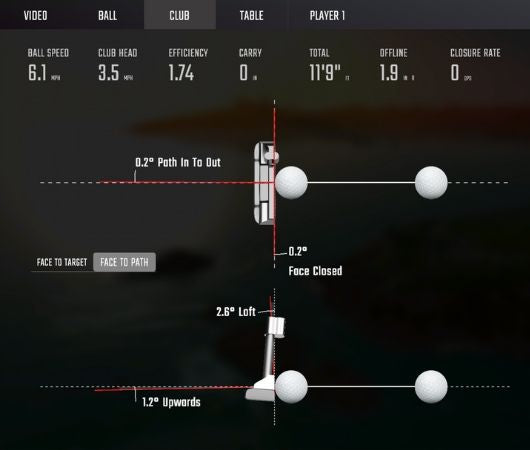
The workflows behind those numbers differ more than the counts suggest. The XO’s double-sticker system (a bar sticker plus a dot sticker, placed on the smooth part of the face by groove-counting rules) is a set-and-forget job per club. The GCQuad’s markers come off a dispenser — clean the face, dispense, stick — and they’re a consumable you replenish through a Foresight retailer. Marker count buys capability: one marker gets speed, smash, attack angle and path; the full four unlock face angle, loft and lie. The GCQuad’s real hardware edge is that fourth camera — versus the GC3’s three, it enables genuine quadrascopic 3D face capture, which is why fitters treat it as the reference.
Two honest notes on the table. First, neither manual segregates measured from calculated — both list every metric in one undifferentiated block, so derivation ambiguity (smash factor, dynamic loft) is a documented gap on both sides, consistent with how the site’s launch-monitor-data guide treats the whole industry. Second, a sticker-count caveat: the XO’s “400-sticker” bundle figure matches the count documented for Uneekor’s QED — treat it as the manufacturer-supplied pack unless the XO’s own packaging confirms the number.

And one scope note: the GCQuad still offers a putting-analysis add-on, Essential Putting Analysis, at $2,500 on Foresight’s store (21 October 2026) — the same as 2022’s price; what it measures is flagged for a future refresh.
Portability and standalone use
| EYE XO | GCQuad | |
|---|---|---|
| Power | AC outlet (PoE-capable) | Removable lithium-ion battery (per the manual) |
| Display | None — PC required | Onboard LCD; full standalone range use |
| Connectivity | Ethernet direct to PC only — the manual forbids hubs and adapters (yet ships a USB adapter in the box, an acknowledged oddity) | USB-C, Ethernet, Wi-Fi, or Bluetooth LE — any path |
| Host | Gaming PC only | PC, or nothing at all |

This is the GCQuad’s whole second life: pick it up, take it to the range, run it off the battery and LCD with no computer in sight. It’s fully outdoor-capable too, with a plain indoor/outdoor check in Foresight’s own compare table (the table’s “if fully covered” footnote belongs to the Falcon), whereas the XO’s safety documentation is blunt: indoor use only, never rain. One wrinkle shipped honestly: Foresight’s 45-day registration renewal blocks all data channels until you check in — standalone practice continues, but connected use pauses. The XO is a fixed installation by design and by cable: a 45ft LAN cable ships in the box, AC power (with a spare grounding wire Uneekor recommends using on ungrounded outlets), and that’s the whole topology.

Two asymmetries the spec sheets underplay. The XO’s bundle includes Swing Optix swing-video cameras — multi-angle swing playback — while the GCQuad has no swing-video capability at all. Against that, only the GCQuad can leave the room.
For what PC the XO needs: one line — a gaming-class Windows machine over Ethernet — and the detail lives in Golf Simulator System Requirements in 2026 – Updated Reference Guide.
Software and the money-per-year question
Uneekor (billed annually, per unit):
| Tier | Price | What it unlocks |
|---|---|---|
| Player | $0 | Core play — club data included free |
| Pro | $199/yr | Third-party software (GSPro and friends) |
| Champion / Ultimate | $399 / $599/yr | Higher content tiers |
GSPro itself adds $250/yr on top of Pro. The AI Trainer rides free for year one in the bundle, $99/yr after. (GSPro, for the unfamiliar, is the community’s favorite third-party sim software.) The author’s configuration verdict holds up well in 2026 terms: “I think a Uneekor Eye Xo equipped with the Refine upgrade and GS Pro makes for a fantastic value golf simulator launch monitor!” — Refine now lives inside the Pro tier rather than as a separate purchase, so today that reads: XO + Pro Package + GSPro, about $449/yr all-in. The full tier map: Uneekor Software Options – Comparison and Best Value Tips.

Foresight: FSX (Foresight’s own Windows sim suite) and Foresight Play, with no public tier list in the manual — a documented gap behind the community’s long-running cost complaints about “stacking” Foresight software. Foresight now publishes a ladder for its Foresight+ membership: Free, Silver $199 a year and Gold $599 a year, with Course Pass ($295) or Course Pass Pro ($595) a year on top (21 October 2026). GSPro connects natively on the GCQuad side, and owners treat that pairing as the trusted default (5 owners on record) — though under Foresight+ it takes the $599 Gold plan plus a separate GSPro subscription, against the XO’s $199 Pro tier for the same connection. Current firmware v4.1.0.1. And the subscription shift that one detailed account reported is now confirmed by Foresight: new devices come with a Foresight+ trial, and FSX licenses (Play, Pro or 2020) keep working.

The buying geography differs too: the XO sells direct in the US at $6,499 with a separate EU storefront at €8,325 net of VAT; the GCQuad’s direct checkout is US-only (US card and address required), with international buyers routed to phone-order regional distributors in Canada, the UK/Europe and Australia.
Warranty and ownership
- XO: 2 years, plus a Limited Strike Warranty — ball-strike sensor replacement for the lesser of 2 years or 2 occurrences, with the XO and XO2 explicitly named (and the rear-mounted XR explicitly not covered by that clause — worth knowing if you’re cross-shopping the family). For an overhead unit mounted in front of the hitting zone, strike coverage is the clause that matters most.
- GCQuad: 2 years included; extensions run $995/1yr or $2,250/2yr — real money, but proportionate to a unit that may spend its life being carried between car trunks and range bays. Order cancellations after 24 hours carry a $250 fee.
- Used-unit realities, both sides: Uneekor accounts transfer for $100 per monitor plus $50 per add-on (Uneekor Software Options – Comparison and Best Value Tips has the fine print). On the Foresight side, one dormant-GCQuad revival thread this summer surfaced the trap: no warranty left, a transfer fee one regular called “ridiculous” — and if the unit never had FSX 2020/Play, “the purchase price for 2020 is going to be a shock.”
Which should you buy in 2026?
The author’s standing verdict: “I believe the Uneekor Eye Xo is the best value launch monitor on the market. You get full suites of ball and club data, excellent software compatibility and non ball-marking technology at a significantly lower price than high-end competitor launch monitors.” The 2026 price gap makes that claim stronger on paper than when it was written — $6,499 versus $15,999 is a wider spread than 2022’s.


What the record adds around that verdict: the one owner running side-by-side comparisons this summer wasn’t comparing an XO to his GCQuad — he was checking a cheaper overhead against it, and found “ball data is very close if not to say identical” while club-data consistency still favored the Quad. That’s the shape of the whole market now: ball data has commoditized downward; club data is still what the GCQuad’s price buys.

The honest counterweights, each in one line:
- The XO2 shadow: if you’re buying new Uneekor, price the XO2 first — $10,999 direct from Uneekor, $4,500 above the XO bundle and still $5,000 under GCQuad list.
- The attention argument: the community reads Uneekor’s development focus as living with its flagships, not the XO (how commenters describe it, not a company statement).
- The GCQuad still owns portability, standalone use, and fitting-grade club data — “If you want accurate club data, get a Quad, especially if price isn’t a consideration,” as one regular put it.
- And nobody in the current record owns both and compares them first-hand — a gap this article says out loud rather than papers over.
By buyer type:
- Fixed home sim, value-first, still wants measured club data → the XO. The bundle price, the free-tier club data, and the clear floor make it the default.
- Fittings, range sessions, or any life outside one room → the GCQuad. Nothing else in this comparison travels, and its club-data reputation is what the fitting community actually uses.
- Both-handed household in a tight room → the XO again: overhead mount, central-aim planning, no unit beside the ball to leapfrog.
- Buying at the top of the market in 2026 → price the successors first. The XO2 at $10,999 splits this comparison’s price gap almost exactly, and the community’s energy is visibly there.
- Tempted by that unsold $8,500 used GCQuad → budget the software reality first: transfer fees, dormant-account revival, and possibly repurchasing FSX titles — the used price is not the whole price.
FAQ
Is the EYE XO discontinued?
No — it still sells alongside the XO2, now badged “Essential” rather than the “Limited Availability” it wore in August (Uneekor’s store, 21 October 2026). Read it as late-lifecycle, not dead — and note Uneekor’s history here: the QED was deprecated with no advance notice, which is exactly why one community regular warns that “hardware does matter” when buying into an aging model.
Which is more accurate?
No current first-hand side-by-side exists. Both are premium photometric units; the GCQuad is the community’s club-data benchmark — the unit fitters bring, the reference owners triangulate cheaper devices against — and the XO’s ball suite is the wider documented set. That’s the honest framing the record supports.
Do both need stickers?
For club data, yes: the XO uses bar+dot stickers (recommended, not required); the GCQuad uses 1–4 club markers depending on how much face data you want, dispensed as a consumable. Ball data needs nothing on either — a genuine advantage both share over marked-ball systems.
Can the GCQuad work without a PC?
Yes — battery, LCD, standalone range mode, and outdoor use. Mind the 45-day registration renewal for connected data use.
What about the XO2 and QuadMAX?
The successor tier: XO2 at $10,999, QuadMAX at $19,999 on Foresight’s store (21 October 2026). This comparison’s logic transfers; the prices don’t.
Summary
| EYE XO | GCQuad | |
|---|---|---|
| Price | $6,499 bundle ($7,999 MSRP; 21 October 2026) | $15,999 list (21 October 2026) |
| Lives | Overhead, fixed | Beside the ball, portable |
| Ball data | 14 measured | 6 listed |
| Club data | 9 via stickers | 8 via markers (incl. closure rate) |
| Second life | None — it’s furniture | Range unit, fitting tool |
| Successor | XO2, $10,999 | QuadMAX, $19,999 |
Value and permanence buy the XO; portability and the club-data benchmark buy the GCQuad. Neither is the wrong answer — they’re answers to different questions, asked from different rooms. And in 2026, with both units selling in their successors’ shadows and a used market already repricing one of them, the smartest money checks the XO2 and QuadMAX before writing either check.
Bushnell Launch Pro vs SkyTrak ST MAX (2026)
Golf Simulator Packages vs Building Your Own: Which Is Better Value?
ABOUT THE AUTHOR
Hello! My name is Alex and it is my mission to bring you all the information you need to build your own home golf simulator! I hope mygolfsimulator.com helps you on your journey to better golf at home!
LEGAL INFORMATION
On this site, you'll find articles on all aspects of building a golf simulator. I will also link to other sites where you can buy some of the simulator components. Some of these links may be affiliate links, which means if you click them I gain a small commission at no extra cost to you. This really helps out me and my site so thank you in advance! mygolfsimulator.com and all related social media accounts are property of Awonline LTD.