Skytrak Plus Space Requirements – Length, Width, Height + More
Posted in Launch Monitors
The numbers first: SkyTrak+ needs a 10ft × 10ft clear floor by the manufacturer’s minimum, a 10ft ceiling is the safe standard (9–9.5ft works for most drivers), and because the unit sits beside the ball rather than behind it, you need almost no depth behind you — the reason this family fits rooms radar units can’t. The 2026 twist is that the SkyTrak+ itself is discontinued, now sold only pre-owned and used — so the space question is now a buying question: if it fits, is it still the right buy when a new ST MAX is on sale at $1,695? This guide answers both.
In a Nutshell
A SkyTrak+ needs a 10ft × 10ft clear floor and a ceiling you can swing your longest club under: 10ft is the safe standard and 9–9.5ft works for most golfers. Depth behind you barely matters because the unit sits beside the ball, and the same numbers cover the original SkyTrak and the ST MAX.
👉 A SkyTrak+ fits any room with a 10ft × 10ft clear floor and a ceiling you can swing your longest club under — 10ft is the safe standard, 9–9.5ft works for most golfers. Depth behind you barely matters; ceiling and swing clearance set the real limit. The same numbers cover the original SkyTrak and the ST MAX, so your room math survives whichever SkyTrak you buy.
In this guide: In a Nutshell · The numbers table · Why it needs so little room · Length · Width · Ceiling · Tee-to-screen · Buying the discontinued model · FAQ
| Dimension | The short answer |
|---|---|
| Floor (manufacturer minimum) | 10ft × 10ft unobstructed |
| Ceiling | 10ft safe standard; 9–9.5ft works for most; 8–8.5ft = mid-irons only |
| Ball to screen | Vendors say 8–10ft; many owners hit happily from 6–9ft |
| Depth behind the golfer | Minimal — the unit sits beside the ball, not behind you |
| Applies to | SkyTrak+, original SkyTrak, and ST MAX alike |
Jargon, once: photometric = camera-based shot capture at impact. Red dot = the laser dot marking exactly where the ball sits. Tee-to-screen = distance from the ball to your impact screen. Working floor = the realistic clear space a build needs, as opposed to the manual’s bare minimum.

How this has changed
- SkyTrak+ is discontinued. SkyTrak’s own product page marks it no longer available and sold out (last listed at $1,995 from a $2,995 list price); SkyTrak now sells it only certified pre-owned, at $895 (21 October 2026).
- The ST MAX took over the range — launched October 2025 at $2,995 and on sale at $1,695 (21 October 2026) — with the same placement geometry, so this article’s numbers carry straight over.
- The community ceiling consensus matured. A clear ladder has settled: 10ft safe, 9–9.5ft workable for most, 8–8.5ft with club restrictions — with a rising trickle of owners making 8ft basements work.
- The garage-door opener found its standard fix: a side-mount conversion at roughly $400–700, the most-praised low-cost ceiling solution in owner threads.
The numbers at a glance
Three different questions hide inside “how much space do I need,” and they have three different answers. This table keeps them separate — the manual’s bare minimum, the comfortable-build recommendation, and what the community actually builds.
| Dimension | Manufacturer minimum | Community consensus | Comfortable build |
|---|---|---|---|
| Length (depth) | 10ft unobstructed | 12ft realistic working minimum; 15ft+ breathes | 15ft or more |
| Width | 10ft unobstructed | 10ft workable; 12–15ft for a centered aim | 15ft or more |
| Ceiling | No fixed figure — “varies by golfer height and club length” | 9ft realistic minimum (8.5ft only for shorter, flatter swings); 9.5–10ft comfortable | 10ft or more |
| Ball to screen | Not specified | 8–10ft vendor convention; 6–9ft works for many camera-unit owners | 8–10ft to start |
The community columns come from the site’s full SkyTrak space guide, which stacked the manual against what owners actually build — the deeper dive lives at Skytrak Space Requirements – A Must Read guide!. Note what the manufacturer honestly refuses to give you: a ceiling number. That’s not evasion — it genuinely varies with your height and swing — but it leaves the real answer to owners, and they’ve supplied it below.
Why SkyTrak+ needs so little room
The SkyTrak+ is a photometric unit with dual radar bolted on, but its placement logic never changed: the unit sits beside the ball, level with the hitting surface, parallel to your target line. The cameras capture the ball in its first inches of flight, so the machine publishes no minimum ball-flight distance — your screen distance is a safety decision, not a tracking one.
The practical consequence: no depth budget behind you. A radar unit like a Garmin R10 or Bushnell Launch Pro needs placing feet behind the ball with a clear view down the line — Bushnell’s convention runs 6–12ft of tee-to-screen alone. The SkyTrak family needs none of that, which is why it keeps coming up in tight-garage threads. When one builder this June described a garage with two feet behind the hitting mat, the reply was blunt: “I don’t think you have enough depth for a radar based unit” — and a side-placed camera unit was the recommendation, corroborated across several similar threads this summer.
Placement is precise, though, and the family convention is exact across all three generations: the unit raised level with the hitting surface, laser aperture 11.5–12.5 inches from the ball position, ball on the red dot or up to 3 inches behind it — never in front.
💡 Lefty-and-righty households, note: the unit physically moves to the other side of the mat when handedness changes, and it must stay parallel to the target line after the move. Owners call it workable but not seamless.
Room length: what actually works
The manual’s 10ft length is a floor, not a plan. My experience is that room lengths under 12 feet tend to compromise the balance between a relaxed swing and realistic ball flight.
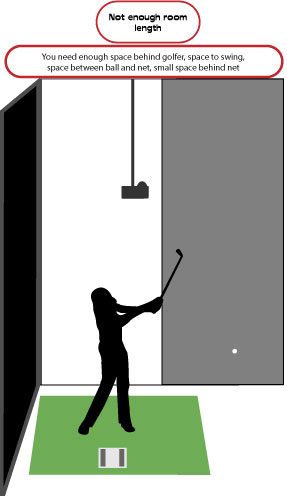
A veteran European installer’s thread this August — one of the most useful room-planning posts of the summer — put hard numbers on the depth budget:
- Behind the screen: about 1.5ft of clearance so the screen can absorb impact safely.
- Ball to screen: the 8–10ft convention (more on the shorter reality below).
- Behind the golfer: stance, backswing, and walking room.
- Seating or spectators: roughly 6.5ft from the ball before anyone can sit safely behind you.
Stack those honestly and 10ft holds a swing, 12ft holds a setup, and 15ft holds a setup you’ll enjoy sharing.
Room width
Ten feet fits; fifteen feet aims straight. Ten feet of width satisfies the manual and physically fits the gear. What it doesn’t buy is a centered aim — hitting at the middle of your screen rather than angling across the room. I recommend at least 15 feet of room width for a comfortable experience with Skytrak Plus (and pretty much all launch monitors).


The geometry behind that: your side-wall clearance needs to roughly match your vertical clearance at a 45-degree swing plane, or the driver head threatens the wall on the backswing — a point several owners make when narrow-room questions come up. That said, compact rooms work: owners have confirmed setups in rooms as narrow as 2.4m (7.9ft), accepting an off-center aim as the price.
Ceiling height: the real answer
The manufacturer says ceiling needs “vary.” Owners have filled in the blanks, and the ladder is remarkably consistent:
| Ceiling | What owners report |
|---|---|
| 10ft+ | The safe baseline for most golfers — any club, no thought required |
| 9–9.5ft | Works for most golfers, including many over 6ft, with a full driver swing |
| 8–8.5ft | Mid-irons only for most; driver and woods risk contact on the follow-through — though success stories at 8ft exist and are growing |
| Under 8ft | No full swings for most golfers — real ceiling and drywall damage reported |
Two findings deserve emphasis. First, the scrape stories: a dozen owners across the 8’4″–9’5″ range admit hitting the ceiling at least once — usually on the follow-through, not the backswing, which is why the damage surprises people. Second, the psychology: owners consistently report that fear of the ceiling quietly shortens and flattens the swing. What if the ceiling doesn’t meet the height requirement? While some might contend that a flatter swing would suffice in such conditions, I would caution against this. Modifying or maintaining an ill-suited swing plane to accommodate a constrained space is counterproductive.

The corroboration for that caution is now painful and specific — one garage owner described a guest who would “shank 9/10 shots because he was subconsciously compacting his swing due to being aware of the ceiling.”
Your ceiling also has to clear your tallest guest’s swing, not just yours — a repeated regret in group-play threads. And watch for bulkheads, joists, and ductwork that cut effective height exactly where the swing peaks.
If your ceiling falls short, the community fix list, cheapest first:
| Fix | Typical cost | Owner verdict |
|---|---|---|
| Choke up / three-quarter swings / iron-only practice | Free | The standard workaround |
| Reposition the hitting spot around obstructions | Free | Common garage move |
| Side-mount (jackshaft) garage-door opener | ~$400–700 | The most-praised low-cost fix |
| Offset the opener rail sideways | Low | Cheap DIY, rail is non-load-bearing |
| Targeted swing-path ceiling cutout (~30in) | Low–moderate | Rising trend; pad the surrounding structure |
| Raise rafter ties / joists (structural engineer) | Hundreds–thousands | Gains 1–2ft; rising trend |
| High-lift garage door track conversion | ~$1,200–4,500 | The expensive route — many judge it not worth it |
💡 The single most trusted test costs nothing: take your longest club and swing it — slowly, then fully — in the exact spot you’ll hit from, before you buy anything. The installer thread’s number-one room-planning mistake was trusting a tape measure over a practice swing.
To close the dimensions story: I recommend dimensions of 10ft or more of room height, 15ft or more of room width, and 15ft or more of room length for a more comfortable experience. The full ceiling mathematics across every launch monitor lives at What’s the Minimum Golf Simulator Ceiling Height?, and the whole-market space guide at How much space do you need for a Golf Simulator?.
Tee-to-screen distance
Two honest answers exist, and they’re different claims rather than a contradiction:
- The vendor convention says 8–10ft from ball to screen, framed around bounceback safety — a ball rebounding off a taut screen at close range is genuinely unpleasant.
- Owner reality runs shorter. Fourteen owners in the community record hit from 6–9ft with camera units and report no tracking issues — several actively prefer the closer, more immersive picture.
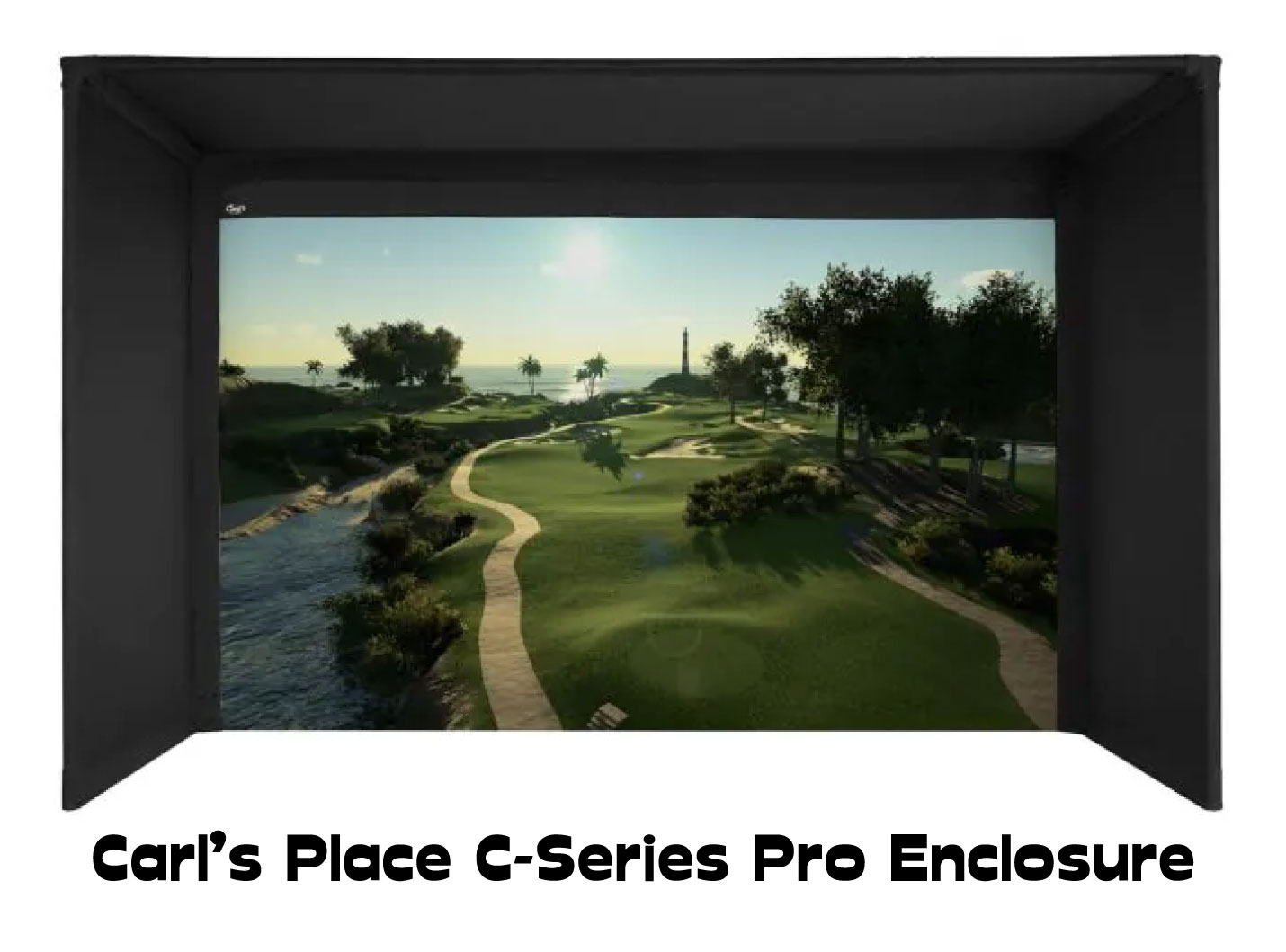
The precedence call: start at 8–10ft, and only tighten once your screen tension is tuned — owners manage bounceback by loosening tension and testing, not by trusting a fixed number. Two caveats keep the short-distance camp honest: high-lofted wedges are the anxiety case at any distance (balls riding up toward the enclosure top), and standing farther back is not automatically safer — shanks and skied balls are likelier to miss a screen that isn’t tall enough for the extra distance. Note the separate claim you’ll meet on enclosure pages: Carl’s Place recommends standing 10–12ft from its screens as a general safety margin — that’s screen-safety guidance, more conservative by design than the camera-unit operational numbers above.
Outdoor space
Outdoors, the same placement logic applies and the openness solves the ceiling problem for free. Keep the unit on a mat-level surface, use a hitting mat rather than grass, and keep direct sun off the lens — the family guidance that carries over from the original SkyTrak manual. The full outdoor playbook (sunlight, batteries, connections, range days) lives in How to use Skytrak Outside (see our 11 Point Checklist).
The 2026 buying question
Spatially, there is nothing to decide: the original SkyTrak, the SkyTrak+, and the ST MAX share the same beside-the-ball placement, the same 10×10 floor minimum, and the same laser-distance convention. Your room fits all three or none. The full three-generation story lives at Skytrak Space Requirements – A Must Read guide!.
Which turns the SkyTrak+ decision into pure price-and-package math:
| Model | Status | Money (checked 21 October 2026) |
|---|---|---|
| SkyTrak+ | Discontinued — no longer sold new | Sold out new (last $1,995 from $2,995 list); certified pre-owned $895 from SkyTrak; wider refurb listings roughly $1,300–2,000 by promo timing |
| SkyTrak ST MAX | Current model | $2,995 MSRP, $1,695 on sale |
| Original SkyTrak | Sold new again in SkyTrak’s own store, though absent from its lineup page | $695 new on sale (list $1,995); $495 certified pre-owned at SkyTrak; used $400–1,000 |
👉 The space parity is the point: since the room math is identical, paying ST+ money only beats the MAX if the discount is real on the day you buy. With no new ST+ left to buy and the MAX on sale at $1,695 (21 October 2026), the MAX is the newer machine, and the ST+ only makes sense used or certified pre-owned well under that — SkyTrak’s own certified pre-owned ST+ was $895 the same day. Whether any SkyTrak is the right buy against the wider market is a different article: the honest ledger lives at Skytrak Pros and Cons – 17 Key Points, and the upgrade specifics at Skytrak Plus Vs Skytrak – 7 Key Upgrades.
SkyTrak+ Space Requirements FAQs
What’s the minimum room size for a SkyTrak+?
A 10ft × 10ft clear floor is the manufacturer minimum, with ceiling height on top — realistically 12ft of depth makes a workable build, and 15ft is comfortable.
What ceiling height do I need?
10ft swings anything safely. Most golfers — including many over 6ft — manage a full driver at 9–9.5ft. At 8–8.5ft, plan on mid-irons and test-swing before committing.
Does the SkyTrak MAX need a different-size room than the SkyTrak+?
No. The ST MAX uses the same beside-the-ball placement, the same 10×10ft floor minimum, and the same ceiling logic — room math carries over unchanged.
How far from the screen should I stand?
Vendors recommend 8–10ft for bounceback safety; plenty of camera-unit owners hit from 6–9ft happily. Start conservative, tune your screen tension, then tighten if you want the immersion.
Will my garage door opener get in the way of my swing?
Center-mounted openers and their rails commonly do — owners have clipped them with inches to spare. The most-praised fix is a side-mount (jackshaft) opener conversion at roughly $400–700; simply offsetting the rail or repositioning the hitting spot are the free alternatives.
Do I need space behind me?
Not for tracking — the unit sits beside the ball. Budget stance and swing room, and about 6.5ft from the ball if anyone sits behind you.
Is the SkyTrak+ still worth buying pre-owned or used?
On space, nothing disqualifies it. On money — per the prices above (checked 21 October 2026) — a used or certified pre-owned unit well under the MAX’s sale price is the only configuration where the ST+ clearly wins.
The installer who’s built simulators for twenty years put the whole article in one line, and it’s the right place to stop: the room should determine the technology, not the other way around. Measure, test-swing, and buy what your space can actually hold.
Bushnell Launch Pro vs SkyTrak ST MAX (2026)
Golf Simulator Packages vs Building Your Own: Which Is Better Value?
ABOUT THE AUTHOR
Hello! My name is Alex and it is my mission to bring you all the information you need to build your own home golf simulator! I hope mygolfsimulator.com helps you on your journey to better golf at home!
LEGAL INFORMATION
On this site, you'll find articles on all aspects of building a golf simulator. I will also link to other sites where you can buy some of the simulator components. Some of these links may be affiliate links, which means if you click them I gain a small commission at no extra cost to you. This really helps out me and my site so thank you in advance! mygolfsimulator.com and all related social media accounts are property of Awonline LTD.