Overhead vs Floor Launch Monitors: Which Suits Your Room?
Posted in Launch Monitors, Room Setup
“Floor” launch monitors come in two kinds that need very different rooms. A unit beside the ball needs almost no extra space, while one behind the ball needs several feet of depth behind the tee. Overhead units need neither; they need ceiling height.
In a Nutshell
Choose overhead if your ceiling is high and the room is a permanent bay; it costs the most. In a shallow room choose a beside-the-ball unit, and choose behind-the-ball radar only if you have depth to spare behind the tee.
👉 Left- and right-handed golfers in one house? A beside-the-ball unit has to be moved to the other side for every switch, which is why some owners call overhead the cleanest fix.
Jargon, once:
- Overhead unit — a launch monitor mounted on the ceiling above or just behind the hitting area.
- Beside the ball — a floor unit that sits next to the ball, facing it.
- Behind the ball — a floor unit, usually radar, that sits on the target line behind you.
- Radar — a sensor that tracks the ball’s flight from behind it.
Three Placements at a Glance
| Overhead | Beside the ball | Behind the ball | |
|---|---|---|---|
| Examples | Uneekor EYE XR and EYE XO2, ProTee VX, Trackman iO, Foresight Falcon | SkyTrak ST MAX, Garmin R50, Bushnell Launch Pro, Square Golf | Garmin R10, Rapsodo MLM2PRO, FlightScope Mevo+ and Mevo Gen2 |
| What it needs | Ceiling height: 9–10 ft on the ProTee and Uneekor pages | Little extra space; R50 sits 1.5 ft to the side of the tee | Depth: 6–8 ft behind the tee for the R10 |
| Lowest maker price checked | $5,999 (EYE XR, on sale from $6,999) | $699 (Square Golf) | $499.99 (Garmin R10) |
| Mixed-handed play | No moving | Move the unit for every switch | Not stated on the pages checked |
Prices as read on 2 October 2026 and re-checked on 21 October 2026. They change often, so check before you buy.
Prices are US dollars from the makers’ pages, read on 2 October 2026.
How this was built: makers’ and retailers’ pages read on 2 October 2026 and makers’ manuals in August 2026; owner reports from Reddit since 2022. Nothing here was tested hands-on.
Overhead: Needs Ceiling Height and a Fixed Room
The limit is the ceiling. Overhead makers state it plainly:
- ProTee VX: a minimum ceiling of 9 ft (2.75 m).
- Uneekor EYE XR: a minimum room of 13 ft wide, 16 ft deep and 10 ft high.
- Trackman iO: its manual’s mounting heights start at 270 cm (about 8 ft 10 in) for one unit; Trackman recommends a room at least 15 ft wide, 10 ft high and 18 ft deep.
Taller golfers need more than the minimum. Owners say golfers over about 6 ft need at least 10 ft to swing a driver cleanly, before ceiling protection eats into it (4 reports from 4 owners).
Overhead is also the expensive route. On the makers’ pages checked, prices ran from $5,999 for the EYE XR (on sale from $6,999) and $10,999 for the EYE XO2 to $13,995 for Trackman iO Home and $16,999 for the Foresight Falcon.
It suits a dedicated bay with a high ceiling, not a room you clear out after each session.
What’s the Minimum Golf Simulator Ceiling Height?
Beside the Ball: The Least Space
A beside-the-ball unit sits on the floor next to the ball, so it needs no room behind you. SkyTrak contrasts its unit, which “sits next to the ball,” with others that need up to 8 ft behind the hitting area. The Garmin R50 sits about 1.5 ft to the side of the tee, and the Bushnell Launch Pro, Foresight GC3 and Square Golf also sit beside the ball, level with it.
The room still has to fit your swing. SkyTrak’s own planning page says a 10 ft ceiling gives most golfers ample clearance and calls a 17 ft deep room comfortable.
It suits shallow rooms, renters who can’t drill a ceiling, and setups that move between rooms.
Behind the Ball: Needs Depth, Not Height
Behind-the-ball units, usually radar, sit on the target line behind you and read the ball as it flies away. They need depth:
- Garmin R10: 6–8 ft (1.8–2.4 m) behind the tee, and at least 8 ft (2.4 m) from tee to net indoors.
- Rapsodo MLM2PRO: 6.5–8.5 ft behind the ball; Rapsodo says a little more than 14 ft in total is needed.
- FlightScope Mevo+: 8 ft behind the tee in the manual (7–9 ft on FlightScope’s site), plus 13 ft of ball flight in front of it.
- Voice Caddie SC4 Pro: 5 ft behind the ball.
It suits long garages and basements where depth is easy but an overhead mount won’t fit, and buyers who want the lowest entry price.
How much space do you need for a Golf Simulator?
Left- and Right-Handed Golfers in One Room
This is where placement matters most for families. A beside-the-ball unit reads from one side of the ball, so it has to be picked up and moved whenever a left-handed and a right-handed golfer take turns (4 reports from 3 owners). Owners call that workable but not ideal: annoying every swing, and impractical for children practicing alone.
Owners who keep a floor unit use simple workarounds: a wide hitting strip or two mats, taped floor marks for each side, and the left/right switch in the software (4 reports from 4 owners).
Overhead units avoid the move. Owners name a ceiling mount as the cleanest fix for mixed-handed play, at a higher price and with less portability. Trackman markets its iO Duo for bays where both right- and left-handed players share, in rooms as narrow as 10 ft.
What are the Best Golf Simulator Mats for Left-Handers and Why?
Living With an Overhead Unit
- Mount it solidly. Owners advise screwing into the joists, not just the drywall, so the unit stays steady.
- Watch for false reads. Some owners report a pre-shot waggle or light reflecting off a club or shoe registering as a swing; adjusting the light angle usually fixes it.
- Keep it out of the swing. Owners with units mounted above or in front of the hitting area worry about hitting them with longer clubs on the follow-through.
- Don’t pair two units. Owners advise against running an overhead and a floor unit together: they can report different carries for the same shot (4 reports from 4 owners).
Which Suits Your Room?
- Ceiling under 9 ft: a floor unit, unless one of the overhead minimums above fits.
- Shallow room, decent ceiling: beside the ball.
- Long room, low ceiling: behind the ball, if you have 6–8 ft behind the tee plus the ball flight your unit needs in front.
- Dedicated bay, high ceiling: overhead, if the budget allows.
- Left- and right-handed golfers sharing: overhead, or a beside-the-ball unit plus a two-mat routine.
- Renting: a floor unit; overhead needs a ceiling mount.
- Tight budget: behind or beside the ball; compare the price row in the table above.
Golf Simulator for a Low Ceiling: What Actually Works (2026)
Best Launch Monitors for a Home Golf Simulator (2026), by Budget
How do Launch Monitors Work? – Radar vs Camera Systems
Overhead vs Floor Launch Monitor FAQ
Is an overhead launch monitor worth it?
For a dedicated bay with a high ceiling, or a mixed-handed household, owners who chose one say it was worth the cost. In a shared or shallow room, a beside-the-ball unit costs far less.
How high a ceiling does an overhead unit need?
ProTee lists 9 ft and Uneekor 10 ft for the EYE XR; Trackman’s manual mounts the iO no lower than 270 cm. Tall golfers need more.
Which placement suits a low ceiling?
A floor unit. Beside-the-ball units need no ceiling mount, and behind-the-ball radar needs depth instead. Either way, check that your driver swing clears the ceiling.
Can left- and right-handed golfers share one launch monitor?
Yes. Overhead units need no moving; beside-the-ball units have to be moved to the other side for each switch.
Do you need room behind you?
Only for behind-the-ball units: 6–8 ft for the Garmin R10, 6.5–8.5 ft for the MLM2PRO.
Can you use an overhead and a floor unit together?
Owners advise against it; the two can disagree on the same shot.
Can an overhead unit go in a hot garage?
Some buyers worry about heat under a garage roof. Check the maker’s operating-temperature range before you mount one.
Is an overhead unit more accurate?
Placement doesn’t decide accuracy on its own; the sensor does. The launch monitor technology guide explains the difference.
Final Thoughts
Measure the ceiling, the depth behind the tee and who will hit, in that order. The answers usually pick the placement before you compare models.
Square Golf Omni Review: What Owners Report
Best Golf Simulator Enclosure Kits Compared (2026)
ABOUT THE AUTHOR
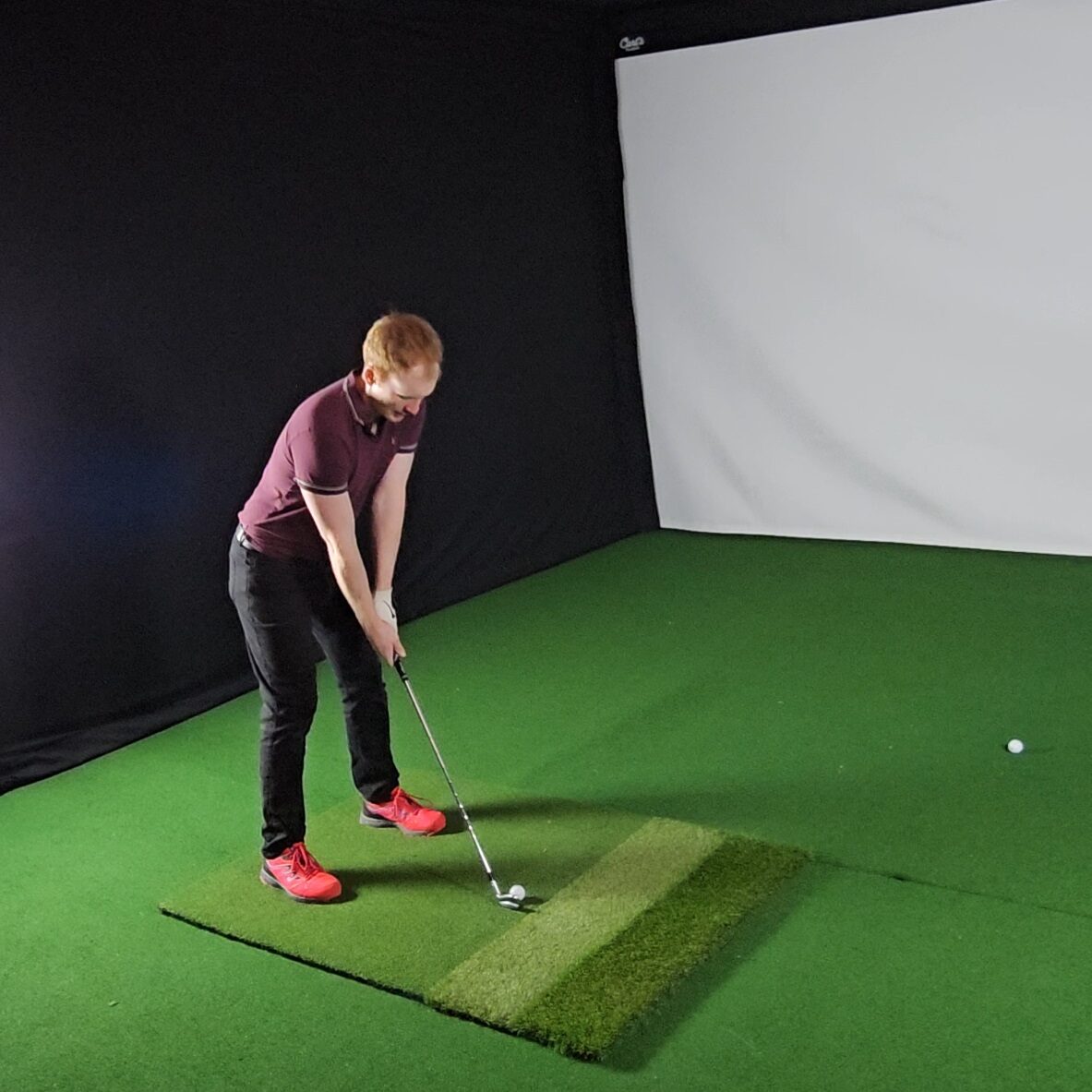
Hello! My name is Alex and it is my mission to bring you all the information you need to build your own home golf simulator! I hope mygolfsimulator.com helps you on your journey to better golf at home!
LEGAL INFORMATION
On this site, you'll find articles on all aspects of building a golf simulator. I will also link to other sites where you can buy some of the simulator components. Some of these links may be affiliate links, which means if you click them I gain a small commission at no extra cost to you. This really helps out me and my site so thank you in advance! mygolfsimulator.com and all related social media accounts are property of Awonline LTD.