Full Swing Kit Space Requirements
Posted in Launch Monitors
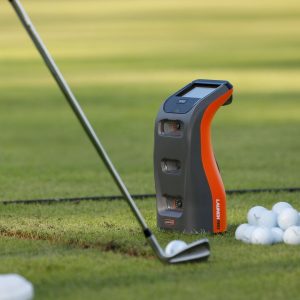
The Full Swing KIT is a radar unit that sits about 10ft behind the ball and needs roughly 10ft of ball flight in front of it — so plan on about 21ft of room length, 10ft of width minimum (15ft is far better), and 10ft of ceiling recommended (8.5–9ft workable). Full Swing publishes no official room dimensions anywhere, so these are working numbers built from the unit’s radar geometry and the owner record — and this guide says exactly which is which.
In a Nutshell
The Full Swing KIT sits about 10ft behind the ball and needs roughly 10ft of ball flight in front of it, so plan on about 21ft of room length, at least 10ft of width (15ft is far better) and a 10ft ceiling (8.5–9ft is workable but cramped).
👉 21ft of depth is the honest planning number — the KIT sits at the deep end of radar-unit space needs, because it stacks 10ft behind the ball AND ~10ft of flight in front. If your room can’t give the ball that flight, full shots may not register at all (see the owner record below).
| Dimension | Minimum | Recommended | Why |
|---|---|---|---|
| Length | ~21ft | 21ft+ | 10ft behind golfer + ~10ft ball flight + screen margin |
| Width | 10ft | 15ft+ | Centered aim point; dual-handed play |
| Height | 8.5–9ft (cramped) | 10ft | Your swing, not the unit — it doesn’t mount overhead |
Jargon, once: Doppler radar = microwave tracking of the moving ball and club, ballistics-style. RCT balls = Titleist’s radar-friendly balls, which the KIT can read with less ball flight. Tee-to-screen = ball position to impact screen. Hitting window = the flight distance the radar needs to see before the screen interrupts it.

Why the manufacturer won’t tell you
Here’s the honest frame this article now leads with: the KIT’s official Safety Manual — all 12 pages, read page-by-page for this refresh — contains no installation geometry, no mounting distances, and no room-dimension guidance of any kind. It covers battery care, thermal shutdown thresholds, an IP54 dust-and-splash rating, and compliance boilerplate — everything except where to put the thing. The spec page’s own dimensions tab doesn’t even render, so not even the unit’s weight is published. The single official distance figure in any Full Swing document is a regulatory one: keep the radar 20cm (about 8 inches) from your body, per FCC compliance. That’s it — 8 inches of legally mandated personal space, and silence on everything else.
Which is why the author filled the gap years ago, and the role stands: “Full Swing do not advise minimum room width and height requirements, but I recommend at least 10ft width and 10ft height.” This article is, in effect, the missing installation page — and one credentialed installer’s principle from a widely-read thread this August frames the job correctly: “The room should determine the technology, not the other way around.”
Depth: the 21ft chain
The KIT is portable — no mount, no fixed install — but its radar has a fixed appetite. The chain:
- ~10ft behind the golfer. The radar sits behind you and needs its view of ball and club.
- ~10ft of ball flight. A Doppler unit reads the ball in flight — especially high wedges — and the owner record puts a number on the floor: in rooms around 8×8ft, drivers and fairway woods sometimes fail to register at all (one owner report). About 10ft of flight looks like the design threshold.
- Screen margin. The original’s chain budgeted 1ft behind the screen; one installer’s general rule of thumb runs 1.5ft “to be 100% safe” — same range, single credentialed source.
Total: the 21ft-class figure this site has always used. That lands at the deep end of the radar band used across this site (16–21ft) — a band that refines the older 15–20ft radar figure in the master space guide (How much space do you need for a Golf Simulator?), stated here as the update it is. The KIT needs the deep end precisely because it stacks both legs: behind-ball distance and flight distance.
Width
“I recommend a minimum of 10ft of width but 15ft or more is much better.” The reasons are the standard ones for any centered setup:
- A target line aimed at the middle of the screen.
- Side-wall clearance roughly matching your vertical clearance at a 45° swing plane — or the driver head finds the wall on the backswing (4 owners and reviewers).
- Both-handed household play, which needs substantially more width than a single-handed bay (2 reviewers).
Width is also the dimension that quietly decides whether the KIT’s behind-the-golfer radar can sit on the target line at all in a shared space — an off-line unit is an inaccurate unit, so the width you buy is alignment insurance as much as swing room.

Height
“I recommend 10ft of room height for indoor golf simulator builds using the Full Swing Kit. This will allow the vast majority of golfers to swing the driver comfortably.” The 8.5–9ft band is feasible but cramped, exactly as the original said. Note what height is about here: your swing. The KIT itself sits on the floor behind you — nothing mounts overhead. The full height-by-golfer matrix lives at What’s the Minimum Golf Simulator Ceiling Height?.


What tight rooms actually do to the KIT — the owner record
Fresh KIT discussion has been thin — one dedicated thread in the last three months — so this section leans on the longer owner record plus that thread, weighted honestly:
- Sub-40-yard shots read unreliably — pitches and partials under ~40 yards are widely flagged as the short-game dealbreaker (owner reports).
- Both halves of the tight-room record, reconciled: owners report reliable operation with as little as 8–10ft of ball flight and praise the KIT’s easy setup against bulkier systems (5 owners) — while the failure report comes from an 8×8 room, which can’t deliver that flight after stance and behind-ball space. As the chain math implies: it isn’t small rooms that break the KIT, it’s rooms that can’t give the ball ~10ft of air. What fails first is the driver.
- The fresh split, quoted both ways: “Indoors the FSK is a piece of crap” versus “Mine tracks well indoors but also have a lot of room to use it” — two conflicting single reports in one recent thread, and the second ties reliability to space explicitly. Shipped here as the live tension it is.
- Mitigations that owners corroborate: RCT Titleist balls and bright, clean LED lighting noticeably improve indoor reads (Lighting in a Golf Simulator – Optimize Accuracy, Practice and Aesthetics). Two setup tips from the original remain good radar hygiene: match the unit’s vertical level to a raised hitting surface, and keep moving metal — fans especially — out of the radar’s field, a quirk camera units simply don’t have.
- One night-use wrinkle: a former owner reports poor tracking in bad light at night — “Yes I know it’s a doppler unit and it shouldn’t matter but I have used it many times at night and found this to be the case” — a single report, filed as such.
- Spin is the KIT’s weakest measurement indoors — identified by independent reviewers and acknowledged by Full Swing, which reportedly keeps improving it via firmware. There’s an honest tension in the record here: Full Swing’s specs present spin as radar-measured, while one independent review describes it as algorithm-derived — either way, it’s the metric room geometry punishes first. The full measured-vs-modeled picture lives in Launch Monitor Data – 33 Parameters Explained.
- One non-space room factor that behaves like one: the KIT normally connects over Wi-Fi (Full Swing also sells a 15 ft USB-C Studio Connection Cable, so ask whether a wired link suits your setup), so an enclosure or basement corner with weak signal penetration becomes an accuracy problem that looks like a space problem. Plan the router with the room.
Outdoor and range use
Outdoors is the KIT’s design center — it’s genuinely portable: range, course, backyard, no mount, no fixed geometry, a claimed ~5 hours per battery charge. The original’s guidance carries: ~10ft behind the golfer, ~10ft to a net if you’re hitting into one, unrestricted on a driving range. Ball placement discipline still applies: on the target line, directly in front of the unit, at least 10ft from it — off-center placement costs accuracy.
Two environmental notes from the safety manual worth planning around: the operating band is 32–104°F, with a thermal warning at 127°F battery temperature and automatic shutdown at 131°F — an uninsulated enclosure in a hot climate can genuinely hit those numbers — and IP54 means splash-resistant, not rainproof.
The KIT in 2026
The author’s context judgment stands as written: “Full Swing was previously best-known for ultra-high-end golf simulators, and the Kit now brings this pedigree into the mainstream launch monitor market. The Kit is said to be tested and trusted by Tiger Woods, and he lends his name and image to the Kit in marketing. I don’t think Tiger would do this if he was not impressed with the technology.” Read that as the author’s color on pedigree — the spec pages themselves, as the earlier section showed, earn less benefit of the doubt.

For buyers doing homework: “Here is a link to the user guide for the Full Swing Kit which is great reading for those considering a purchase.” Full Swing KIT user guide. Current pricing: $4,999 at PlayBetter (21 October 2026) for the Full Swing KIT — notably, zero fresh price chatter surfaced in recent owner discussion, so check the live page.

FAQ
What’s the absolute minimum room for the KIT?
Honestly tiered: the KIT wants ~21ft. At ~16–21ft you’re in compromised territory — full shots can go unregistered (drivers dropped in 8×8-class rooms; reliable owner reports start at 8–10ft of actual ball flight). Below ~16ft, a camera unit (the 10–15ft depth class) fits your room better — that whole class watches the ball at impact instead of needing to see it fly, which is exactly the trade this article’s depth chain explains.
Does the KIT mount to the ceiling?
No — it’s a floor unit that sits behind you, and it’s genuinely portable by design. Room height matters only for your swing, which is why the height section pointed at your driver, not the hardware.
Why do my wedges read badly indoors?
Two stacked limits: sub-40-yard shots are the KIT’s known weak zone, and short rooms shrink the flight window the radar needs.
Do RCT balls help?
Yes — Full Swing frames RCT as an enhancement, not a requirement: it improves spin detection by needing less ball flight, and the base capability works without special markings. In a tight room, that “less ball flight” is exactly the help you want.

Can I run a KIT in a garage with an 8’6″ ceiling?
That’s a swing-clearance question, not a KIT question — the unit doesn’t care about your ceiling, your driver does. Apply the test-swing rule from What’s the Minimum Golf Simulator Ceiling Height?.
Summary
21ft of length, 10–15ft of width, 10ft of height — with the manufacturer silent, the geometry comes from the radar’s needs and the owner record, and both point the same way: give the ball its flight and the KIT rewards you; starve it and the driver disappears first. Or, as the installer put it: “The room should determine the technology, not the other way around.”

Bushnell Launch Pro vs SkyTrak ST MAX (2026)
Golf Simulator Packages vs Building Your Own: Which Is Better Value?
ABOUT THE AUTHOR
Hello! My name is Alex and it is my mission to bring you all the information you need to build your own home golf simulator! I hope mygolfsimulator.com helps you on your journey to better golf at home!
LEGAL INFORMATION
On this site, you'll find articles on all aspects of building a golf simulator. I will also link to other sites where you can buy some of the simulator components. Some of these links may be affiliate links, which means if you click them I gain a small commission at no extra cost to you. This really helps out me and my site so thank you in advance! mygolfsimulator.com and all related social media accounts are property of Awonline LTD.